

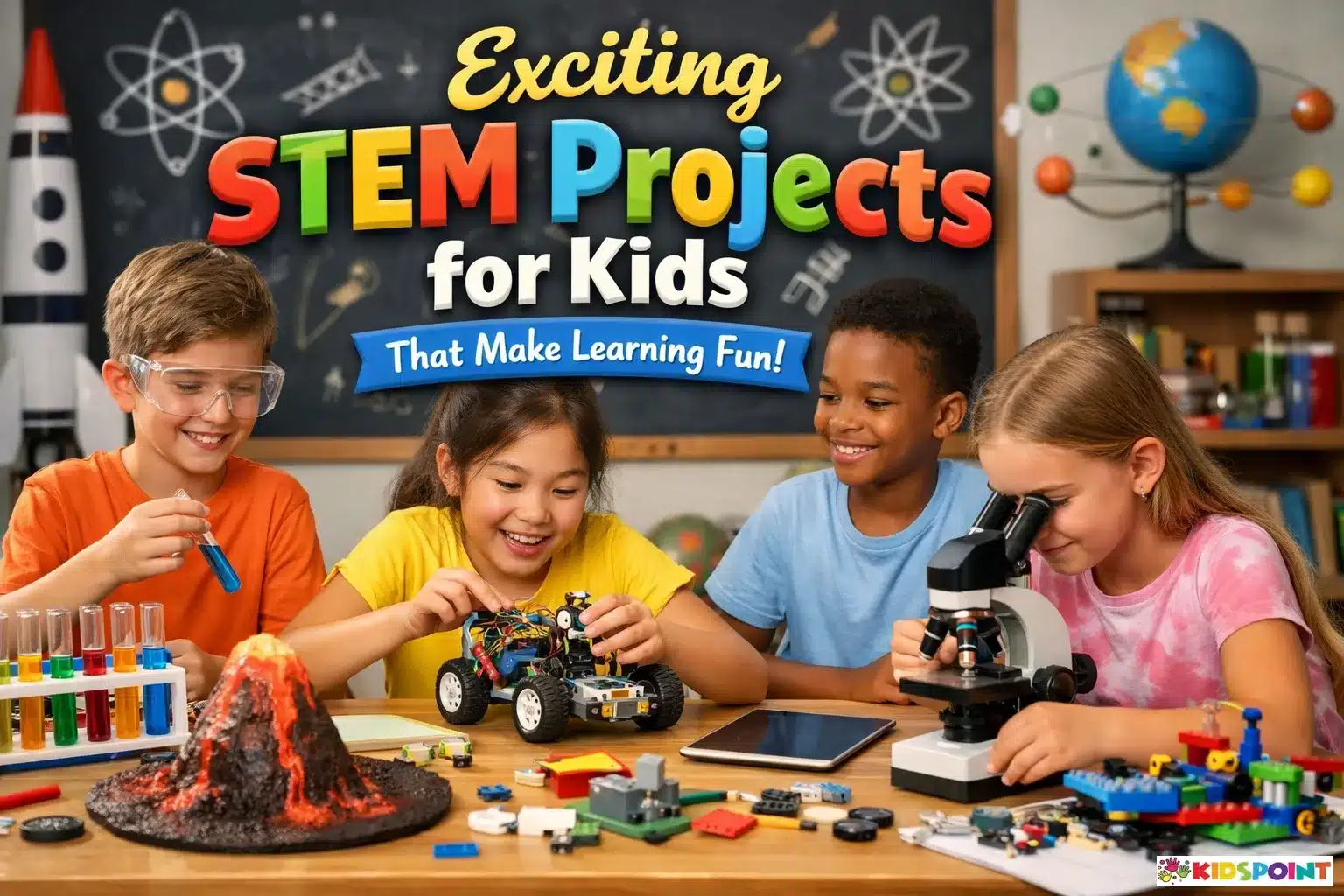
STEM—Science, Technology, Engineering, and Mathematics—is not just a school subject anymore; it’s a life skill. From building simple machines to exploring space science, STEM projects help children become curious thinkers, creative problem-solvers, and confident learners. At The Kids Point, we believe that the best way to teach STEM is through fun, hands-on activities that spark imagination while developing real-world skills.
In this guide, you’ll discover why STEM learning is so important and explore a wide range of exciting STEM projects that kids of different ages can enjoy at home or in the classroom.
Why STEM Projects Matter for Kids
STEM projects go far beyond textbooks. They encourage kids to ask questions, test ideas, and learn from mistakes. When children experiment, build, code, and calculate, they develop:
- Critical thinking skills – Learning how to analyze problems logically
- Creativity – Turning simple materials into innovative designs
- Confidence – Feeling proud of building or discovering something on their own
- Collaboration – Working with friends or classmates
- Real-world awareness – Understanding how science and technology shape daily life
We’ve seen how project-based learning can transform children into enthusiastic explorers.
Easy STEM Projects for Preschool and Kindergarten Kids
Younger children learn best through play and sensory activities. These beginner-friendly projects introduce STEM concepts gently.
Color Mixing Magic
What You Need: Clear cups, water, food coloring, droppers
What Kids Learn: Primary and secondary colors, cause and effect
Activity Idea: Let kids mix red, yellow, and blue water to create new colors. Ask them to predict what will happen before mixing.
Sink or Float Experiment
What You Need: A bowl of water, small household objects
What Kids Learn: Basic physics and observation skills
Activity Idea: Have kids guess which items will sink or float. Record results with pictures or stickers.
Shape Builders
What You Need: Straws, clay or playdough
What Kids Learn: Engineering basics and geometry
Activity Idea: Let children create triangles, squares, and cubes using straws as sticks and clay as connectors.
Fun Science Projects for Elementary Kids
Elementary-aged children are ready to explore more complex ideas through exciting science experiments.
Volcano Eruption
What You Need: Baking soda, vinegar, food coloring
What Kids Learn: Chemical reactions
Activity Idea: Build a volcano using clay or paper and watch it erupt with colorful foam.
Rainbow in a Jar
What You Need: Sugar, water, food coloring
What Kids Learn: Density and liquids
Activity Idea: Create colored sugar water with different densities and layer them in a jar to form a rainbow.
Grow Your Own Crystals
What You Need: Epsom salt or sugar, warm water, string
What Kids Learn: Evaporation and crystal formation
Activity Idea: Let kids watch crystals form over several days and track changes.
Technology Projects That Inspire Young Coders
Technology projects teach kids that computers aren’t just for games—they’re tools for creation.
Build a Simple Game Using Scratch
What Kids Learn: Basic coding, logic, creativity
Activity Idea: Use Scratch to design a character and create a simple interactive story or game.
Digital Storytelling
What You Need: Tablet or computer
What Kids Learn: Multimedia skills, communication
Activity Idea: Kids create short animated stories using free tools and present them to family or classmates.
Engineering Projects for Curious Builders
Engineering challenges teach kids to plan, test, and improve their designs.
Bridge Building Challenge
What You Need: Popsicle sticks, glue
What Kids Learn: Structural strength, problem-solving
Activity Idea: Build a bridge that can hold coins or small toys.
Balloon-Powered Cars
What You Need: Cardboard, bottle caps, balloons
What Kids Learn: Motion and air pressure
Activity Idea: Design a car that moves using air from a balloon.
Marble Run Maze
What You Need: Cardboard tubes, tape
What Kids Learn: Gravity and angles
Activity Idea: Create a maze and test how fast marbles travel through it.
Math Projects That Turn Numbers Into Fun
Math doesn’t have to be boring. With hands-on projects, kids learn naturally.
DIY Board Games
What Kids Learn: Addition, subtraction, counting
Activity Idea: Create a simple board game where players solve math problems to move ahead.
Measurement Scavenger Hunt
What You Need: Ruler or measuring tape
What Kids Learn: Units and estimation
Activity Idea: Find objects around the house and measure their length or height.
STEM Projects for Middle School Kids
As children grow, they can handle more complex concepts.
Solar Oven
What You Need: Pizza box, aluminum foil, plastic wrap
What Kids Learn: Solar energy and heat transfer
Build a Simple Robot
What You Need: Motor, batteries, cardboard
What Kids Learn: Electronics and mechanics
Water Filtration System
What You Need: Sand, gravel, plastic bottles
What Kids Learn: Environmental science
How Parents and Teachers Can Encourage STEM Learning
We believe adults play a key role in nurturing curiosity.
- Ask open-ended questions
- Celebrate mistakes as learning moments
- Provide everyday materials for experiments
- Allow kids to explore freely
- Share excitement about discoveries
Safety Tips for STEM Projects
- Always supervise experiments involving liquids or small parts
- Use child-safe tools
- Teach kids to clean up after projects
- Explain safety rules before starting
FAQs – Exciting STEM Projects for Kids
What age is best to start STEM projects?
Kids can begin simple STEM activities as early as preschool with basic experiments and building games.
Do STEM projects require expensive materials?
No, most projects use everyday household items like paper, bottles, and cardboard.
How often should kids do STEM activities?
Even 1–2 projects per week can greatly improve problem-solving and creativity.
Are STEM projects suitable for group learning?
Yes, they are perfect for classrooms, playgroups, and family activities.
How does The Kids Point support STEM learning?
We share fun, age-appropriate ideas that make science and technology exciting for kids.
The Lasting Impact of STEM Learning
STEM projects build skills children will use for life—problem-solving, teamwork, and resilience. Whether your child becomes a scientist, engineer, artist, or teacher, the habits formed through hands-on STEM learning will support their success.At The Kids Point, we are passionate about creating joyful learning experiences that inspire kids to explore the world around them. With these exciting STEM projects, you can turn everyday moments into unforgettable educational adventures. Let curiosity lead the way!