

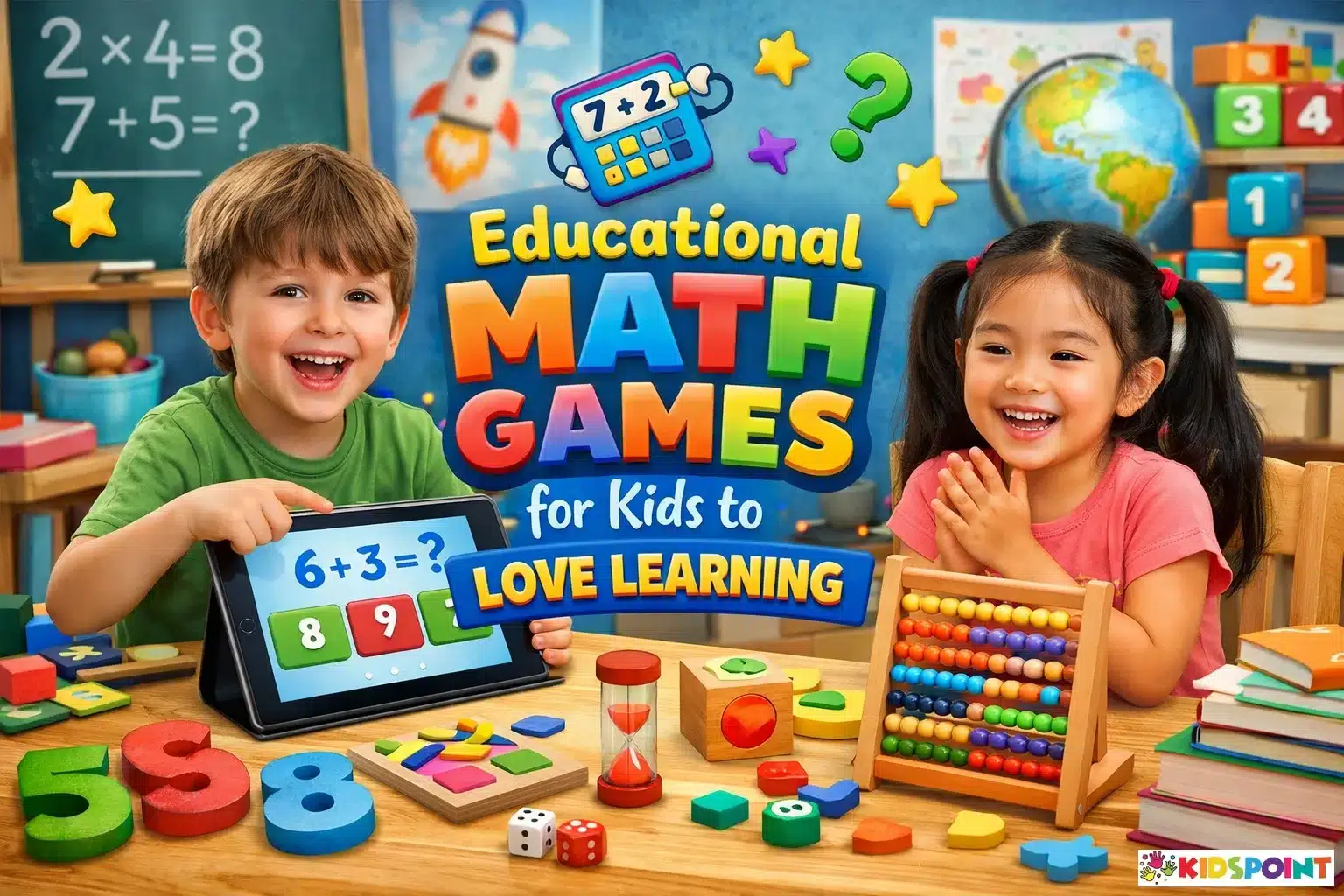
Mathematics is often seen as one of the most challenging subjects for children. Many kids struggle to engage with numbers and abstract concepts, which can lead to frustration and even a dislike for learning. However, the right approach can completely transform a child’s perception of math. One of the most effective ways to do this is through educational math games that make learning fun, interactive, and meaningful.
At The Kids Point, we believe learning should never feel like a chore. By incorporating math games into daily routines, parents and educators can help children develop strong mathematical skills while keeping the experience enjoyable. In this article, we explore the benefits of educational math games, types of games suitable for different age groups, and practical tips to make math a playful adventure.
Why Educational Math Games Are Important
Educational math games go beyond rote memorization and worksheets. They provide a hands-on approach that helps children understand math concepts naturally. Here’s why they are essential:
Make Learning Engaging
Games capture a child’s attention and make learning interactive. Instead of passively listening to lessons, kids actively participate in challenges, puzzles, and problem-solving activities, which boosts engagement and retention.
Build Critical Thinking Skills
Math games often involve logic, strategy, and reasoning. As children make decisions, predict outcomes, and solve problems, they develop critical thinking and analytical skills that extend beyond math.
Improve Confidence
Many children develop math anxiety early on. Fun and non-threatening games allow kids to practice without the pressure of grades, gradually building their confidence and willingness to tackle challenging problems.
Encourage Collaboration
Many math games can be played in pairs or groups, fostering teamwork and communication. Collaborative games help children learn from each other and develop social skills while reinforcing mathematical concepts.
Provide Immediate Feedback
Unlike traditional worksheets, educational games often give instant feedback. Children quickly see the results of their choices, helping them understand mistakes and learn from them in real-time.
Types of Educational Math Games for Kids
There are countless math games available, ranging from board games and card games to digital apps. Choosing the right type depends on your child’s age, learning style, and interests. Below is a breakdown of effective math games for different categories.
Number Recognition and Counting Games (Ages 3–6)
For younger children, the focus is on building a strong foundation in number recognition, counting, and basic arithmetic. Some excellent options include:
- Counting Treasure Hunt: Hide number cards around the room. Ask your child to find them and count objects corresponding to each number.
- Number Bingo: A classic game where children match numbers on their cards with numbers called out.
- Dice Games: Simple dice-rolling activities help children practice counting, addition, and even subtraction.
These games make numbers tangible and relatable, helping preschoolers and kindergartners develop confidence in basic math skills.
Addition and Subtraction Games (Ages 6–8)
Once children have a handle on numbers, they can move on to simple arithmetic. Games that focus on addition and subtraction include:
- Math Board Games: Create a board game where children move forward by solving addition or subtraction problems. Correct answers allow them to advance, while incorrect answers provide a chance to learn.
- Card Flip Challenge: Use a deck of cards and have children flip two cards at a time. They must add or subtract the numbers correctly to earn points.
- Math Puzzles: Incorporate simple puzzles that require addition and subtraction to solve.
These activities reinforce fundamental arithmetic in a fun, pressure-free environment.
Multiplication and Division Games (Ages 8–10)
As children progress, multiplication and division can be challenging. Interactive games make these concepts easier to grasp:
- Multiplication Bingo: Similar to number bingo, but children solve multiplication problems to mark their cards.
- Times Table Hopscotch: Create a hopscotch grid with numbers. Children solve multiplication problems to determine which square to jump to.
- Division Dominoes: Use domino tiles to match division problems with correct answers.
Hands-on and visual approaches help children understand patterns in multiplication and division, making learning more intuitive.
Fraction and Geometry Games (Ages 9–12)
For older children, math becomes more abstract. Games that incorporate fractions, shapes, and measurements can make learning practical and enjoyable:
- Pizza Fractions: Use pizza-shaped cutouts to teach fractions. Children can “slice” pizzas to match fractional problems.
- Shape Scavenger Hunt: Have children identify geometric shapes around the house or classroom.
- Tangram Challenges: Tangram puzzles encourage spatial reasoning while teaching shapes and symmetry.
These games connect math to real-world situations, helping children see its relevance and application.
Logic and Strategy Math Games (Ages 10+)
Older children and pre-teens benefit from games that challenge logical thinking, strategic planning, and problem-solving:
- Math Board Games: Games like “Mathopoly” or “Prime Climb” combine strategy with mathematical operations.
- Sudoku: Enhances logical reasoning, pattern recognition, and number placement skills.
- Escape Room Math Challenges: Create problem-solving scenarios where children must solve math puzzles to “escape” or complete a mission.
These games cultivate higher-order thinking skills while making math feel like an exciting adventure.
Digital Math Games for Kids
In today’s tech-savvy world, digital games can complement hands-on activities. Many educational apps are designed to make math interactive and visually appealing:
- Prodigy Math Game: A role-playing game where children solve math problems to progress in the story.
- Khan Academy Kids: Offers interactive math challenges for younger children with animated explanations.
- Mathletics: Provides adaptive math exercises aligned with school curricula.
- Cool Math Games: A website offering a variety of logic and math-based games for all age groups.
When using digital games, it’s important to balance screen time with offline learning activities to ensure a well-rounded experience.
DIY Math Games at Home
Parents don’t need to rely solely on store-bought games. DIY math activities can be just as engaging and educational:
- Math Bingo Cards: Create your own cards using numbers or simple arithmetic problems.
- Flash Card Races: Write problems on flashcards and challenge children to answer as quickly as possible.
- Board Game Makeover: Turn classic board games into math challenges by adding counting, addition, or multiplication tasks.
DIY games are cost-effective, customizable, and can be tailored to your child’s interests and learning pace.
How to Make Math Games Effective
Simply playing math games isn’t enough. To maximize learning outcomes, follow these practical tips:
Keep It Age-Appropriate
Ensure the game matches your child’s developmental stage. Overly complex games can frustrate younger children, while too simple games may bore older kids.
Encourage Exploration
Allow children to experiment and make mistakes. The learning happens in trial and error, and games provide a safe space for this exploration.
Make It Social
Whenever possible, involve siblings, friends, or classmates. Social interaction makes games more enjoyable and fosters teamwork.
Incorporate Real-Life Examples
Connect games to everyday situations. For example, use coins for counting, kitchen measurements for fractions, or building blocks for geometry.
Praise Effort, Not Just Accuracy
Celebrate the learning process, persistence, and problem-solving skills rather than just correct answers. Positive reinforcement builds confidence and a love for math.
Benefits of Math Games Beyond Numbers
While math games focus on numerical skills, the benefits extend far beyond the classroom:
- Boosts Memory: Repeated problem-solving improves working memory.
- Enhances Focus: Games require attention to detail and sustained concentration.
- Promotes Creativity: Puzzles, patterns, and strategy games stimulate creative thinking.
- Strengthens Emotional Skills: Learning through games teaches patience, resilience, and adaptability.
By integrating math games into daily routines, children gain a wide array of cognitive, social, and emotional skills that support overall development.
Recommended Math Games from The Kids Point
We have curated a selection of engaging math games that children absolutely love:
- Number Adventure Cards: Interactive cards designed for counting, addition, and subtraction challenges.
- Math Quest Board Game: A story-based board game that incorporates arithmetic, logic, and strategy.
- Fraction Fun Puzzles: Hands-on puzzles to teach fractions and measurements.
- Geometry Explorer Kits: Tools and games that help children discover shapes, symmetry, and spatial reasoning.
- Digital Math Challenge App: A kid-friendly app combining problem-solving with rewards and progression.
These resources ensure that children not only learn math but also develop a lasting enthusiasm for numbers.
Tips for Parents and Educators
To make the most of educational math games, consider these tips:
- Set a Routine: Dedicate a regular time for math games to create consistency.
- Mix Game Types: Rotate between board games, digital apps, and DIY activities to maintain interest.
- Monitor Progress: Keep track of areas where children excel or need more practice.
- Encourage Discussion: Ask children to explain their thinking and strategies, reinforcing understanding.
- Celebrate Milestones: Reward progress and achievements to motivate continued engagement.
Quick FAQs About Educational Math Games
At what age should I start math games with my child?
You can start as early as age 3 with simple number recognition and counting games.
Are digital math games effective for learning?
Yes, when balanced with offline activities, digital games can enhance engagement and concept retention.
How can I make math games less competitive?
Focus on collaboration, praise effort, and allow children to explore solutions without pressure.
Can math games help kids who dislike math?
Absolutely! Games create a fun, hands-on environment that builds confidence and interest in math.
How often should children play math games?
A few times a week for 15–30 minutes is ideal, though frequency can be adjusted based on the child’s interest.
Making Math Fun and Memorable
Educational math games are powerful tools that transform learning from a stressful task into an exciting adventure. By combining interactive play, problem-solving, and real-world applications, children can develop strong math skills, confidence, and a genuine love for learning.
At The Kids Point, we are dedicated to providing parents and educators with resources, tips, and games that make math enjoyable for every child. When learning is fun, curiosity grows, and children discover that math is not just numbers on a page—it’s a gateway to creativity, logic, and endless possibilities.