

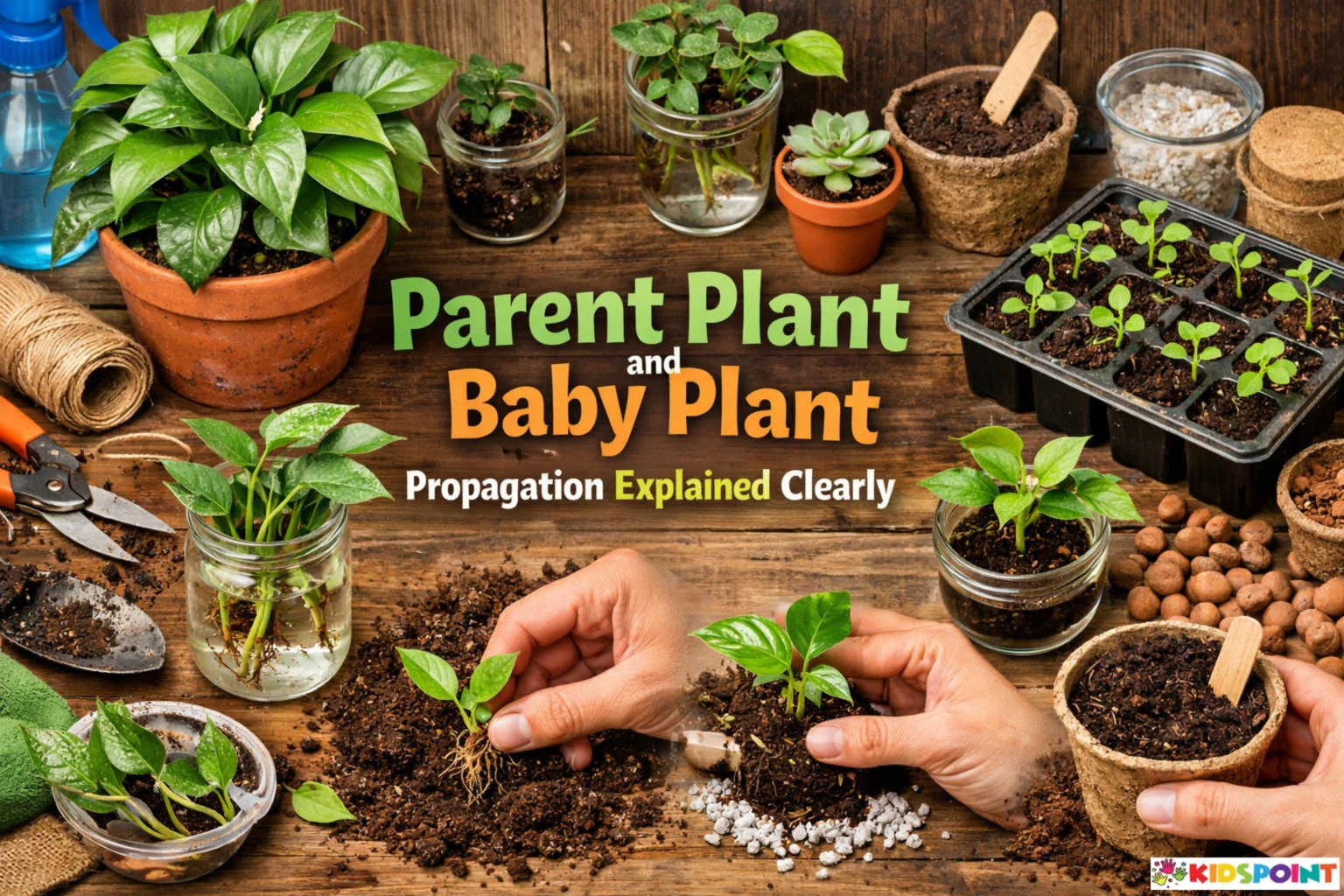
Plants are more than just greenery—they are living organisms that reproduce, grow, and share life in fascinating ways. One of the most rewarding aspects of gardening is propagating plants, allowing gardeners to grow baby plants from parent plants. This process not only saves money but also lets you expand your garden and share plants with friends and family.
At The Kids Point, we believe that understanding plant propagation can be fun, educational, and empowering for gardeners of all ages. This comprehensive guide will explain what parent and baby plants are, the science behind propagation, popular methods, care tips, and common mistakes to avoid.
Understanding Parent Plants and Baby Plants
What Is a Parent Plant?
A parent plant is the mature plant that provides the genetic material, energy, and tissues needed to produce offspring. It is often healthy, strong, and well-established in your garden. Parent plants can be flowers, vegetables, fruits, succulents, or even trees. The quality of the parent plant directly impacts the growth and health of the baby plant.
Key points about parent plants:
- Strong roots and stems indicate a healthy parent.
- Proper nutrition and care increase the success rate of propagation.
- Some plants reproduce better from parent plants that are mature but not too old.
What Is a Baby Plant?
A baby plant, also called a propagule, is a new plant created from a parent plant. Baby plants may be grown from seeds, cuttings, leaves, or other plant parts. Baby plants carry the genetic characteristics of the parent, and in some cases, may be genetically identical clones.
Key points about baby plants:
- Require proper care to establish roots and grow strong.
- Initially fragile and need ideal environmental conditions.
- Can be grown indoors or outdoors depending on plant type.
The Science Behind Plant Propagation
Propagation is the process of creating new plants from a parent plant. There are two main types:
Sexual Propagation
This involves reproduction through seeds. Flowers are pollinated, and seeds develop. Seed propagation creates genetic variation, meaning the baby plant may differ from the parent in appearance or growth characteristics.
Advantages:
- Genetic diversity increases resilience to diseases and pests.
- Can produce many offspring from a single parent plant.
Disadvantages:
- Slower growth compared to vegetative methods.
- Baby plants may not look exactly like the parent.
Asexual (Vegetative) Propagation
This involves growing baby plants from parts of the parent plant such as stems, leaves, roots, or bulbs. The resulting baby plant is genetically identical to the parent.
Advantages:
- Faster growth and earlier flowering or fruiting.
- Maintains desirable traits of the parent plant.
- Can propagate plants that do not produce seeds easily.
Disadvantages:
- Less genetic diversity, making plants more susceptible to disease.
Popular Methods of Plant Propagation
Propagation can be fun and educational, and there are several common techniques:
Cuttings
One of the easiest methods is taking a cutting from a parent plant and encouraging it to grow roots.
Steps:
- Choose a healthy parent plant.
- Select a stem, leaf, or root section.
- Cut a piece about 4–6 inches long.
- Remove lower leaves and dip the cutting in rooting hormone.
- Place it in water or soil and keep it moist.
Ideal Plants:
Pothos, succulents, geraniums, hibiscus, and coleus.
Layering
Layering encourages a stem to grow roots while still attached to the parent plant. Once roots develop, the baby plant can be cut and planted separately.
Steps:
- Choose a flexible stem close to the ground.
- Bend it gently and bury part of the stem in soil.
- Anchor with a pin or stone.
- Wait for roots to form (weeks to months).
- Cut the rooted stem to separate as a baby plant.
Ideal Plants:
Roses, jasmine, blackberries, and figs.
Division
Division involves separating a parent plant into multiple sections, each capable of growing independently.
Steps:
- Dig up the parent plant.
- Separate roots carefully into smaller sections.
- Replant each section in suitable soil.
- Water and care for the baby plants until established.
Ideal Plants:
Hostas, ferns, daylilies, and some perennials.
Grafting
Grafting combines tissues from a parent plant with another plant to create a new plant with desirable traits.
Steps:
- Select a healthy rootstock and scion (top part).
- Make a clean cut and join the tissues.
- Wrap to protect and ensure successful growth.
Ideal Plants:
Fruit trees like apples, citrus, and grapes.
Seed Propagation
Starting plants from seeds is a natural method that works well for many vegetables, flowers, and herbs.
Steps:
- Collect fresh seeds from the parent plant.
- Plant seeds in seed-starting mix.
- Maintain warmth, moisture, and light.
- Transplant seedlings when strong enough.
Ideal Plants:
Tomatoes, peppers, sunflowers, marigolds, and beans.
Environmental Factors for Successful Propagation
Successful growth depends on environmental conditions:
- Light: Most baby plants need indirect sunlight until established.
- Soil: Use well-draining soil suitable for the plant type.
- Water: Keep soil moist but avoid waterlogging.
- Temperature: Maintain ideal warmth; avoid extreme cold or heat.
- Humidity: Some plants, especially tropical ones, benefit from high humidity.
Providing the right conditions reduces stress on baby plants and promotes faster growth.
Tips for Caring for Baby Plants
- Monitor Growth: Check for root development, leaf health, and pests.
- Gradual Transition: Acclimate baby plants to sunlight gradually (hardening off).
- Nutrient Support: Use mild fertilizers when the baby plant is established.
- Avoid Overcrowding: Give each plant enough space for root and leaf growth.
- Pest and Disease Control: Inspect regularly to prevent infestations.
Common Mistakes to Avoid
- Using unhealthy or weak parent plants.
- Cutting during extreme weather or inappropriate seasons.
- Overwatering or underwatering baby plants.
- Ignoring soil quality and drainage.
- Not labeling or tracking propagated plants.
Awareness of these mistakes improves success rates significantly.
Educational Benefits for Kids
Propagation can be a hands-on learning activity for children. It teaches:
- Life cycles of plants
- Responsibility and care
- Patience and observation
- Environmental awareness
We encourage parents to involve children in simple propagation projects, such as rooting a pothos in water or planting seeds in a small pot.
Creative Propagation Projects for Beginners
- Water Propagation: Grow pothos, philodendrons, or coleus in jars of water.
- Leaf Cuttings: Propagate succulents from single leaves.
- Seed Experiments: Compare germination rates in different soils or light conditions.
- Mini Greenhouse: Use clear containers to increase humidity and success rate.
- Layering Fun: Bend and pin flexible stems like strawberries or jasmine.
These projects are suitable for adults and kids alike, making propagation both fun and educational.
Advantages of Propagating Your Own Plants
- Cost-effective: Grow new plants without buying seeds or nursery plants.
- Preserve Traits: Maintain preferred colors, shapes, or fruit quality.
- Share with Friends: Create gifts or swap plants.
- Expand Your Garden: Increase plant variety with minimal expense.
- Sustainable: Reduces dependence on commercial plant production.
Propagation strengthens both gardening skills and environmental awareness.
FAQ – Parent Plant and Baby Plant Propagation
Can all plants be propagated from cuttings?
Not all plants. Woody trees and some perennials are more challenging; research plant-specific methods.
How long does it take for a baby plant to grow roots?
It depends on the method and species. Some cuttings root in a week, others take months.
Do baby plants need the same care as parent plants?
No, they are more fragile. Provide indirect sunlight, moderate water, and protection from stress.
Can I propagate plants indoors?
Yes. Many herbs, succulents, and tropical plants root successfully indoors with proper light and humidity.
Is propagation from parent plants genetically identical?
Asexual methods like cuttings and layering produce clones. Seed propagation creates genetic variation.
Conclusion – Nurturing Growth from Parent to Baby Plant
Plant propagation is a remarkable way to experience the cycle of life firsthand. Whether through seeds, cuttings, layering, or division, every baby plant represents growth, care, and patience. By understanding the relationship between parent plants and baby plants, gardeners can create thriving green spaces while learning valuable lessons about biology, ecology, and responsibility.
At The Kids Point, we encourage both adults and children to engage in propagation projects. Watching a baby plant grow from a parent plant teaches patience, respect for nature, and the joy of nurturing life. With proper care, your garden can flourish, expand, and continue the beautiful cycle of growth for years to come.