

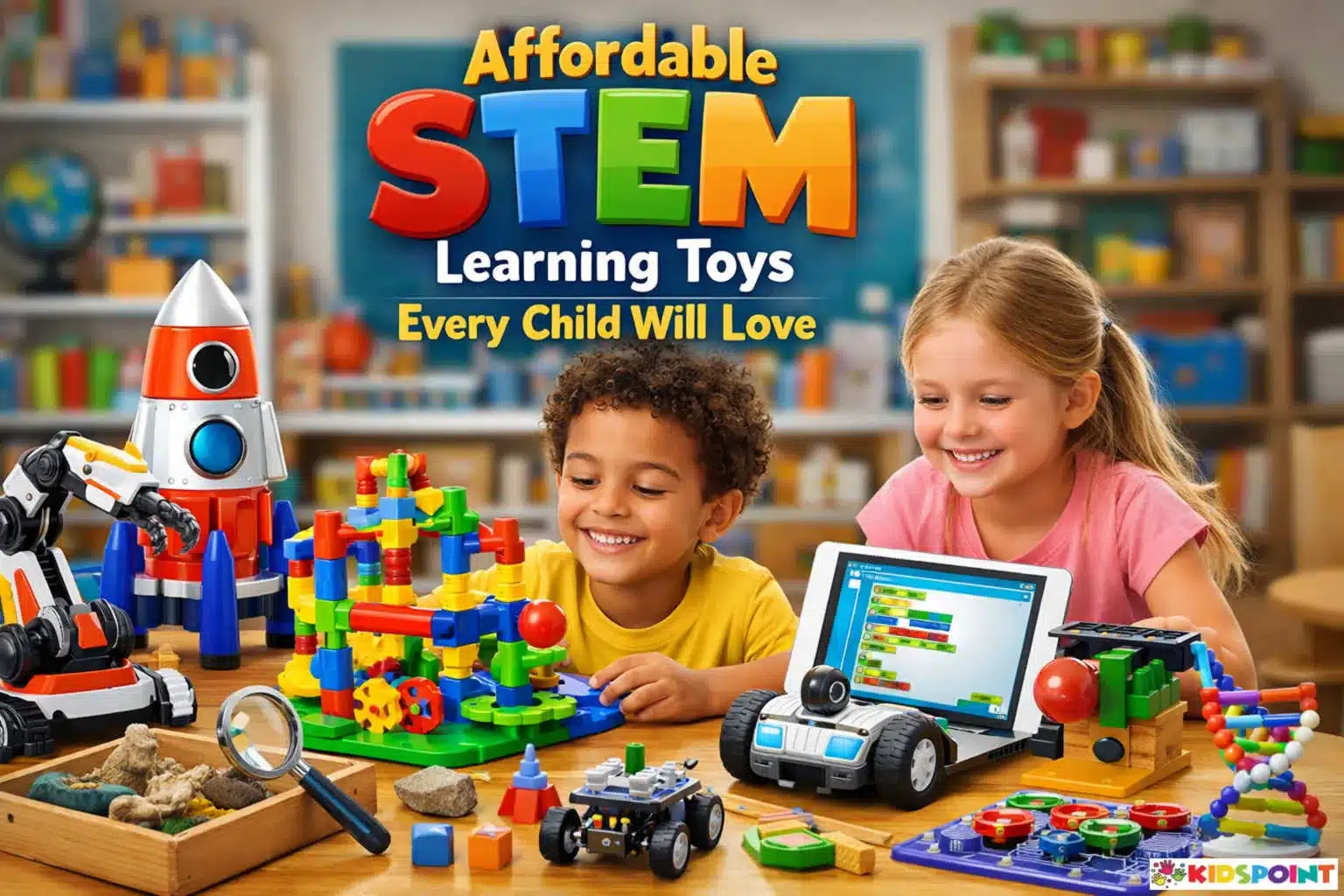
In today’s fast-changing world, children need more than memorization skills to succeed. They need curiosity, creativity, critical thinking, and problem-solving abilities. STEM education—covering Science, Technology, Engineering, and Mathematics—helps build exactly those skills. The good news is that you don’t need to spend a fortune to introduce your child to STEM learning at home.
At The Kids Point, we believe that quality education should be accessible to every family. Affordable STEM toys can turn everyday playtime into powerful learning experiences without stretching your budget. In this comprehensive guide, we’ll explore the best budget-friendly STEM learning toys, their benefits, how to choose the right ones by age, and tips to maximize learning at home.
Why STEM Toys Matter for Children
STEM toys are more than just trendy educational tools. They encourage:
- Logical reasoning
- Hands-on experimentation
- Creativity and innovation
- Collaboration and teamwork
- Real-world problem-solving
Unlike passive entertainment, STEM toys require children to think, build, test, and improve. These activities help develop neural pathways associated with higher-order thinking skills. Even simple building sets or science kits can spark a lifelong love for discovery.
Affordable Building and Engineering Toys
LEGO Classic Sets
Few toys are as versatile and affordable as basic brick-building sets from LEGO. Classic sets come with colorful bricks that allow children to design houses, vehicles, robots, and anything their imagination creates.
STEM Benefits:
- Spatial awareness
- Engineering basics
- Creative design
- Fine motor skills
You don’t need expensive themed sets. A simple brick box offers endless possibilities and long-term learning value.
Magnetic Building Tiles
Magnetic tiles allow children to build both 2D and 3D structures. As they experiment, they naturally learn about geometry, balance, symmetry, and structural stability.
STEM Benefits:
- Early geometry concepts
- Structural engineering basics
- Problem-solving skills
- Creativity and design
Many affordable brands now offer durable magnetic tiles that provide hours of meaningful play.
Science Experiment Kits That Inspire Curiosity
Beginner Science Lab Kits
Simple chemistry or physics kits introduce children to scientific observation and experimentation in a safe and engaging way.
STEM Benefits:
- Understanding the scientific method
- Observation and analysis
- Safe lab skills
- Cause-and-effect learning
Affordable kits often include experiments like volcano reactions, crystal growing, magnet testing, or simple circuit activities.
Crystal Growing Kits
Crystal kits teach patience and chemistry fundamentals. Children observe how solutions transform over time and form solid structures.
STEM Benefits:
- Basic chemistry knowledge
- Patience and observation
- Recording and documenting results
- Understanding chemical reactions
These kits are typically budget-friendly and provide a visually rewarding experience.
Technology-Based STEM Toys on a Budget
Coding Board Games
Coding doesn’t always require a computer. Screen-free coding board games introduce sequencing, logic, and algorithmic thinking through interactive challenges.
STEM Benefits:
- Logical sequencing
- Critical thinking
- Strategic planning
- Team collaboration
These games are often more affordable than electronic coding devices while still teaching core programming concepts.
Entry-Level Robotics Kits
Basic robotics kits introduce children to motors, gears, circuits, and mechanical design. Many beginner sets are specifically designed for easy assembly and understanding.
STEM Benefits:
- Engineering principles
- Circuit fundamentals
- Hands-on assembly skills
- Troubleshooting abilities
Affordable robotics kits provide an exciting introduction to technology without overwhelming complexity.
Math-Based Learning Toys Kids Enjoy
Abacus and Counting Frames
An abacus may seem traditional, but it remains a powerful and affordable math-learning tool.
STEM Benefits:
- Number recognition
- Basic arithmetic operations
- Mental math improvement
- Pattern identification
Wooden versions are durable, budget-friendly, and perfect for early learners.
Math Puzzle Games
Puzzle-based math games turn numbers into engaging challenges that encourage children to think strategically.
STEM Benefits:
- Logical reasoning
- Strategic thinking
- Improved confidence in math
- Persistence and patience
These games make mathematics less intimidating and more enjoyable.
Engineering Through Everyday Materials
Not all STEM learning requires store-bought toys. Parents can create meaningful learning experiences using simple household items such as:
- DIY marble runs
- Paper bridge challenges
- Balloon-powered cars
- Homemade pulley systems
- Basic battery-and-wire circuits
We encourage families to combine affordable purchased toys with creative DIY projects to maximize learning and imagination.
Best STEM Toys by Age Group
Ages 3–5
- Magnetic tiles
- Counting toys
- Shape sorters
- Basic building blocks
Focus on hands-on exploration, sensory experiences, and simple problem-solving.
Ages 6–8
- Science experiment kits
- Beginner robotics sets
- Math puzzle games
- Classic building bricks
Encourage structured challenges and guided experimentation at this stage.
Ages 9–12
- Advanced robotics kits
- Coding board games
- Engineering construction sets
- Chemistry experiment kits
Support deeper exploration, independent projects, and creative problem-solving.
How to Choose Affordable STEM Toys Wisely
When shopping on a budget, keep these factors in mind:
Open-Ended Play: Choose toys that allow multiple solutions and creative possibilities rather than single-outcome kits.
Durability: High-quality materials ensure the toy lasts longer, providing better value over time.
Skill Development: Look for toys that promote critical thinking, creativity, logic, collaboration, and perseverance.
Expandability: Select sets that can grow with your child by adding components or increasing complexity later.
Screen-Free vs. Digital STEM Toys
Digital STEM tools can be beneficial, but screen-free toys often promote deeper focus and hands-on engagement. Physical building sets and science kits encourage tactile learning and active experimentation.
Balancing digital and non-digital experiences ensures children benefit from both technological literacy and practical problem-solving skills.
Benefits Beyond Academics
STEM toys offer advantages that go far beyond school performance. They help children develop:
- Resilience through trial and error
- Patience and persistence
- Confidence in solving challenges
- Communication skills
- Teamwork abilities
When children successfully build a structure or complete a science experiment, they gain a strong sense of accomplishment that supports emotional growth.
Making STEM Learning a Family Activity
Parents can strengthen learning by participating in activities together. Try:
- Asking open-ended questions
- Encouraging predictions before experiments
- Discussing results afterward
- Celebrating mistakes as valuable learning moments
For example, while building a tower, ask:
- What makes it stable?
What happens if we change the base?
How can we make it stronger?
These conversations deepen understanding and make learning meaningful.
Budget Tips for Parents
To make STEM learning more affordable:
- Look for seasonal sales and bundle deals
- Swap toys with friends or relatives
- Choose versatile, reusable kits
- Combine DIY materials with purchased toys
- Buy classic versions instead of licensed themes
Smart planning ensures you get maximum educational value without overspending.
Encouraging All Children to Explore STEM
Affordable STEM toys help ensure every child has access to science, engineering, and technology learning. Providing equal encouragement and opportunities allows children to discover interests that may shape future careers.
Exposure at a young age builds confidence and breaks down stereotypes about who belongs in STEM fields.
Common Mistakes to Avoid
- Choosing toys that are too advanced for your child’s age
- Overloading with too many complex kits at once
- Focusing only on academic outcomes instead of fun
- Ignoring your child’s natural interests
STEM learning should feel exciting and playful, not stressful or forced.
Common Questions Parents Ask About STEM Toys
What age should children start using STEM toys?
Children can start as early as age 3 with simple building blocks, counting toys, and basic problem-solving games.
Are affordable STEM toys as effective as expensive ones?
Yes. The learning value depends more on how the toy is used than its price. Open-ended, hands-on toys often provide excellent educational benefits.
Do STEM toys require parental supervision?
Younger children may need guidance, especially with science kits or small parts. Older kids can often explore independently with minimal supervision.
Can STEM toys reduce screen time?
Yes. Many STEM toys encourage hands-on, screen-free learning that promotes creativity and focus.
How do I choose the right STEM toy for my child?
Consider your child’s age, interests, and skill level. Look for durable, open-ended toys that promote problem-solving and creativity.
Building Bright Futures Affordably
STEM education does not require expensive gadgets or high-tech laboratories. With thoughtful choices, affordable toys can inspire innovation, curiosity, and lifelong learning.
At The Kids Point, we believe every child deserves access to engaging, hands-on educational tools. Whether it’s a simple building brick set, a magnetic construction kit, or a beginner science experiment box, affordable STEM toys can open doors to creativity and discovery.
By choosing wisely and encouraging exploration, parents can transform everyday play into powerful learning experiences—without breaking the budget.