

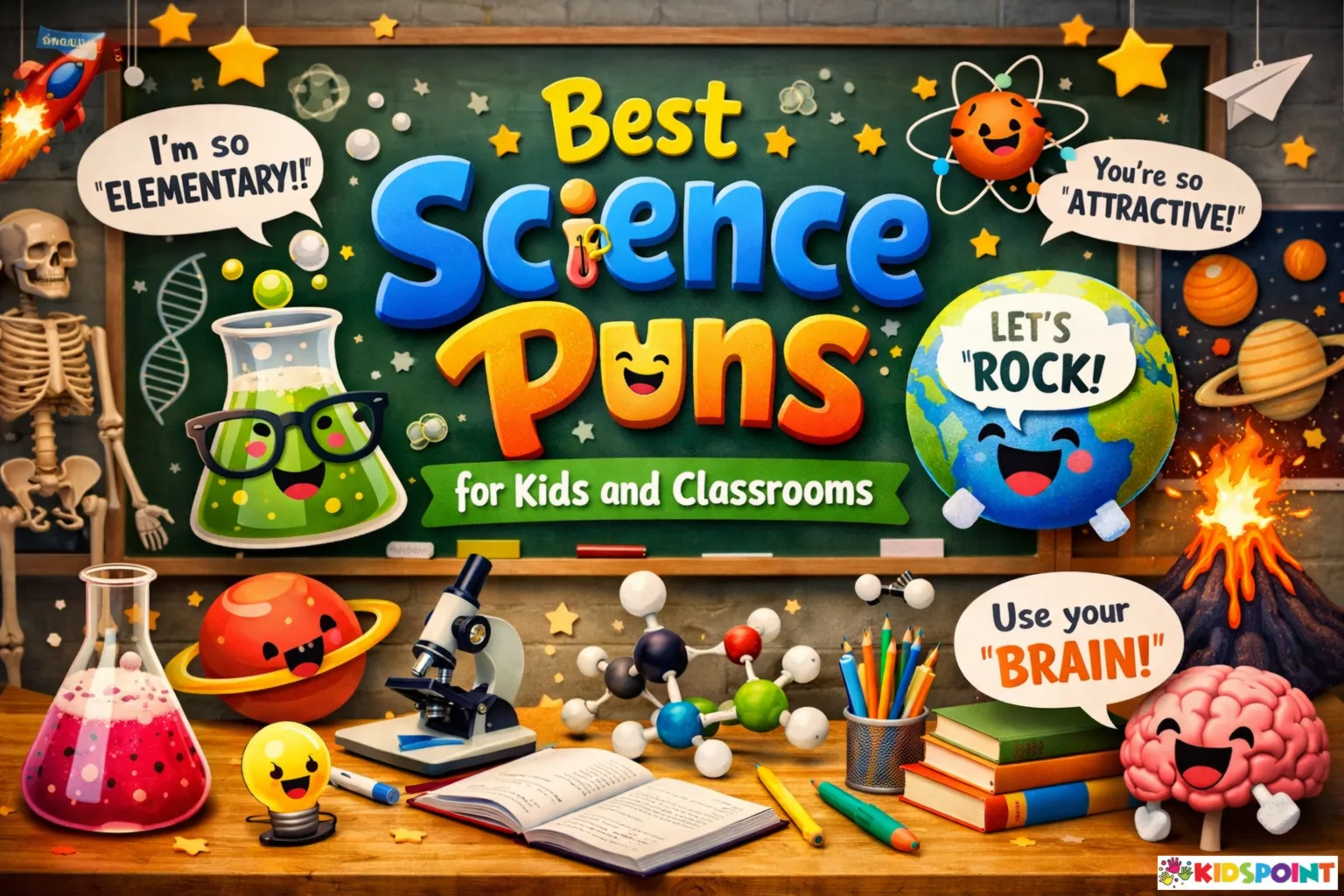
Science doesn’t have to be serious all the time. With the right mix of humor and learning, kids can enjoy experiments, explore concepts, and remember key ideas. At The Kids Point, we believe combining humor with science is one of the best ways to engage young learners. That’s why we’ve put together this complete guide to the best science puns for kids and classrooms — perfect for laughter, learning, and creating memorable lessons.
Whether you’re a parent, teacher, or homeschooler, this guide is packed with puns, activities, and tips for making science fun and memorable for children.
Why Science Puns Are Perfect for Kids
Science puns are a playful way to explore complex ideas without making learning feel heavy. They combine wordplay with scientific concepts, helping children:
- Build vocabulary and spelling skills
- Understand scientific terms in context
- Boost memory through humor
- Encourage classroom participation
- Promote curiosity about experiments
- Improve social sharing and teamwork
Humor also reduces anxiety around difficult topics. We encourage teachers to sprinkle puns into lessons to make concepts approachable and exciting.
Top Science Puns for Kids
Here’s a list of clean, kid-friendly science puns your students or children will love.
Why can’t you trust atoms?
Because they make up everything!
What did the biologist wear to impress their date?
Designer genes.
Why did the physics book break up with the math book?
It found the chemistry too complicated.
How do chemists like to greet each other?
“Hey, what’s up, molecule?”
Why did the germ go to school?
To improve its culture.
What’s a scientist’s favorite type of tree?
A lab-rador!
Why did the skeleton go to the party alone?
It had no body to go with.
What did the light bulb say to the other light bulb?
“I’m shocked you’re still glowing!”
Why did the biologist go on a diet?
Too many cells!
Why did the bacteria fail the test?
Because it didn’t study enough colonies.
Chemistry-Themed Puns
Chemistry is full of elements and reactions that make great puns.
- Never trust an atom — they’re always splitting.
- What do you do with a sick chemist?
If you can’t helium, and you can’t curium, you might as well barium. - I told a chemistry joke, but there was no reaction.
- Why do chemists like nitrates so much?
They’re cheaper than day rates. - Gold is the best element — it’s AU-some!
Physics-Themed Puns
Physics concepts can be hilarious when turned into jokes.
Why did the photon refuse to check a suitcase?
It was traveling light.
What’s a physicist’s favorite food?
Fission chips.
Why did the electron go to therapy?
It had too much negative energy.
Heisenberg was speeding and got pulled over.
The officer asked, “Do you know how fast you were going?”
Heisenberg replied, “No, but I know exactly where I am!”
Why can’t you trust gravity?
It’s always bringing you down.
Biology-Themed Puns
Biology is full of living things that inspire fun jokes.
Why did the plant go to school?
To get to the root of the problem.
What did the cell say to its sister cell?
“Stop dividing!”
Why was the mushroom invited to every party?
Because he was a fungi!
What’s a bacteria’s favorite music?
Hip-hop.
Why did the virus go on vacation?
It needed a little R-n-R (Rest and Replication).
Earth Science & Space Puns
From planets to rocks, these puns spark curiosity.
Why did the sun go to school?
To get a little brighter.
What planet likes to party?
Saturn — it really knows how to ring in fun!
Why don’t scientists trust atoms on Earth?
Because they’re always making mountains out of mole-hills.
Why did the geologist break up with the rock?
It was too boulder than they could handle.
How do you organize a space party?
You planet!
Fun Science Joke Activities for Classrooms
Adding jokes to classroom activities can improve engagement and learning. Here are some ideas:
Joke of the Day
Start each science class with a pun. Encourage students to guess the punchline or explain the scientific concept behind it.
Pun Writing Challenge
Let students create their own science puns about atoms, planets, or cells. This builds vocabulary and creativity.
Pun Posters
Students design posters illustrating a pun with drawings and scientific labels. Display them around the classroom for visual reinforcement.
Group Pun Battles
Divide the class into teams and see who can come up with the funniest science pun in one minute. Encourage teamwork and quick thinking.
Pun-Based Experiments
Combine jokes with small experiments. For example, “Why did the water go to school?” — “To become a little more cultured!” Then do a safe microbiology activity.
How Science Puns Support Learning
Science puns aren’t just funny — they reinforce key concepts:
- Vocabulary Building: Words like “atom,” “molecule,” and “photosynthesis” stick better when paired with humor.
- Concept Recall: A funny punchline triggers memory of the science topic.
- Creative Thinking: Crafting or interpreting puns encourages lateral thinking.
- Class Participation: Jokes motivate shy students to share and interact.
- Positive Associations: Kids associate science with fun, not stress.
We emphasize that laughter is a gateway to curiosity. Children who laugh at a concept are more likely to explore it further.
Parent and Teacher Tips for Science Humor
- Keep it simple: Use age-appropriate jokes that are easy to understand.
- Relate to curriculum: Connect puns with lessons, experiments, or homework.
- Encourage creativity: Let kids invent puns — it boosts confidence.
- Balance humor and learning: Use jokes to reinforce, not distract from, scientific concepts.
- Share outside the classroom: Pun-based science can be a fun family activity, too.
Quick Classroom-Friendly Science Puns
Why did the microscope break up with the slide?
It needed some space.
Why was the chemistry lab so full of energy?
Because everyone was reacting.
What do you call a nervous cell?
A jitter-cell.
Why did the astronaut break up with the moon?
It needed its space.
Why are chemists excellent at solving problems?
They have all the solutions.
Why did the biology book look sad?
It had too many “cell-f” issues.
Why did the light beam stay home?
It didn’t want to get reflected upon.
What’s a physicist’s favorite type of music?
Heavy metal — Newton approved.
Why did the Earth go to therapy?
It had too many faults.
Why was the math book sad in science class?
It felt divided from the group.
Making Science Fun at Home
Parents can use science puns to make learning engaging outside the classroom:
- Share a pun during breakfast or dinner.
- Connect puns with simple experiments (like vinegar and baking soda reactions).
- Encourage kids to create pun-filled science notebooks.
- Play pun-based science games online or with cards.
- Use jokes as icebreakers before homework or study sessions.
Quick Questions Kids and Teachers Ask
What are science puns for kids?
They are jokes that play on science terms, making learning fun and memorable.
What age group enjoys these puns most?
Kids aged 6–12 usually love science wordplay, but younger or older learners can enjoy them too.
Can teachers use these puns in class?
Absolutely — they work as icebreakers, memory aids, and engagement tools.
How do science puns help learning?
They reinforce vocabulary, improve concept recall, and make children more curious.
Can parents use science puns at home?
Yes — share them during meals, study time, or fun experiments to inspire learning.
Final Thoughts on Science Humor
Science is full of fascinating concepts, and puns make them memorable and approachable. By laughing while learning, children develop curiosity, critical thinking, and a love for discovery.
At The Kids Point, we believe that humor is a key ingredient in science education. The right pun can turn a challenging concept into a fun memory, help children connect with their peers, and make classrooms more lively.
Remember: every atom of laughter counts toward learning!