

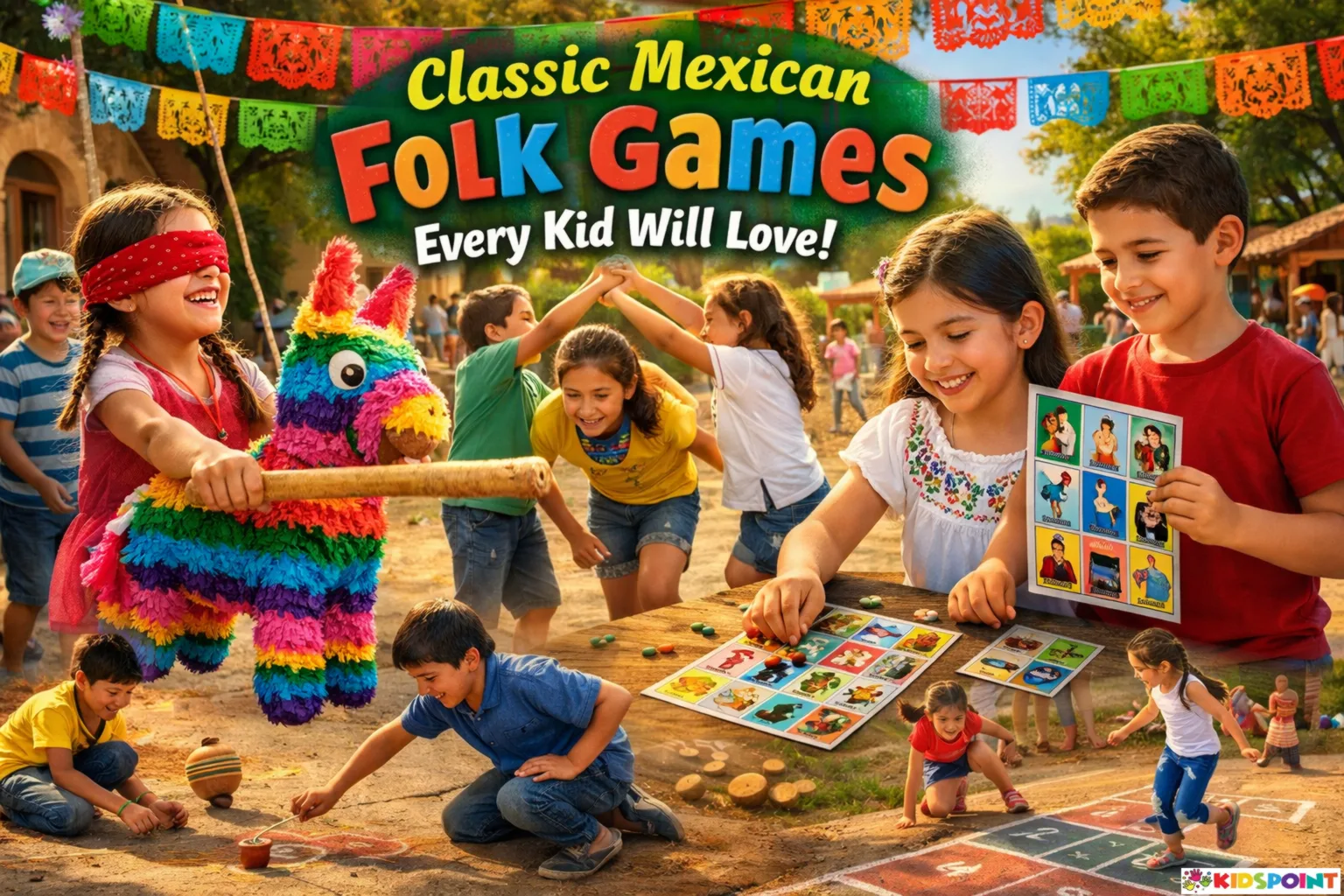
Games are a universal language of fun, learning, and connection. When children play, they develop social skills, coordination, creativity, and cultural awareness—all while laughing and having fun. Traditional games, passed down through generations, carry the history, stories, and values of their communities. Mexican folk games, in particular, are colorful, lively, and deeply rooted in cultural traditions, making them a perfect way for children to learn, explore, and enjoy themselves.
At The Kids Point, we believe that introducing kids to classic games from around the world nurtures curiosity, respect for cultural diversity, and joyful learning. This article explores some of the most beloved Mexican folk games that every child will love, how to play them safely, and why they are still relevant today.
Why Mexican Folk Games Are Special
Mexican folk games, known as juegos tradicionales, are more than just entertainment. They combine physical activity, creativity, teamwork, and problem-solving. They often reflect seasonal celebrations, historical stories, and community life.
These games are special because:
- They are interactive and hands-on, encouraging movement and active play.
- They often use simple, everyday materials, making them accessible and easy to set up.
- They encourage teamwork, patience, and fairness among children.
- They are culturally rich, allowing kids to connect with Mexican heritage and traditions.
By introducing these games to children, parents and educators create opportunities for both fun and cultural education.
Top Classic Mexican Folk Games for Kids
Here’s a list of classic Mexican games that kids of all ages can enjoy, whether at home, school, or community events.
Lotería (Mexican Bingo)
Lotería is a traditional Mexican game similar to bingo but played with illustrated cards instead of numbers. Each card features colorful images like “La Sirena” (the mermaid) or “El Gallo” (the rooster), making the game visually engaging for kids.
How to Play:
- Each player gets a board with a 4×4 or 4×5 grid of images.
- A caller draws cards from a deck and announces the image.
- Players mark the matching image on their boards.
- The first player to complete a row or column shouts “¡Lotería!” and wins.
Benefits:
- Boosts visual recognition and memory
- Encourages listening skills and focus
- Fun for large groups of kids
We love Lotería because it’s perfect for family game nights or school activities, and it can be adapted for all age groups.
La Rueda de San Miguel (The San Miguel Wheel)
This is a circle game where children hold hands and move in a spinning motion while singing a traditional song. It’s often played during festivals and celebrations.
How to Play:
- Children form a circle, holding hands.
- One child stands in the middle and performs a small action or sings a line.
- The circle spins while repeating the song or rhyme.
- The child in the middle changes after a round, giving everyone a turn.
Benefits:
- Encourages coordination and balance
- Promotes group interaction and cooperation
- Fun for outdoor and indoor settings
This game introduces children to traditional Mexican songs, promoting cultural literacy alongside physical activity.
Piñata Breaking Game
The piñata is iconic in Mexican celebrations, often shaped like animals, stars, or other fun designs. While commonly seen at birthdays, the game has roots in Mexican festivals.
How to Play:
- Fill a piñata with small candies or toys.
- Hang the piñata from a rope or tree branch.
- Blindfold a child and give them a stick to hit the piñata.
- Children take turns swinging until the piñata breaks and goodies fall.
Benefits:
- Improves hand-eye coordination
- Teaches turn-taking and patience
- Brings excitement and joy to celebrations
We recommend using soft sticks and adult supervision to keep the game safe and fun.
El Juego de la Lotería de Sonrisas (Smiling Lotería)
A playful variation of Lotería, this game combines cards and movement. Each card might instruct kids to perform a fun action, like “jump three times” or “make a funny face,” instead of marking it.
How to Play:
- Prepare a deck of cards with images and actions.
- Each child draws a card and performs the action.
- The game continues until all cards are used.
Benefits:
- Encourages creativity and laughter
- Enhances motor skills and confidence
- Perfect for classroom or party settings
This version is a favorite at our workshops because it blends traditional culture with active, imaginative play.
El Trompo (Spinning Top)
The spinning top, or trompo, is a classic Mexican toy that children can play with individually or in competitions.
How to Play:
- Wrap a string around a wooden or plastic top.
- Throw the top to make it spin on the ground.
- Compete to see whose top spins the longest.
Benefits:
- Builds fine motor skills and dexterity
- Encourages focus and patience
- Offers opportunities for friendly competition
We encourage introducing spinning tops to kids as a creative, screen-free play option.
La Vibora de la Mar (The Sea Snake Game)
This playful game is often part of weddings or festivals but can be adapted for children. Two players form an arch with their hands, while the others line up and pass under, weaving in and out.
How to Play:
- Two players create an arch with joined hands.
- The remaining players line up and pass under the arch while singing a song.
- At the end of the song, the arch comes down to “catch” a player, who becomes part of the arch.
Benefits:
- Improves agility and coordination
- Encourages teamwork and rhythm
- Fun for outdoor parties
This game combines movement, music, and playful challenge, making it a favorite at events.
Rayuela (Hopscotch)
While hopscotch exists worldwide, the Mexican version has its own traditional layout and rules. Children draw chalk patterns on the ground and hop through numbered spaces, trying to retrieve a marker without stepping outside the lines.
How to Play:
- Draw a hopscotch grid on the ground with chalk.
- Players throw a marker into a square and hop through the squares without losing balance.
- Retrieve the marker on the return journey.
- The first to complete all squares wins.
Benefits:
- Enhances balance, coordination, and counting skills
- Encourages friendly competition
- Can be played anywhere, indoors or outdoors
We hopscotch is a simple yet engaging way to introduce kids to traditional play.
Carrera de Sacos (Sack Race)
Sack races are common in Mexican festivals and school sports days. Kids hop in large sacks toward a finish line, making it an exciting and energetic activity.
How to Play:
- Give each child a large sack to stand inside.
- Mark a start and finish line.
- Children hop in their sacks toward the finish line.
- The first to cross wins.
Benefits:
- Boosts gross motor skills and coordination
- Promotes healthy competition
- Perfect for parties and outdoor play
Sack races are a staple at outdoor events because they combine exercise with fun.
How Parents Can Introduce Mexican Folk Games
Parents play a key role in making these games accessible and enjoyable. Here are some tips:
- Adapt games for space and safety: Many traditional games require outdoor space, but simple modifications make them safe indoors.
- Encourage cultural storytelling: Explain the origins and traditions behind each game to make play educational.
- Join in the fun: Adults playing alongside children enhance bonding and engagement.
- Rotate games regularly: Keep children interested by introducing new games and rotating old favorites.
We emphasize that playtime is a chance to nurture both physical skills and cultural appreciation.
Benefits of Playing Mexican Folk Games
Playing traditional Mexican games offers children numerous benefits:
- Physical Development – Games like sack races and trompos strengthen motor skills.
- Cognitive Skills – Lotería and hopscotch develop memory, counting, and focus.
- Social Skills – Team games teach cooperation, patience, and conflict resolution.
- Cultural Awareness – Children learn about Mexican traditions and heritage.
- Creativity – Games involving actions, songs, and improvisation encourage imagination.
These benefits make Mexican folk games an invaluable part of childhood experiences.
Incorporating Mexican Folk Games Into Daily Life
You don’t need a festival to enjoy these games. Here are ways families can include them in everyday life:
- At home: Create mini Lotería cards or use chalk to draw hopscotch grids in the backyard.
- In school: Teachers can incorporate circle games or piñata activities during cultural lessons.
- Community events: Organize Mexican game days for neighborhood children to play together.
- Birthdays and parties: Include piñatas, sack races, and Lotería for festive, interactive fun.
We encourage parents to see these games as tools for learning, creativity, and family connection.
Digital Adaptations of Mexican Folk Games
Some traditional games can be adapted into digital versions, helping children play safely indoors:
- Lotería apps with interactive boards
- Online hopscotch tutorials
- Virtual piñata games
Digital adaptations should supplement, not replace, physical play. Hands-on games remain vital for physical and social development.
Preserving Mexican Folk Games for Future Generations
Mexican folk games are cultural treasures. By playing them, sharing them with friends and family, and teaching kids their histories, we ensure that these traditions continue.
At The Kids Point, we believe every child should experience the joy of these games. Whether through physical play, storytelling, or simple creative adaptations, traditional games remain a bridge between generations.
Questions Parents and Kids Ask About Mexican Folk Games
What are Mexican folk games?
Traditional games passed down through generations in Mexico, often playful and educational.
Are these games suitable for all ages?
Yes, most games can be adapted for younger or older children.
Do I need special equipment for these games?
No—many use simple items like chalk, cards, or sacks.
Can Mexican folk games be played indoors?
Yes, with small adaptations like mini hopscotch or Lotería cards.
Why are these games important for kids?
They promote physical activity, social skills, creativity, and cultural learning.
Final Thoughts
Classic Mexican folk games are lively, educational, and endlessly entertaining. They teach children movement, memory, teamwork, and cultural pride, all while providing hours of fun. From Lotería to sack races and piñatas, each game offers unique experiences and memorable family moments.
Introducing these games at home, school, or community events fosters joy, connection, and cultural understanding. At The Kids Point, we celebrate the power of play and the importance of preserving traditions. By sharing Mexican folk games with children, we pass on stories, laughter, and lessons that last a lifetime.
Every child deserves the magic of a game that is both fun and culturally meaningful—classic Mexican folk games make that magic real.