

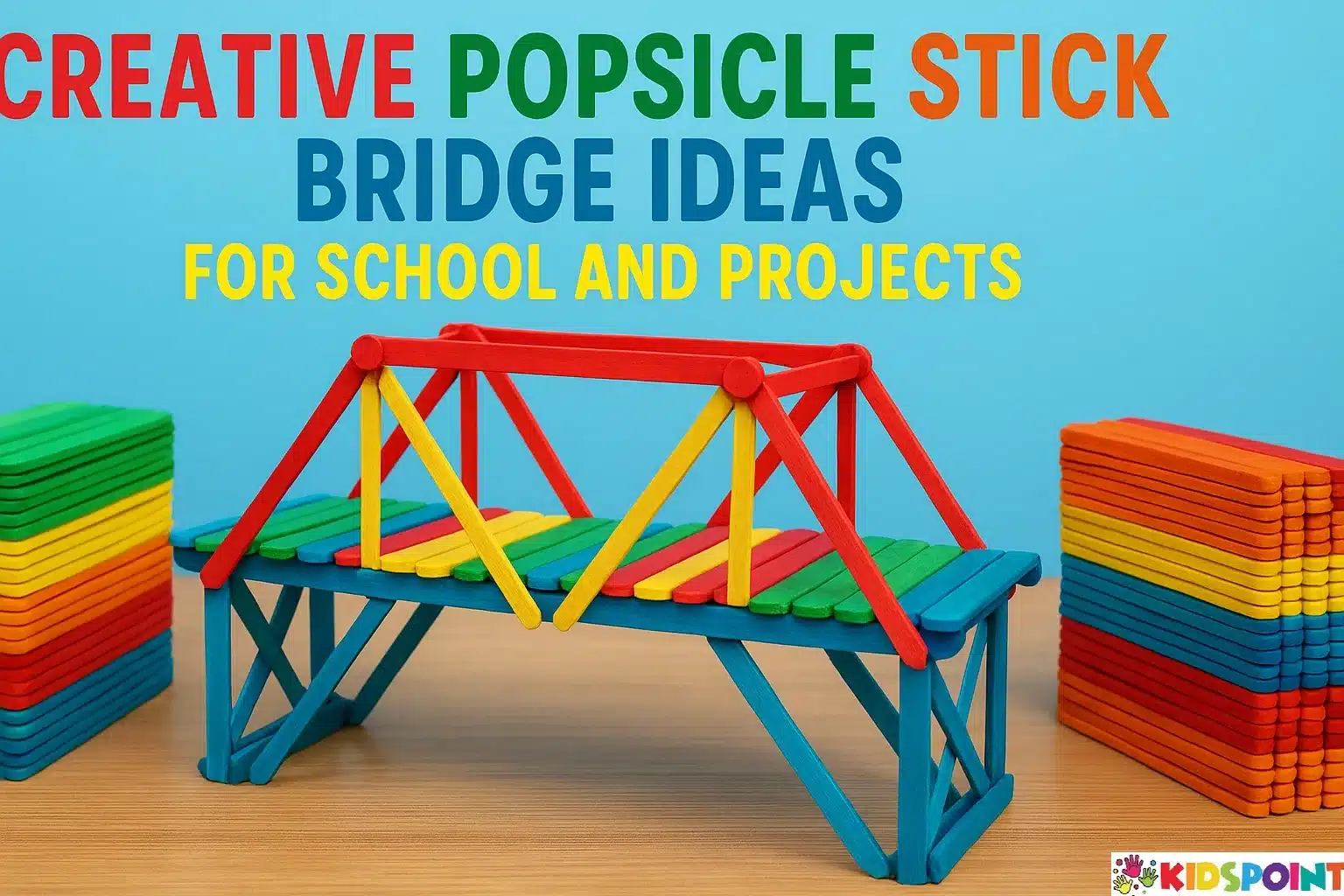
Building a popsicle stick bridge is one of the most exciting and educational STEM activities for kids. It combines creativity, engineering, physics, mathematics, and problem-solving in a hands-on way that children of all ages can enjoy. Whether it’s for a school competition, a science fair, a classroom challenge, or just a fun weekend project, popsicle stick bridges help kids understand real-world structural concepts while also having fun crafting.
At The Kids Point, we believe in practical learning through interactive, imaginative, and meaningful activities. Popsicle stick bridges are a perfect example—simple materials, unlimited possibilities, and a great opportunity for kids to “learn by doing.”
In this comprehensive guide, we’ll explore the best popsicle stick bridge ideas, step-by-step building tips, design variations, weight-bearing strategies, and creative challenges to inspire students of all levels.
Why Popsicle Stick Bridges Are Perfect for Kids’ Learning
Popsicle stick bridges are more than just craft projects. They introduce children to essential STEM concepts in a fun and approachable way.
Strengthens Problem-Solving and Critical Thinking
Kids must plan, design, and build a structure that can hold weight or span a certain length. This encourages logical thinking, strategic planning, and trial-and-error learning—skills essential for future engineering or technical interests.
Teaches Basic Engineering Concepts
Through these projects, children learn about:
- Tension and compression
- Forces and load distribution
- Triangles and stability
- Beam, truss, and arch designs
- Support points and structural balance
These are foundational concepts in civil engineering—but kids learn them naturally through building.
Encourages Creativity and Innovation
There’s no single “right” way to build a popsicle stick bridge. Kids can create:
- Tall or wide structures
- Flexible or rigid bridges
- Decorative or functional bridges
- Experimental designs that test new ideas
The challenge allows endless room for creativity.
Budget-Friendly and Classroom-Friendly
All you need are:
- Popsicle sticks
- White glue or hot glue
- Craft tools (scissors, rulers, markers)
- Optional decorations
Materials are cheap, widely available, and safe for students.
Fun for Competitions and Group Activities
Teachers often use these bridges for:
- STEM fairs
- School competitions
- Team-building challenges
- Science clubs
- After-school activity projects
We encourage adding friendly challenges like testing which bridge can hold more books or span the longest distance.
Choosing the Right Bridge Design
Understanding different bridge types helps kids make informed design decisions. Below are the most effective and creative popsicle stick bridge styles.
Beam Bridge – Best for Beginners
A beam bridge is the simplest structure and perfect for younger kids. It consists of:
- A straight, horizontal beam
- Two support points on either end
Why it works: Beam bridges distribute weight evenly across their length. Kids learn about compression in the top beam and tension in the bottom.
Ideal for:
- Early-grade students
- First-time builders
- Simple classroom demos
Tips: Use double or triple layers of sticks glued together for extra strength.
Truss Bridge – Strong and Popular for Competitions
Truss bridges are known for their repeating triangular patterns, which provide superior stability. This is the most popular choice for STEM competitions.
Common Truss Types:
- Pratt Truss
- Howe Truss
- Warren Truss
- K-Truss
Triangles reduce bending forces and increase resistance. Kids learn how engineers use geometry to strengthen structures.
Benefits:
- Extremely strong
- Great for weight-bearing challenges
- A fantastic learning experience in load distribution
Tip: For maximum strength, ensure triangles are symmetrical and joints are firmly glued.
Arch Bridge – Beautiful and Flexible
Arch bridges rely on curved structures that transfer weight into the supports on each end.
Features:
- Elegant and decorative
- Can support impressive weight if built properly
- More complex but fun for older students
How It Works: The curved shape pushes downward force outward toward the sides, preventing collapse.
Creative Twist: Kids can experiment with arches made from:
- Curved popsicle sticks
- Shorter stick segments forming a polygonal arch
- Laminated glued sticks shaped into a curve
Suspension Bridge – Great for Artistic and Engineering Flair
Suspension bridges look impressive and challenge kids to think beyond traditional beams.
They feature:
- Towers
- Cables (string or thin sticks)
- A suspended deck
This introduces students to tension strength and cable support systems.
Why Kids Love It: It looks like the Golden Gate bridge but made from popsicle sticks!
Suggestion: Use strong twine or fishing line as cables for a more realistic effect.
Cantilever Bridge – A Creative Engineering Challenge
Cantilever bridges extend outward without direct support underneath the middle. This concept stretches kids’ engineering imagination.
Key Concepts Learned:
- Counterbalances
- Load transfer
- Structural projection
Perfect for advanced builders or science competitions.
Materials Needed for Popsicle Stick Bridge Building
We recommend keeping these supplies ready:
- Standard popsicle sticks (100–300 depending on design)
- Glue (white glue for kids, hot glue for stronger joints)
- Craft knife (adult-supervised)
- Ruler or measuring tape
- Binder clips or clothespins (to hold sticks while drying)
- Markers for planning and decorating
- Cardboard or foam base for stability
Optional for advanced builders:
- Toothpicks for smaller joints
- Wood glue for extra strength
- Small weights for testing
How to Build a Strong Popsicle Stick Bridge
Here’s a clear, educational guide suitable for students and classrooms.
Plan the Design
Before building, students should:
- Sketch their bridge
- Decide on length and height
- Choose the bridge type
- Estimate how many sticks they’ll need
- Identify support points
We always recommend making at least 2–3 design drafts.
Build the Base (Deck)
The deck is the walkway or roadway of the bridge.
How to build:
- Lay down popsicle sticks side by side
- Glue sticks in layers for strength
- Add cross-sticks underneath to support the beam
Tip: Use a flat ruler to check for straightness.
Construct the Sides or Trusses
Trusses are what make most popsicle stick bridges strong.
Steps:
- Lay sticks flat
- Build repeating triangles
- Make two identical side frames
- Let them dry completely
Strong trusses = strong bridge.
Attach the Trusses to the Deck
Once the sides are dry:
- Stand them upright
- Glue them to the deck
- Reinforce with vertical support sticks
Kids will learn how stability works by seeing the bridge become stronger as they add more support.
Add Cross Bracing
Cross bracing creates diagonal supports between the two sides of the bridge.
This helps prevent:
- Twisting
- Side-to-side movement
- Collapsing under uneven weight
Tip: Even one or two diagonal braces can double the strength!
Reinforce Weak Points
Check for:
- Loose joints
- Gaps in the structure
- Uneven sides
Reinforce by adding extra sticks or glue.
Let it Fully Dry
Drying time is essential. Rushing can cause:
- Weak joints
- Warped beams
Allow at least 6–12 hours for maximum strength.
Fun & Creative Popsicle Stick Bridge Ideas for Kids
Here are exciting designs kids can try at home or school projects.
The Colored Rainbow Truss Bridge
Kids paint each stick before assembling to create a rainbow-themed bridge. Great for art-integrated STEM lessons.
The Curved Arch Garden Bridge
Decorate with:
- Artificial grass
- Pebbles
- Mini trees
- LED strips
Perfect for diorama projects or school exhibitions.
The Extra-Strong Challenge Bridge
Students test engineering strength by:
- Using triple-layered sticks
- Adding reinforced triangles
- Trying to hold books, sandbags, or weights
Builders can compete to see whose bridge holds more weight.
The Suspension Fantasy Bridge
Add towers and colorful strings to create a magical, fantasy-style suspension bridge.
Kids can design themes such as:
- Ocean bridge
- Fairy bridge
- Space bridge
The Longest-Span Bridge Contest
This encourages students to build the longest possible bridge without collapsing.
Rules can include:
- No middle support
- Maximum stick limit
- Minimum weight-bearing requirement
Testing Popsicle Stick Bridges
Testing bridges is fun and educational.
Kids can test for:
Strength (Weight Test)
- Add textbooks
- Add water bottles
- Add weighted bags
Stability (Side Push Test)
Lightly nudge the bridge from each side to see how stable it is.
Flexibility (Suspension Test)
Check if the deck bends gracefully without breaking.
Span Length Test
Measure how far the bridge reaches between two tables.
Always supervise younger kids during weight tests.
Common Mistakes to Avoid
We’ve seen many classroom builds. These mistakes are very common:
Using Too Much Glue
Excess glue weakens joints instead of strengthening them.
Poor Symmetry
Uneven sides lead to unstable designs.
Skipping Cross Bracing
This is crucial for preventing breakage.
Not Allowing Enough Drying Time
Patience equals strength.
Ignoring the Importance of Triangles
Triangles = stability. Squares collapse easily.
Educational Benefits for Teachers and Schools
Teachers love popsicle stick bridges because they support:
STEM Learning
Bridges introduce physics, math, and engineering concepts.
Teamwork
Group building encourages communication and collaboration.
Hands-On Learning
Students physically engage with the material and concepts.
Problem-Solving Skills
Kids adjust, redesign, test, and improve their structures.
Creativity & Innovation
Every bridge is unique and reflects personal imagination.
We encourage schools to integrate popsicle stick bridge projects into STEM weeks, science fairs, and project-based learning modules.
Tips for Making a Bridge Extra Strong
Want a super strong popsicle stick bridge? Use these strategies:
- Use triangular patterns consistently
- Add double layers on high-stress areas
- Glue sticks in overlapping patterns
- Create identical trusses for balance
- Make sure the deck is reinforced
- Use cross bracing underneath and on the sides
- Let each section dry completely before attaching
With these techniques, some bridges can hold 20–50 kg or more in competitions!
How to Turn This Into a Full Learning Project
Teachers and parents can expand this into a complete learning module:
Design Phase
Have kids study real bridges around the world.
Math Integration
Let kids measure, calculate angles, and estimate materials.
Science Integration
Teach about gravity, force, and balance.
Engineering Notebook
Students record steps, sketches, and observations.
Testing & Evaluation
Compare different bridge designs to see which performs best.
Presentation
Kids can present their designs and results.
We recommend this approach for robust learning outcomes.
FAQs
What is the easiest popsicle stick bridge for beginners?
A simple beam bridge is the easiest design for kids and first-time builders.
Which bridge design is strongest?
A truss bridge—especially a Pratt or Warren truss—is strongest due to its triangular support system.
How many popsicle sticks do I need?
Basic bridges need 100–150 sticks, while advanced competition bridges may require 200–300.
What glue works best?
White craft glue is safe for kids, but hot glue or wood glue gives stronger joints.
How can I make my bridge hold more weight?
Use triangular braces, double-layer beams, cross bracing, and ensure all joints are firmly dried.
Final Thoughts
Popsicle stick bridge building is one of the most engaging and educational STEM activities for kids. It blends creativity, problem-solving, and hands-on building skills while teaching real engineering concepts in a fun way.
Whether your child is creating a simple beam bridge or experimenting with advanced truss and suspension structures, the learning experience is rich and memorable. With imagination and the right guidance, popsicle stick bridges open a world of discovery—one popsicle stick at a time.
At The Kids Point, we’re committed to guiding parents, teachers, and students with fun educational resources, project ideas, and helpful tutorials. Popsicle stick bridges are just one of many activities that spark curiosity and inspire young builders.