

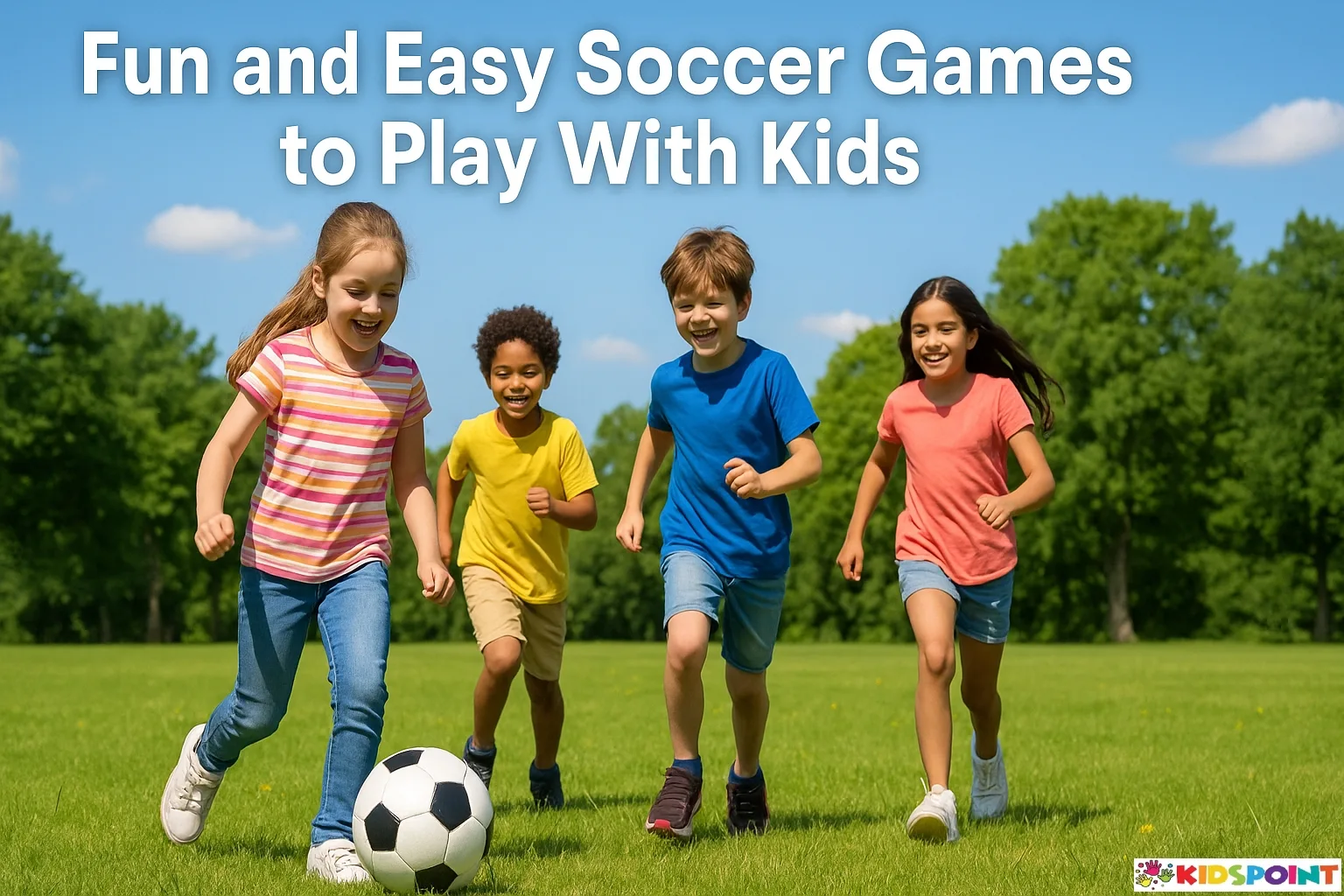
Soccer is one of the simplest and most enjoyable sports for children. All you need is a ball, a bit of open space, and a group of excited players ready to run, laugh, and learn. Whether you’re a parent, teacher, or coach, soccer provides an amazing opportunity to help kids build physical skills, teamwork, strategic thinking, and confidence—without requiring complicated rules or expensive equipment.
But traditional soccer scrimmages can sometimes feel overwhelming or competitive for young children. That’s where fun and easy soccer games come in—they keep kids engaged, active, and learning, while making the sport playful and stress-free.
At The Kids Point, we believe that sports should encourage joy, creativity, curiosity, and positive development. The following soccer games are perfect for classrooms, family gatherings, birthday parties, youth camps, playgrounds, and beginner soccer practices. Each activity is simple to set up, child-friendly, and adaptable for different ages and skill levels.
Why Kids Love Playing Soccer
Before diving into the game ideas, it’s helpful to understand why soccer is so beneficial for growing minds and bodies.
Boosts Physical Fitness
Soccer improves:
- Coordination
- Balance
- Agility
- Cardiovascular strength
- Motor skills
- Muscle development
Kids burn energy naturally—and soccer keeps them moving in fun ways.
Encourages Teamwork and Communication
Children learn how to:
- Share the ball
- Support teammates
- Take turns
- Strategize together
- Practice good sportsmanship
These social lessons benefit them far beyond the field.
Strengthens Emotional Development
Soccer teaches resilience, patience, leadership, responsibility, and self-expression. Kids learn how to win humbly and lose respectfully.
Can Be Played Anywhere
Fields, backyards, living rooms, playgrounds, gyms—soccer is endlessly adaptable.
Requires Minimal Equipment
A ball and safe space are enough—especially when games are creative and imaginative.
That’s why we encourage parents and educators to promote soccer-based play from an early age.
How to Prepare Before Playing
To create a safe and enjoyable soccer play session:
Choose a Safe Area
- Smooth ground, grass, or turf
- No glass, holes, or sharp objects
- Enough space for running comfortably
Use Age-Appropriate Equipment
- Size 3 soccer balls for ages 3–7
- Size 4 for ages 8–11
- Cones, chalk, ropes, or natural landmarks to mark boundaries
Set Simple Rules
Avoid overwhelming kids—rules should be:
- Clear
- Positive
- Consistent
Prioritize Safety
Remind kids:
- No pushing or aggressive kicking
- Watch where you run
- Wear proper shoes
Encourage Participation, Not Perfection
Praise effort, creativity, and kindness.
Once the environment feels safe and inviting, it’s time for fun!
Fun and Easy Soccer Games for Kids
These games work for all skill levels, from complete beginners to confident young athletes. They keep the focus on laughter, teamwork, and learning.
Red Light, Green Light Soccer
Best for: Ages 4–10
Players: 3+
Skills Developed: Ball control, stopping, dribbling, listening
How to Play
- One adult or child stands as the “traffic light.”
- Kids line up with a ball on the opposite side.
- When the leader yells “Green light!” players dribble forward.
- “Red light!” means freeze—ball and body.
- First person to reach the finish wins.
Why Kids Love It: It’s exciting, silly, and encourages quick reactions.
Sharks and Minnows
Best for: Ages 6–12
Players: 5+
Skills Developed: Speed, spatial awareness, dodging
How to Play
- Choose one or two “sharks” to stand in the middle.
- All other kids (the “minnows”) dribble from one side of the field to the other.
- Sharks try to steal or knock balls away.
- Minnows who lose their ball become sharks.
Fun Variation: Make sharks hop, dribble backward, or use smaller boundaries.
Freeze Dribble Tag
Best for: Ages 5–10
Players: 4+
Skills Developed: Ball handling under pressure, teamwork
How to Play
- One or two kids are “taggers” without a ball.
- Everyone else dribbles around the area.
- If tagged, a player freezes in place.
- Teammates can unfreeze them by tapping their ball to theirs.
What It Teaches: Helping others, awareness, and creative movement.
Cone Knockdown
Best for: Ages 4–9
Players: Any number
Skills Developed: Accuracy, shooting, aiming
How to Play
- Set up cones randomly around the field.
- Kids dribble and try to knock them down by passing or shooting.
- Count how many cones they hit in a minute.
Pro Tip: Replace cones with stuffed animals for younger kids—extra adorable!
Follow the Leader Dribble
Best for: Ages 3–7
Players: 2–6
Skills Developed: Mirroring movement, control, creativity
How to Play
- One child leads while dribbling around.
- Others follow and copy movements—zigzags, circles, fast, slow, backward walking.
Encouragement Strategy: Let every child take turns being the leader.
Soccer Bowling
Best for: Ages 5–11
Players: 1+
Skills Developed: Directional passing, aiming, consistency
How to Play
- Set up cones or plastic bottles like bowling pins.
- Kids kick the ball and try to knock them down.
- Count strikes and spares.
Why Kids Love It: Familiar, silly, and visually satisfying.
Treasure Hunt Dribble
Best for: Ages 4–10
Players: Groups or teams
Skills Developed: Focus, endurance, task completion
How to Play
- Place beanbags, cones, scarves, or small balls around the field.
- Kids must dribble to each item, collect it, and return it to a “treasure base.”
- The team with the most treasures wins.
Learning Opportunity: Turn treasures into vocabulary or math challenges.
Balloon Soccer
Best for: Ages 3–6
Players: Indoor groups
Skills Developed: Timing, low-pressure kicking, giggles!
How to Play
- Replace the soccer ball with a balloon.
- Kids tap, kick, and chase it toward goals.
Important: Supervise closely—avoid latex around allergy-prone children.
Partner Pass Challenge
Best for: Ages 6–12
Players: 2+
Skills Developed: Communication, precision, teamwork
How to Play
- Kids pair up and pass the ball back and forth.
- After each successful pass, they take one step farther apart.
- If the ball breaks the passing streak, restart.
Coaching Tip: Encourage verbal cues—not louder kicks.
Mini World Cup Tournament
Best for: Ages 7–13
Players: 6+
Skills Developed: Strategy, collaboration, excitement
How to Play
- Divide players into small teams—2v2 or 3v3 works best.
- Give each team a country name.
- Play short, fun games—3–5 minutes each.
- Rotate teams until everyone plays everyone.
Why It Works: Competitive energy without overwhelming pressure.
How These Games Help Kids Learn
We value play-based learning. These soccer games help children develop important skills:
Physical Growth
- Strengthens muscles
- Enhances stamina
- Improves reaction time
- Builds hand-eye and foot-eye coordination
Cognitive Development
- Decision-making
- Problem-solving
- Predicting movement
- Understanding cause and effect
Social Skills
- Cooperation
- Conflict resolution
- Leadership
- Empathy
Emotional Well-being
- Reduced anxiety
- Increased self-esteem
- Positive mindset
- Joy in physical activity
Soccer is more than a sport—it’s a child development tool.
Tips for Making Soccer More Fun for Kids
To ensure a positive experience:
- Celebrate effort—not just winning
- Let kids choose team names or chants
- Allow creativity—silly kicks encouraged
- Rotate positions and leadership roles
- Keep games short and varied
- Be patient—every child learns differently
- Provide breaks, hydration, and encouragement
Children learn best when they feel supported, valued, and allowed to explore.
Adapting Soccer Games for Different Ages
Toddlers (2–4 years)
- Use large, soft balls
- Focus on rolling, chasing, light kicking
- Keep games short—3–5 minutes
Early Elementary (5–8 years)
- Introduce dribbling, passing, stopping
- Prioritize imagination and storytelling
- Encourage teamwork gently
Older Kids (9–12 years)
- Teach shooting accuracy, strategy, positioning
- Offer mini competitions
- Introduce sportsmanship discussions
Kids With Special Needs
- Modify space, rules, or pace
- Use visual cues
- Allow extra time and support
- Focus on personal progress
Soccer should be accessible and welcoming for all children.
What Parents and Coaches Should Avoid
- Over-coaching
- Yelling or shaming
- Making games too complex
- Favoring stronger players
- Prioritizing winning over enjoyment
Kids remember how sports made them feel, not the score.
Common Questions About Kids’ Soccer Games
What age can kids start playing soccer games?
Children as young as 3 can begin with simple kicking and movement games.
Do we need a full field to play soccer with kids?
No—any safe open space like a yard, park, or playground works.
What equipment is needed for kids’ soccer games?
A lightweight soccer ball and optional cones or markers are enough.
How long should soccer games last for young kids?
Short sessions of 5–10 minutes keep children engaged and energized.
How can I keep soccer fun for beginners?
Use playful games, offer encouragement, rotate roles, and avoid pressure.
Wrapping Up the Fun on the Soccer Field
Soccer becomes magical when it’s fun, inclusive, and pressure-free. Children don’t need perfectly organized drills—they need opportunities to laugh, move, explore, try new skills, and feel proud of themselves. By using playful soccer games, parents, teachers, and coaches can turn every practice, recess, or family afternoon into a joyful bonding experience.
At The Kids Point, we encourage active learning and meaningful play—because the best childhood memories are made outdoors, with friends, running freely, and kicking a ball with joy.
So grab a soccer ball, gather some enthusiastic kids, pick a game from this list, and enjoy watching them shine!