

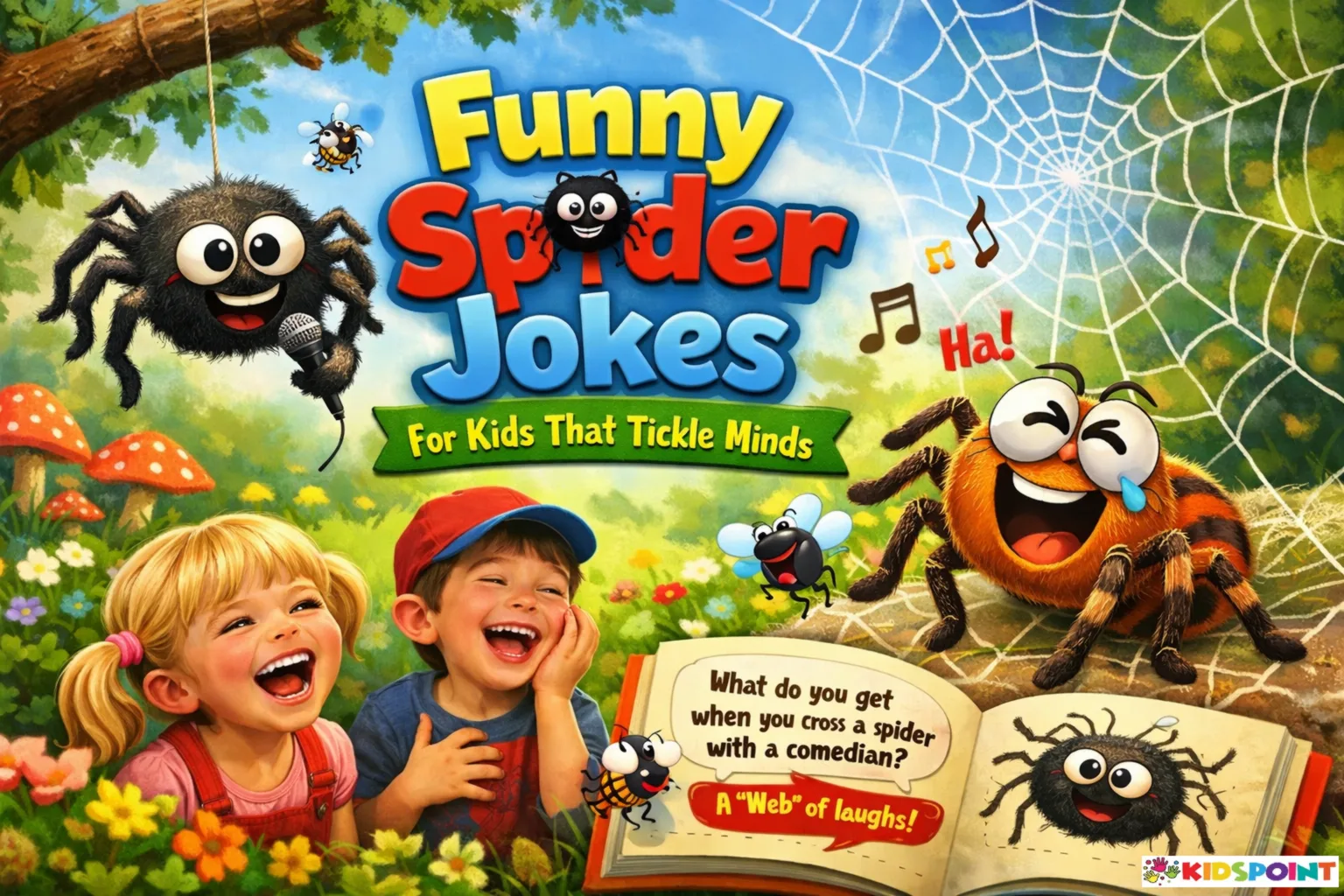
Spiders may look a little creepy to some kids, but when you add humor, they quickly become silly, friendly, and fun. Jokes about spiders are perfect for children because they mix a tiny bit of spooky with a whole lot of laughter. Instead of fear, kids feel curiosity and amusement — and that’s a great combination for learning and confidence.
At The Kids Point, we believe jokes are more than just fun — they’re powerful learning tools. Humor builds vocabulary, improves memory, encourages reading, and helps children feel relaxed about topics that might otherwise seem scary. Spider jokes are especially great around Halloween, nature lessons, or animal-themed activities.
This complete guide includes funny spider jokes, riddle jokes, classroom-friendly humor, learning benefits, and creative ways to use jokes with kids at home or school.
Let’s spin a web of laughter.
Why Kids Love Spider Jokes
Spider jokes work so well with children because they combine:
- Silly wordplay
- Tiny creatures with big personalities
- Light “not-too-scary” themes
- Easy punchlines
- Animal-based humor kids understand
Spiders also appear in many children’s stories and cartoons, which makes them familiar characters for playful jokes.
Humor turns “Eww, a spider!” into “Tell me another one.”
Classic Funny Spider Jokes for Kids
Let’s start with simple, kid-friendly spider jokes that always get laughs.
- Why are spiders so smart?
Because they can find everything on the web. - What do spiders eat in Paris?
French flies. - Why did the spider go to school?
To improve his web-writing skills. - What is a spider’s favorite subject?
Web design. - Why did the spider sit on the computer?
To keep an eye on the web page. - What do you call a spider with great math skills?
A math-a-web-tician. - Why did the spider become a detective?
It was great at catching bugs. - What do spiders do before dinner?
They set the table with webkins. - Why did the spider get a job online?
It loved working on the web. - What’s a spider’s favorite sport?
Fly-fishing.
Silly Spider One-Liner Jokes
Perfect for quick giggles and joke-of-the-day moments.
- I tried to race a spider — it won by a web-length.
- That spider is such a good cook — everything is home-web-made.
- Spiders are great at the internet — they built it.
- A spider’s favorite music style is heavy web-metal.
- Never lie to a spider — it will catch you in your own web.
- Spiders don’t get lost — they follow their thread.
- My pet spider opened a website — zero bugs allowed.
- Spiders love homework — especially the web projects.
Spider Riddle Jokes for Curious Kids
Riddle-style jokes help kids think and laugh at the same time.
- What has eight legs, builds houses, and never pays rent?
A spider. - What kind of spider works in technology?
A web developer. - What kind of spider likes baseball?
A catch-er. - What kind of spider can sing?
A hum-bug spider. - What do you get when a spider becomes a chef?
A web cook.
Not-So-Scary Spider Jokes for Younger Kids
These are extra gentle for little ones who may still feel unsure about spiders.
- Why was the baby spider so happy?
It just learned to crawl online. - What do polite spiders say?
“Web you please?” - Why did the spider bring a pillow?
It wanted a web nap. - What do spiders call their friends?
Best webbies. - Why did the spider smile all day?
It had a sticky situation solved.
Classroom Spider Jokes for Teachers
Teachers can use these during animal lessons or nature units.
- Teacher: What do spiders learn first in school?
Student: The web alphabet. - Why did the spider get an A+?
Its work was well-connected. - What did the spider write in its notebook?
Web notes. - Why are spiders great students?
They pay attention to details and connections. - What’s a spider’s favorite school club?
The website club.
Spider Knock-Knock Jokes
Knock-knock jokes are perfect for interactive laughter.
Joke 1
Knock, knock
Who’s there?
Spider
Spider who?
Spider-mind if I tell another joke?
Joke 2
Knock, knock
Who’s there?
Web
Web who?
Web been laughing all day.
Joke 3
Knock, knock
Who’s there?
Fly
Fly who?
Fly into my web of jokes.
How Spider Jokes Support Learning
We encourage humor because it supports child development in many ways.
Builds Vocabulary
Wordplay like “web,” “bug,” and “fly” teaches multiple meanings of words.
Improves Reading Skills
Kids love reading jokes aloud, which improves fluency and confidence.
Encourages Curiosity About Nature
Spider humor often leads to questions like:
- Where do spiders live?
- How do webs work?
- What do spiders eat?
Reduces Fear
Gentle humor helps children feel less afraid of insects and small creatures.
Strengthens Memory
Punchlines are easier to remember than plain facts.
Spider Joke Activities for Kids
Turn jokes into fun learning activities.
Joke Writing Challenge
Ask kids to write their own spider joke using:
- A spider
- A place
- A silly action
Example formula:
Why did the spider go to the library?
To check out the web pages.
Joke Illustration
Kids draw their favorite spider joke scene.
Fill-in-the-Punchline Game
Give the setup and let kids invent endings.
Why did the spider open a bakery?
Kids create answers.
Joke Performance Time
Kids stand up and perform a spider joke like a mini comedy show.
Fun Spider Facts You Can Pair With Jokes
Mixing facts with humor makes learning stick.
- Spiders have eight legs.
- Most spiders are harmless to humans.
- Spiders help by catching insects.
- Webs are made from silk they produce.
- Some spiders rebuild their webs daily.
Example combo teaching line:
“Spiders make silk webs — and also worldwide webs of jokes.”
Using Spider Jokes at Home
Parents can use spider humor in simple daily ways.
During Reading Time
Add a few jokes between pages.
Before Bed
Tell one gentle spider joke to end the day with smiles.
During Nature Walks
If kids see a web, share a spider joke instead of reacting with fear.
Lunchbox Notes
Write a short spider joke on a note card.
Example:
Why are spiders calm?
They know how to stay connected.
Using Spider Jokes in School
Teachers can easily include these in lessons.
- Animal units
- Insect science topics
- Halloween activities
- Creative writing classes
- Reading warm-ups
- Speech practice
A two-minute joke break often improves attention for the next twenty minutes.
Encourage Kids to Create Their Own Spider Humor
Creative humor builds thinking skills. Encourage kids to:
- Change punchlines
- Mix spider jokes with other animals
- Draw comic strips
- Create joke books
- Record joke videos
Simple prompt:
“Create a joke using spider + school + food.”
Example result:
Why did the spider bring lunch to class?
It didn’t trust cafeteria flies.
When to Keep Spider Humor Gentle
Some children are truly afraid of spiders. In those cases:
- Use cute cartoon spider jokes
- Avoid scary descriptions
- Focus on friendly spider characters
- Let the child skip if uncomfortable
- Pair jokes with cute drawings
The goal is laughter, not fear.
FAQs – Funny Spider Jokes for Kids
Are spider jokes suitable for all kids?
Yes, most spider jokes are light and silly, but choose gentle ones for kids who are scared of spiders.
What age group enjoys spider jokes most?
Spider jokes are best for kids aged 5–12, though older kids can enjoy clever wordplay too.
Can spider jokes be used in classrooms?
Absolutely. Teachers can use them as fun icebreakers during science or nature lessons.
Do spider jokes help children learn?
Yes, jokes improve reading confidence, vocabulary, memory, and creative thinking.
How can parents use spider jokes at home?
Parents can share them during reading time, add them to lunch notes, or use them to make learning fun with style humor.
A Happy Wrap-Up of Spider Laughs
Spider jokes are a wonderful mix of silly, smart, and slightly spooky fun. They help children laugh, learn, read, and think creatively. With the right humor, even creatures that once seemed scary can become friendly joke characters.
Whether used at home, in classrooms, during nature lessons, or at parties, spider jokes bring easy smiles and memorable moments. Humor keeps learning light and curiosity strong.
At The Kids Point, we always support playful learning, joyful reading, and laughter-filled discovery. Keep sharing jokes, keep encouraging creativity, and keep spinning webs of fun learning.