

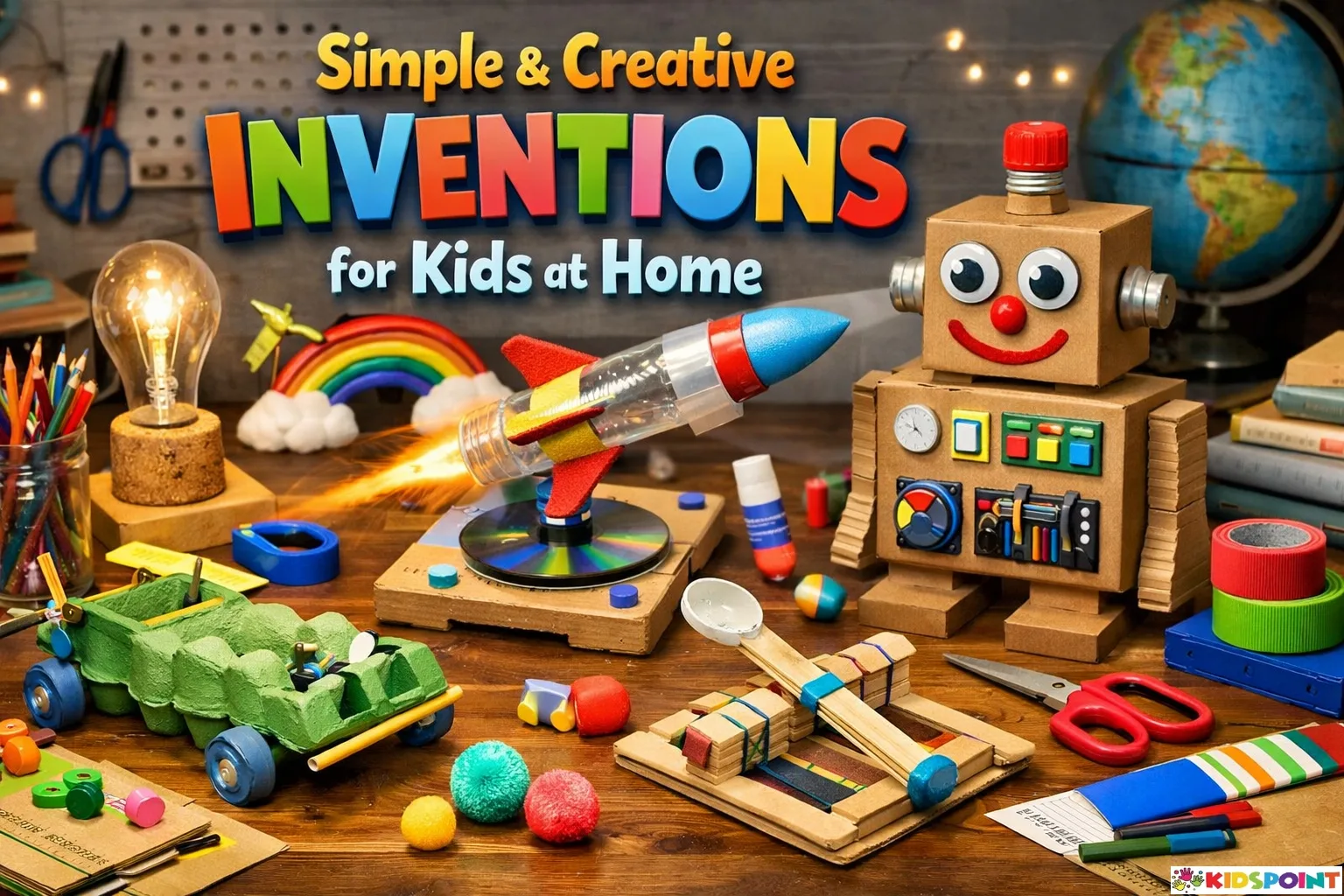
Encouraging kids to invent, build, and experiment at home is one of the most powerful ways to nurture creativity, problem-solving skills, and confidence. Children are naturally curious, and when that curiosity is guided through simple inventions, it transforms into meaningful learning. The best part? You don’t need expensive tools or advanced science knowledge. With everyday household items and a bit of imagination, kids can create amazing inventions right at home.
At The Kids Point, we believe that hands-on learning helps children understand how the world works while making education fun and memorable. This guide explores simple and creative inventions for kids that are easy to make, safe, and packed with learning value.
Why Inventions Are Important for Kids’ Learning
Inventions help children go beyond memorizing facts. They allow kids to think, test, fail, and improve, which builds real-world skills.
Benefits of Making Inventions at Home
- Boosts creativity and imagination
- Improves critical thinking and problem-solving
- Introduces basic STEM concepts naturally
- Encourages patience and perseverance
- Builds confidence through achievement
- Reduces screen time with productive activities
When kids invent something themselves, learning becomes exciting instead of overwhelming.
Getting Started: What Kids Need to Invent at Home
Before jumping into invention ideas, it’s helpful to prepare a small “invention kit.”
Common Household Items for Kids’ Inventions
- Cardboard boxes and paper towel rolls
- Plastic bottles and caps
- Rubber bands
- Popsicle sticks
- String, yarn, or thread
- Paper clips
- Tape and glue
- Old CDs
- Balloons
- Aluminum foil
Always ensure adult supervision, especially when scissors or small items are involved.
Simple Inventions for Younger Kids (Ages 5–7)
These inventions focus on basic movement, cause-and-effect, and sensory exploration.
Balloon-Powered Car
Kids can create a simple car using cardboard, bottle caps for wheels, and a balloon for power. When the balloon releases air, the car moves forward.
What kids learn:
- Air pressure
- Motion and force
- Cause and effect
Paper Spinner Helicopter
Cut paper into a simple helicopter shape and drop it from a height. The spinning motion fascinates young children.
What kids learn:
- Gravity
- Air resistance
- Observation skills
Cardboard Binoculars
Two toilet paper rolls taped together become binoculars for pretend exploration.
What kids learn:
- Creative reuse
- Imaginative play
- Observation
Creative Inventions for Kids (Ages 8–10)
At this age, kids are ready for slightly more complex ideas that involve planning and testing.
DIY Marble Run
Using cardboard, paper tubes, and tape, kids can design a marble run on a wall or board.
What kids learn:
- Engineering basics
- Gravity and speed
- Trial and error
Homemade Compass
A magnetized needle floating on water helps kids find direction.
What kids learn:
- Magnetism
- Earth’s magnetic field
- Navigation basics
Simple Water Filter
Layer sand, gravel, and charcoal inside a bottle to filter dirty water.
What kids learn:
- Environmental science
- Water purification concepts
- Problem-solving
Fun STEM Inventions for Kids (Ages 10–12)
Older kids enjoy inventions that feel more “real-world” and scientific.
Solar Oven
Using a pizza box, foil, and plastic wrap, kids can build a solar oven to warm snacks.
What kids learn:
- Solar energy
- Heat absorption
- Sustainability
Rubber Band Guitar
Stretch rubber bands of different thicknesses over a box to create a musical instrument.
What kids learn:
- Sound vibration
- Pitch and frequency
- Creative expression
DIY Periscope
With cardboard and mirrors, kids can make a working periscope.
What kids learn:
- Light reflection
- Angles
- Optical science
Problem-Solving Inventions Kids Can Design Themselves
Encourage kids to invent solutions to everyday problems.
Anti-Spill Cup Holder
Kids design a cup holder that prevents spills using cardboard and padding.
Skills developed:
- Design thinking
- Real-world application
- Creativity
Automatic Pet Feeder (Simple Version)
Using gravity and recycled bottles, kids can design a basic feeder.
Skills developed:
- Planning
- Responsibility
- Mechanical thinking
Eco-Friendly Invention Ideas for Kids
Teaching sustainability through invention is a powerful lesson.
Wind-Powered Pinwheel Generator
Attach a pinwheel to a small motor (or simulate movement) to show wind energy.
Learning focus:
- Renewable energy
- Environmental awareness
Recycled Paper Maker
Kids can reuse old paper to make new sheets.
Learning focus:
- Recycling
- Environmental responsibility
We strongly encourage eco-friendly creativity that teaches children to care for the planet while inventing.
Tips for Parents to Support Kids’ Inventions
Parents play a vital role in turning invention time into a positive experience.
How to Encourage Creativity
- Let kids lead the idea
- Avoid correcting too quickly
- Ask open-ended questions
- Celebrate effort, not just results
- Allow mistakes—they are part of learning
Safety Tips
- Supervise cutting and building
- Use child-safe tools
- Avoid heat or electricity unless guided by adults
Turning Inventions into Learning Projects
You can extend these activities into mini learning projects.
Simple Project Ideas
- Ask kids to explain how their invention works
- Have them draw a design plan
- Encourage improvements after testing
- Let them present their invention to family
This builds communication skills and confidence.
Why At-Home Inventions Matter More Than Ever
In a digital world, hands-on creativity is becoming rare—but also more important. Making inventions helps kids slow down, focus, and engage deeply with ideas. It develops skills that screens alone cannot teach.
We believe every child has the potential to be a creator, not just a consumer. Simple inventions at home help unlock that potential in fun and meaningful ways.
FAQs: Simple and Creative Inventions for Kids at Home
What age is best for invention activities?
Kids as young as 5 can start with simple inventions, while older kids can handle more complex projects.
Do inventions require expensive materials?
No, most inventions can be made using recycled or household items.
How long should invention activities last?
Anywhere from 20 minutes to an hour, depending on the child’s interest level.
Are invention activities educational?
Yes, they naturally teach STEM concepts, creativity, and problem-solving skills.
How can parents encourage kids who feel stuck?
Ask guiding questions, show examples, and remind them that mistakes are part of inventing.
Final Thoughts
Simple and creative inventions for kids at home are more than just fun activities—they are powerful learning tools. Through building, testing, and improving, children gain confidence, creativity, and essential life skills. With minimal materials and maximum imagination, kids can explore science, engineering, and problem-solving in exciting ways.
At The Kids Point, we are passionate about helping parents and educators inspire young minds through hands-on learning. By encouraging invention at home, you are not only keeping kids engaged—you are helping shape future thinkers, creators, and innovators.