

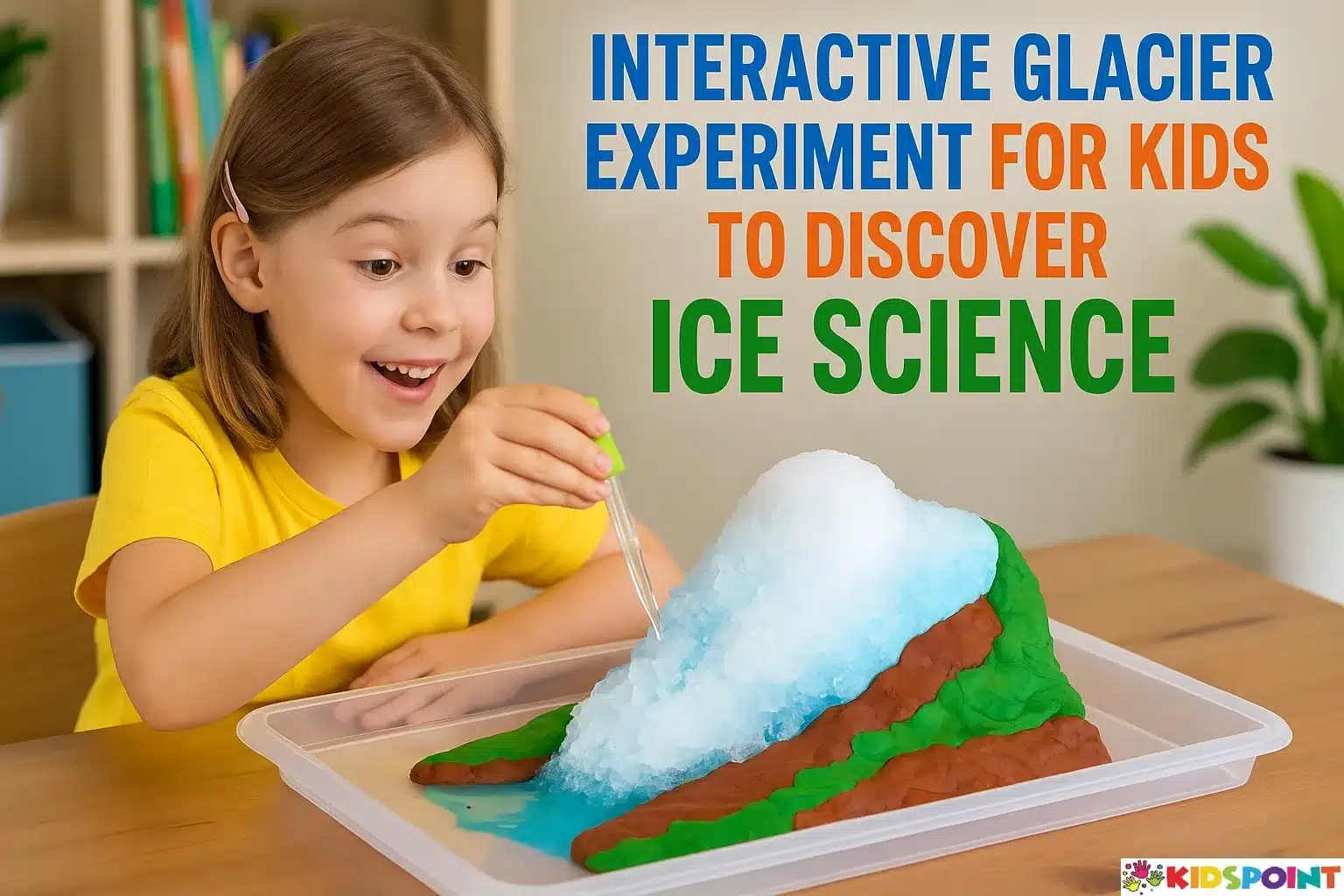
Glaciers are some of the most fascinating natural wonders on Earth. These giant rivers of ice move slowly, shape landscapes, carve valleys, and hold important clues about our planet’s climate history. While kids can’t travel to Antarctica or the Himalayas to see glaciers up close, they can explore how glaciers form, move, melt, and change right at home or in the classroom with hands-on, interactive glacier experiments.
In this comprehensive guide, The Kids Point presents an exciting, kid-friendly approach to learning glacier science through experiments that make learning fun, visual, and meaningful. Whether you’re a parent, teacher, or curious young learner, these activities will help kids understand ice, erosion, climate, and the powerful forces of nature—all through play and discovery.
What Are Glaciers? A Kid-Friendly Explanation
Before beginning any experiment, kids should know what glaciers actually are. A glacier is a massive, slow-moving block of ice that forms over hundreds or thousands of years when layers of snow pile up, compress, and turn into ice. They grow bigger as more snow falls and shrink when ice melts faster than new snow forms.
Key features of glaciers kids should understand:
- They move! Although it seems impossible, glaciers slide like slow rivers due to gravity and pressure.
- They erode land. As they move, glaciers pick up rocks and scrape the Earth’s surface, carving valleys and shaping mountains.
- They hold most of Earth’s fresh water. Over 68% of fresh water is stored in glacial ice.
- They are indicators of climate change. When temperatures rise, glaciers melt more quickly, causing sea-level rise.
Helping kids understand these points sets the foundation for conducting an engaging glacier experiment.
Why Glacier Experiments Are Perfect for Hands-On Learning
Children learn best when they can see, touch, and interact with concepts. Glacier experiments offer:
Visual Learning
Kids actually see how ice moves, melts, and affects surrounding materials.
Sensory Stimulation
Water, ice, pressure, and movement make the experience memorable.
Critical Thinking
Kids predict, observe, and analyze what happens during the experiment.
Scientific Method Practice
They learn steps such as forming hypotheses, gathering data, and drawing conclusions.
Environmental Awareness
These experiments help kids understand why glaciers matter for Earth’s health and future.
This makes glacier science ideal for classroom projects, homeschool activities, or weekend fun.
The Ultimate Interactive Glacier Experiment for Kids
Below is the full step-by-step experiment designed by The Kids Point to help children discover how glaciers form, move, melt, and reshape landscapes.
Create a Mini Glacier That Moves and Erodes
Objective
To help kids understand glacier formation, movement, and erosion.
Materials Needed
- Bowls or small containers
- Water
- Sand or soil
- Small rocks, pebbles, or gravel
- Food coloring (optional, to make the glacier visible)
- Freezer
- Tray or plastic bin
- Sloped surface (a book or box can be used)
Build the Landscape
- Fill a tray or plastic bin with sand or soil.
- Create small hills or sloped land on one side.
- Add rocks to simulate mountains and natural terrain.
- The landscape will act as the valley the glacier moves through.
Make the Glacier Ice
- Fill small containers with water.
- Add gravel, sand, and tiny rocks inside—these will act as the glacier’s “debris.”
- Add blue food coloring if desired.
- Freeze overnight.
This mixture simulates real glaciers filled with rock fragments picked up from the land.
Start the Glacier Movement
- Remove the ice from the freezer and place it on the high side of the sloped tray.
- Allow the ice to slowly slide and melt down the landscape.
- Kids will see the glacier “flow” downward.
As it moves, children will witness erosion—rocks and debris embedded in the ice will scrape the ground and reshape the landscape.
Observe Erosion and Deposition
As the glacier melts:
- Sediments will be pushed forward like real glaciers.
- Meltwater streams will form “glacial rivers.”
- Kids can observe valleys being carved and rocks being moved.
Encourage children to take notes, draw diagrams, and describe what they see.
What Kids Learn From This Experiment
Glacier Movement
Children see that glaciers are not static blocks—they flow slowly due to gravity.
Glacial Erosion
Rocks trapped in the glacier grind against the ground, carving landforms.
Deposition
Melting glaciers drop sediments, forming moraines just like in nature.
How Landforms Are Created
Kids witness valleys, grooves, channels, and ridges created by ice.
This hands-on learning creates deep understanding and curiosity about Earth science.
Glacier Melt and Climate Change Simulation
Objective
To teach kids how temperature affects glacier size and sea levels.
Materials Needed
- Two shallow containers
- Ice blocks of equal size
- Warm water
- Cold water
- Timer
- Paper and pencil for data collection
- Ruler (optional)
Prepare the Ice
Freeze two identical ice blocks.
Set Up the Test
- Place one ice block in cold water.
- Place the other ice block in warm water.
Ask kids: Which one will melt faster?
Observe and Record
Have students time how long each block takes to melt. They may also measure width and height every few minutes.
Compare Results
Kids will notice the glacier in warm water melts much faster—similar to how rising global temperatures speed up glacier melt around the world.
What Kids Learn
- Warm climates cause faster glacier melting.
- Faster melting contributes to sea-level rise.
- Small temperature changes make big environmental impacts.
- Humans must protect the environment to preserve glaciers.
Glacier Creep — The Oozing Ice Demonstration
Objective
To explore how glaciers “creep,” or flow, over time.
Materials
- Cornstarch
- Water
- Mixing bowl
- Tray
- Food coloring (optional)
Create Oobleck
Mix water and cornstarch to create a thick, slow-moving substance.
Add Color
Add a few drops of food coloring for visibility.
Tilt the Tray
Pour the oobleck onto a sloped tray and watch it move slowly like a glacier.
Observe Creep
Kids can see how pressure makes the ooze flow in slow motion—similar to real glacier creep.
What This Demonstrates
- Glaciers can appear solid but still flow.
- Pressure and gravity cause glaciers to ooze and deform.
- Changes in slope affect speed.
This is an excellent experiment for younger kids who enjoy sensory learning.
Extra Hands-On Learning Extensions
To make glacier science even more fun, we recommend adding these activities:
Measuring Meltwater
Have kids collect water in a cup at the bottom of the tray and measure daily.
This teaches volume measurement and data tracking.
Create Glacier Vocabulary Cards
Words to include:
- Glacier
- Erosion
- Sediment
- Moraine
- Valley
- Meltwater
- Ice sheet
- Creep
Kids can illustrate each card for deeper understanding.
Glacier Art Project
Kids can draw or paint:
- U-shaped valleys
- Carved mountains
- Moving glaciers
- Icebergs
Art connects creativity with Earth science.
Story Writing: “A Day in the Life of a Glacier”
Encourage kids to write a short adventure story from a glacier’s perspective. This enhances creativity and reinforces scientific understanding.
Real-World Glacier Facts to Inspire Kids
Here are some incredible glacier facts children will love:
- Some glaciers move only a few centimeters per day, but during surges they can move several meters!
- Glaciers carved famous landmarks like Yosemite Valley and the Great Lakes.
- Greenland’s ice sheet is up to 3,000 meters thick.
- The world’s largest glacier, Lambert Glacier, is over 400 km long.
- When glaciers melt, they often leave behind glacial lakes, which can burst and cause floods.
Sharing these facts before or after the experiment keeps kids excited and engaged.
How These Glacier Experiments Connect to School Subjects
Science
Kids learn chemistry (states of matter), physics (movement and pressure), and Earth science (erosion, climate, water cycle).
Math
Measuring melt rates, tracking data, and comparing results.
Geography
Understanding mountains, valleys, and landforms shaped by glaciers.
Environmental Science
Recognizing the importance of climate and conservation.
Critical Thinking
Making predictions, analyzing cause-and-effect, and drawing conclusions.
This makes glacier experiments ideal for school STEM lessons or at-home learning programs.
Tips for Parents and Teachers
We suggest the following tips to make the experience smoother and more educational:
- Let kids lead. Ask open-ended questions to spark curiosity.
- Record everything. Observations, drawings, and measurements enhance understanding.
- Encourage predictions. Before every step, ask what they think will happen.
- Use videos or images. Show real glacier footage after the experiment.
- Create a science journal. Kids can keep track of their experiments and results.
With encouragement, kids can become little glaciologists in no time!
Why Studying Glaciers Matters Today
Teaching kids about glaciers isn’t just about fun experiments—it’s about helping the next generation understand Earth’s changing climate.
Here’s why glacier education is essential:
- Glaciers provide fresh water for millions of people.
- They reflect sunlight, helping keep Earth cool.
- Melting glaciers cause sea levels to rise, affecting coastal communities.
- Glaciers give scientists clues about past climates through ice cores.
By understanding glaciers early, children become more aware of environmental responsibility.
Common Questions Kids Ask About Glaciers
What is a glacier in simple words?
A glacier is a huge, slow-moving mass of ice formed from compacted snow over many years.
Why do glaciers move?
Glaciers move because gravity pulls them downhill and pressure inside the ice makes them slowly flow.
What do kids learn from glacier experiments?
Kids learn about ice science, erosion, melting, climate change, and how glaciers shape landscapes.
Do glaciers melt faster in warm temperatures?
Yes, glaciers melt much faster when temperatures rise—similar to how ice melts quickly in warm water.
Are glacier experiments safe for kids?
Yes! They use simple materials like ice, sand, and water and are safe with adult supervision.
The world of glaciers is full of wonder, science, and discovery. With simple materials and engaging hands-on experiments, kids can explore how glaciers form, move, melt, and shape the Earth’s surface—right from home or school. Through interactive glacier demonstrations, children gain a deeper understanding of Earth science, climate change, and natural forces.
As part of its mission to promote fun, accessible learning, The Kids Point encourages parents, teachers, and caregivers to make science interactive and enjoyable. These glacier activities not only entertain kids but also teach them valuable lessons about observation, experimentation, and environmental awareness.
Whether your child is a budding scientist or simply curious about nature, this interactive glacier experiment will spark their imagination and inspire a lifelong love of discovery.