

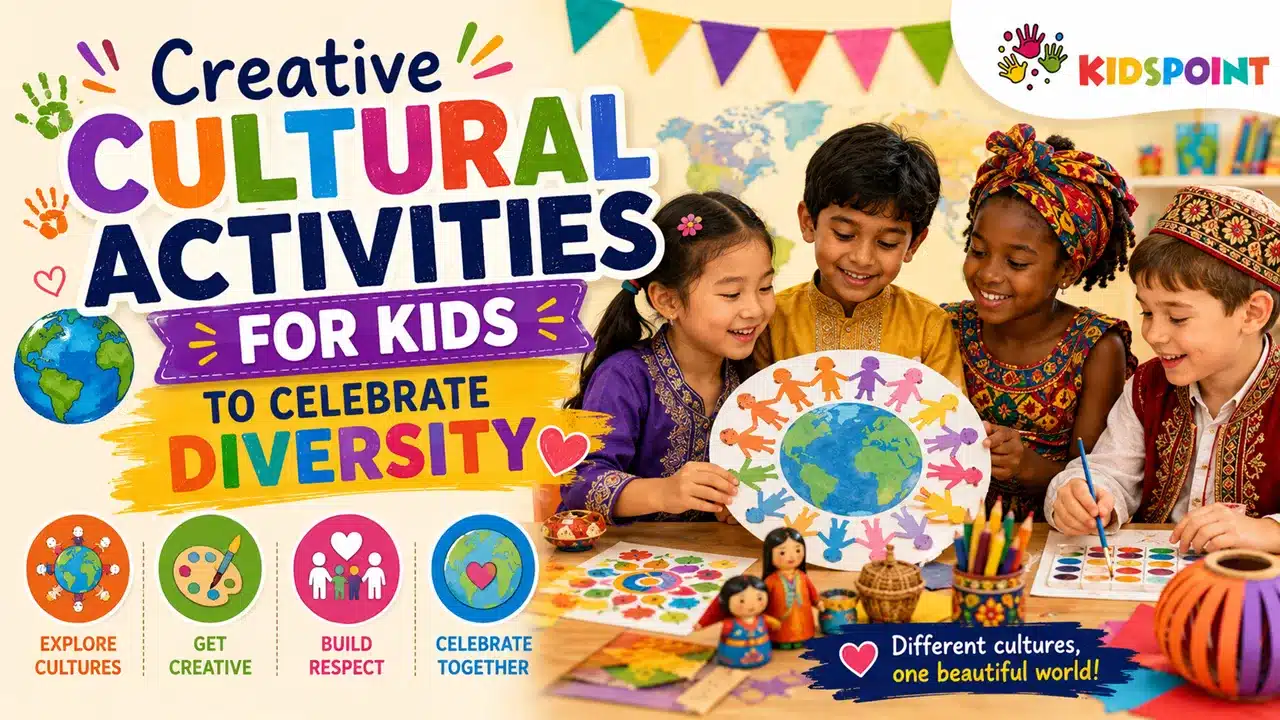
Children live in an increasingly connected world where they meet people with different languages, traditions, foods, celebrations, family structures, clothing, music, art, and stories. Introducing children to these differences in positive and age-appropriate ways can help them become curious, respectful, and open-minded.
Cultural activities for kids offer a fun way to explore diversity through creativity and play. Instead of simply reading about different cultures, children can learn through art projects, music, storytelling, food-related activities, games, crafts, and conversations.
At The Kids Point, we believe every child deserves opportunities to learn about the world around them. Our goal is to provide safe, engaging, informative, and inclusive resources that encourage curiosity, creativity, kindness, and understanding.
Why Are Cultural Activities Important for Kids?
Children naturally notice differences between people. Cultural activities can help them understand that differences are a normal and valuable part of the world.
Age-appropriate cultural learning can help children:
- Develop curiosity about the world
- Learn to appreciate different traditions
- Understand that families may have different customs
- Explore different languages
- Discover music and art from around the world
- Develop respectful communication
- Learn about similarities and differences
- Encourage creativity
- Build a sense of belonging
- Become more comfortable with diversity
The goal is not to teach children that one culture is better than another. Instead, cultural activities can help them understand that people have many different ways of expressing themselves and celebrating important parts of life.
What Makes a Good Cultural Activity for Kids?
A good cultural activity should be engaging, age-appropriate, respectful, and presented in a way that avoids stereotypes.
When planning an activity, consider:
Encourage Curiosity
Give children opportunities to ask questions rather than expecting them to memorize facts.
Focus on Real People and Traditions
Use authentic books, music, artwork, stories, and information whenever possible.
Avoid Stereotypes
A culture is never represented by one costume, food, holiday, or tradition. Encourage children to understand that people within the same culture can have different experiences and preferences.
Find Connections
After exploring something new, ask children what similarities they noticed between their own experiences and what they learned.
Make Participation Optional
Children should be encouraged to explore without feeling pressured to imitate unfamiliar traditions.
15 Creative Cultural Activities for Kids
There are many ways to introduce children to diversity without making learning feel like a formal lesson. Here are some creative activities families and educators can try.
1. Create a Cultural World Map
A large world map can become the starting point for an ongoing cultural exploration project.
Choose a country or region and locate it on the map. Children can then learn a few age-appropriate facts about the place.
They might explore:
- Geography
- Languages
- Animals
- Famous landmarks
- Traditional arts
- Music
- Everyday life
- Children’s stories
Encourage children to add drawings, notes, or symbols to their map.
Learning Benefits
This activity combines geography with cultural learning and helps children understand that communities around the world have their own histories and traditions.
2. Explore Greetings in Different Languages
Learning simple greetings can be an enjoyable introduction to language diversity.
Choose several languages and learn how people commonly greet one another. Children can practice saying the words and discovering how they sound.
You can also discuss why learning someone’s language can be a thoughtful way to show interest and respect.
Avoid turning unfamiliar languages into jokes. The focus should be on curiosity and appreciation.
3. International Story Time
Stories provide a wonderful way for children to explore different perspectives.
Choose age-appropriate children’s books created by authors from different cultural backgrounds.
After reading, ask:
- Who are the characters?
- Where does the story take place?
- What is important to the characters?
- What was similar to something you have experienced?
- What was different?
- What did you learn?
Stories can help children explore culture through the experiences of individual characters rather than relying only on lists of facts.
4. Cultural Music Exploration
Music can introduce children to different rhythms, instruments, languages, and artistic traditions.
Choose age-appropriate music from different parts of the world and invite children to listen carefully.
Ask them:
“What instruments can you hear?”
“Is the rhythm fast or slow?”
“What sounds are new to you?”
Children can draw while listening or create their own simple rhythm using safe household objects.
The goal is listening and appreciation rather than trying to imitate a cultural performance without context.
5. Make a Global Art Gallery
Explore visual art from different cultures and time periods.
Children can look at paintings, patterns, sculptures, textiles, or other forms of art and discuss what they notice.
Then invite them to create their own artwork inspired by a particular artistic idea.
For example, they might explore:
- Color
- Repetition
- Shapes
- Nature
- Storytelling
- Geometric patterns
Explain that creating something inspired by an artistic concept is different from copying sacred or culturally significant designs without understanding their meaning.
6. Family Tradition Interview
Every family has stories and traditions worth exploring.
Ask children to interview a parent, grandparent, caregiver, or another family member about a tradition that is meaningful to them.
Questions might include:
- What traditions did you enjoy as a child?
- What foods were part of special occasions?
- What games did you play?
- What songs or stories do you remember?
- What family traditions are important to you?
Children can write or draw what they learn.
This activity reminds children that culture is not something that exists only in distant countries. Every family can have its own traditions and experiences.
7. Cultural Recipe Exploration
Food is often an important part of family and cultural life.
With adult supervision, children can help prepare an age-appropriate recipe associated with a particular culture.
Younger children might wash ingredients, measure suitable items, or help arrange food. Older children can assist with simple preparation tasks appropriate for their age.
While preparing the food, discuss where the recipe comes from and how food traditions can vary between families.
Be mindful of allergies, dietary needs, and food safety.
8. Learn About Traditional Clothing
Clothing can provide an opportunity to learn about history, climate, identity, celebrations, and artistic traditions.
Rather than turning cultural clothing into a costume, explore photographs, illustrations, books, or museum resources.
Ask:
- What materials are used?
- When might people wear this clothing?
- How does the local climate influence clothing?
- What colors or patterns are common?
- What does the clothing mean to the people who wear it?
This approach helps children understand clothing within its cultural context.
9. Cultural Celebration Calendar
Create a calendar featuring holidays, festivals, observances, and cultural events from different communities.
Children can choose one event at a time to research using age-appropriate resources.
Discuss:
- Where it is observed
- Why it is important
- How families may participate
- What values or traditions are associated with it
Make it clear that not everyone within a cultural or religious community celebrates in exactly the same way.
The purpose is learning, not pretending to participate in traditions that are not one’s own.
10. “Same and Different” Activity
Choose two communities, families, or traditions and look for both similarities and differences.
For example, children might compare how different families celebrate birthdays.
They may discover that one family has a particular food tradition while another has a different one, but both enjoy spending time with people they care about.
This teaches an important lesson:
Differences and similarities can exist at the same time.
11. Cultural Games and Play
Games can offer a fun introduction to how children in different places play.
Choose age-appropriate games with reliable cultural context and explain where they come from.
After playing, discuss:
- How does the game work?
- What skills does it involve?
- Is it played individually or with others?
- How is it similar to games you already know?
Avoid presenting a single game as representative of an entire country or culture.
12. Diversity Collage
Give children magazines, printed images, drawings, or other age-appropriate materials and ask them to create a collage representing people and communities around the world.
The collage might include:
- Languages
- Families
- Foods
- Music
- Art
- Landscapes
- Celebrations
- Everyday activities
Encourage children to include ordinary daily life, not only special festivals.
This helps them understand that culture is part of everyday living.
13. Multilingual Storytelling
Choose a familiar children’s story and explore how the same idea can be expressed in different languages.
Children can learn a few words or phrases connected with the story.
For example, they might learn words for:
- Friend
- Family
- Book
- Sun
- Animal
- Thank you
Emphasize that languages can have different sounds and structures while communicating many of the same human experiences.
14. “A Day in the Life” Research Project
Choose a child-friendly cultural topic and explore what everyday life might look like for children in a particular location.
Focus on ordinary experiences such as:
- School
- Transportation
- Games
- Family meals
- Weather
- Hobbies
- Homes
- Community spaces
Avoid suggesting that every child in a country lives exactly the same way.
The activity should introduce possibilities rather than create stereotypes.
15. Diversity Friendship Garden
Create a paper or classroom garden where every flower represents something that makes people unique.
Children can write or draw:
- A language they know
- A favorite family tradition
- A hobby
- A favorite food
- Something they enjoy learning
- Something they appreciate about another person
Put the flowers together to create a large garden.
The visual message is simple: different flowers can grow together in the same garden.
Cultural Activities for Different Ages
Preschoolers
Young children can explore diversity through:
- Picture books
- Music
- Simple greetings
- Family stories
- Art
- Colors and patterns
- Maps
- Age-appropriate food activities
Keep explanations simple and focus on similarities, kindness, and curiosity.
Early Elementary Children
Children can begin exploring:
- Geography
- Languages
- Cultural stories
- Art
- Music
- Family traditions
- Games
- Celebrations
Encourage them to ask questions and explain what they discovered.
Older Elementary Children
Older children can participate in deeper projects involving:
- Research
- Interviews
- Cultural history
- Geography
- Comparative activities
- Creative presentations
- Multicultural literature
Encourage them to use trustworthy, age-appropriate sources and recognize that individual experiences can differ within the same community.
How Parents Can Talk About Cultural Differences
Children may naturally ask questions about someone’s language, clothing, food, appearance, or traditions.
Instead of telling children not to notice differences, adults can respond calmly and respectfully.
For example:
“Yes, people can have different traditions. Would you like to learn more about it?”
This teaches children that differences are not something to fear or mock.
It is also useful to explain that one person cannot represent an entire culture. People within the same community have different personalities, interests, family traditions, and experiences.
Avoiding Stereotypes in Cultural Learning
Cultural education should help children understand people rather than reduce communities to simple stereotypes.
Avoid activities that suggest:
- Everyone from one country behaves the same way
- One food represents an entire culture
- One traditional outfit represents everyone
- A culture can be explained through a single holiday
- Children should imitate cultural practices without context
Instead, use authentic resources and explain that cultures are diverse and constantly changing.
When possible, learn from people who belong to the culture being discussed.
How Cultural Activities Support Inclusive Learning
Cultural activities can help children understand that there are many ways to live, communicate, celebrate, create, and build relationships.
They can also help children appreciate their own family backgrounds.
Ask children:
“What traditions are important in our family?”
“What makes our family unique?”
“What can we learn from other people?”
These questions encourage children to see diversity as something valuable rather than simply something different.
Creating a Culture-Friendly Learning Environment
Parents and educators can make diversity part of everyday learning rather than limiting it to special occasions.
Consider including:
- Children’s books featuring diverse families
- Maps and globes
- Music from different regions
- Artwork from different cultures
- Stories from international authors
- Multilingual resources
- Discussions about family traditions
The more naturally children encounter diversity, the more comfortable they may become discussing differences respectfully.
The Kids Point: Celebrating Diversity Through Learning
At The Kids Point, we believe every child deserves to see themselves represented and to have opportunities to learn about the experiences of others.
Our team of educators, writers, and parents creates engaging content designed to spark curiosity, creativity, and joy. We prioritize safety, educational quality, inclusivity, and age-appropriate learning.
Cultural activities fit naturally into this mission. Through stories, art, music, games, language, geography, and family traditions, children can discover that the world is filled with different perspectives and experiences.
The goal is not simply to teach children facts about different cultures. It is to encourage them to become curious, respectful learners who appreciate both similarities and differences.
Frequently Asked Questions
What are cultural activities for kids?
Cultural activities for kids are age-appropriate experiences that introduce children to different languages, traditions, art, music, stories, foods, geography, family customs, and perspectives. They can help children explore diversity through creative and educational play.
Why are cultural activities important for children?
Cultural activities can help children develop curiosity, respect, communication skills, and appreciation for differences. They can also help children understand that people may have different traditions and experiences while sharing many common interests and values.
How can I teach my child about different cultures?
Parents can use children’s books, maps, music, art, stories, age-appropriate recipes, language activities, and cultural resources. Encourage children to ask questions and focus on learning about real people and traditions rather than stereotypes.
What cultural activities are good for preschoolers?
Preschoolers can enjoy simple activities such as reading diverse picture books, listening to music, learning basic greetings, exploring maps, creating art, discussing family traditions, and trying age-appropriate food activities with adult supervision.
How can cultural activities teach children about diversity?
Cultural activities allow children to explore different ways people communicate, create, celebrate, eat, play, and live. They can help children understand that differences are a normal and valuable part of human communities.
How can parents avoid cultural stereotypes?
Use authentic, age-appropriate resources and explain that no single food, outfit, holiday, or tradition represents an entire culture. Encourage children to understand that people within every community have different experiences and preferences.
Can food be used to teach kids about culture?
Yes. Food can provide an introduction to family and cultural traditions when approached respectfully. Children can help with age-appropriate preparation under adult supervision while learning about the history or context of a recipe.
How can schools celebrate cultural diversity?
Schools can incorporate diverse books, music, art, geography, stories, classroom discussions, and student or family experiences into everyday learning. Activities should represent cultures respectfully and avoid reducing them to stereotypes.
Discover More Creative Learning Activities at The Kids Point
Looking for more ways to help children explore the world through fun and meaningful activities? Visit The Kids Point for educational games, creative projects, stories, learning resources, and child-friendly activities designed to inspire curiosity and imagination. Explore ideas that help children learn about diversity, creativity, science, math, reading, art, and more while developing important skills through play. Visit The Kids Point today and discover new ways to help children learn, connect, create, and grow!