

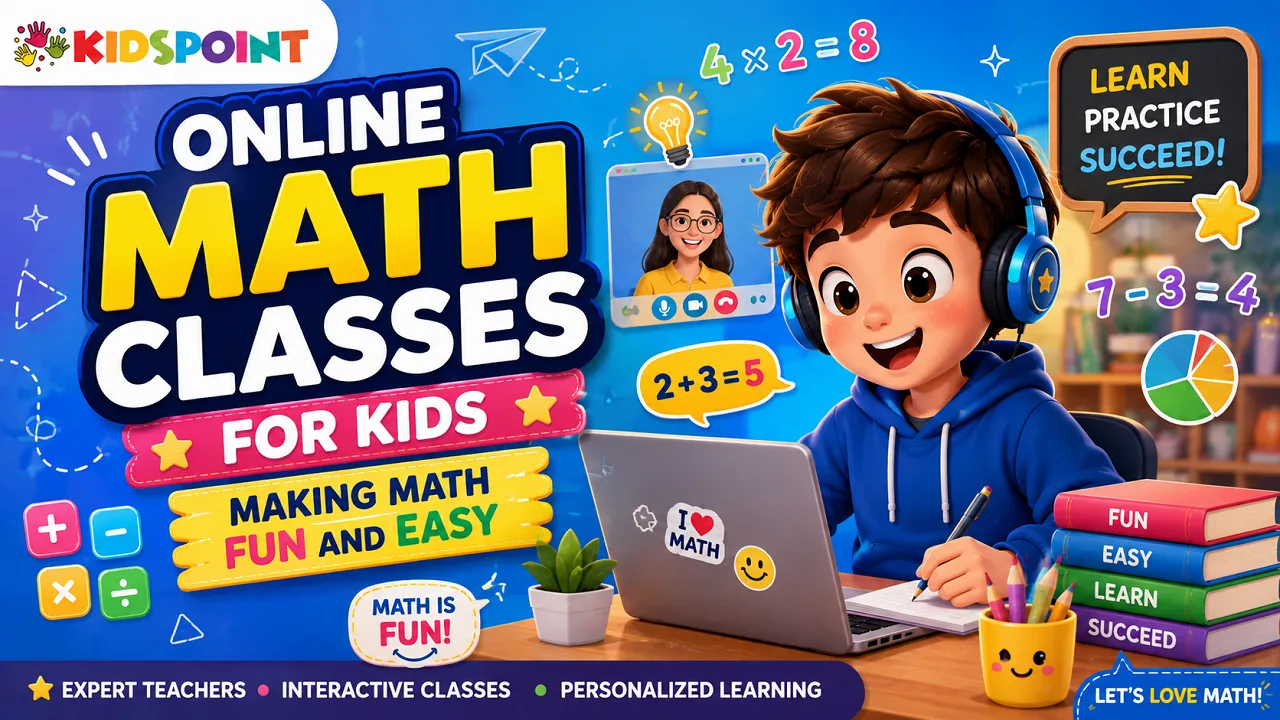
Math is everywhere. Children use it when they count toys, share snacks, compare sizes, tell time, play games, measure ingredients, or save money. Yet for some children, traditional math lessons can feel difficult or intimidating.
Online math classes for kids offer a different way to approach the subject. With interactive activities, visual explanations, games, puzzles, and personalized practice, online learning can help children understand mathematical ideas while keeping them engaged.
The goal is not simply to help children memorize formulas or complete worksheets. Good math education should help children understand why something works, develop confidence, and learn how to approach unfamiliar problems.
At The Kids Point, we believe children learn best when education feels interesting and meaningful. Online math classes can turn challenging concepts into opportunities to explore, experiment, and discover.
What Are Online Math Classes for Kids?
Online math classes are educational lessons delivered through the internet using computers, tablets, or other compatible devices.
Depending on the program, children may learn through live classes with teachers, recorded lessons, interactive exercises, educational games, quizzes, virtual manipulatives, or guided projects.
Some programs focus on a particular grade level, while others allow children to work at their own pace.
A good online math experience should match the child’s current ability rather than making every learner follow exactly the same path.
For example, one child may need additional practice with multiplication, while another may already be ready for fractions or introductory geometry.
Why Online Math Learning Can Be Helpful
One of the biggest advantages of online math education is flexibility.
Children can often learn from home without traveling to a classroom. Families may be able to choose learning schedules that fit around school, activities, and family routines.
Online platforms can also provide immediate feedback. When children answer a question, they may quickly discover whether their solution worked.
This allows them to correct mistakes and try again while the concept is still fresh.
Visual learning can also make abstract mathematical ideas easier to understand. Instead of simply seeing numbers on a page, children might use shapes, animations, number lines, or virtual objects to understand what those numbers represent.
Online Math Classes Can Make Learning Interactive
Children often become more interested when they can participate rather than simply listen.
Interactive math lessons might ask children to move objects, solve puzzles, answer questions, complete patterns, or make decisions.
For example, instead of explaining fractions only through written numbers, an online activity might show a pizza divided into equal pieces.
The child can see how two-fourths relates to one-half.
Visual experiences like this can help children connect mathematical symbols with real ideas.
Math Games Can Reduce Learning Anxiety
Some children become nervous when they see a page full of math problems.
Games can provide a more relaxed way to practice.
A child might solve addition problems to help a character complete a challenge or answer multiplication questions to unlock the next level.
The mathematics remains important, but the surrounding activity gives children another reason to stay engaged.
This can help transform practice from something that feels repetitive into something that feels like a challenge.
Personalized Learning Can Help Children Progress
Children do not all learn mathematics at the same speed.
One learner may quickly understand multiplication but struggle with fractions.
Another child may need additional practice with place value but understand geometry easily.
Online platforms can sometimes provide different levels of difficulty, allowing children to spend more time on concepts they find challenging.
Personalized learning can also prevent children from becoming bored when a particular concept is already easy for them.
The key is to use personalization as a tool for support rather than pressure.
Building Strong Math Foundations
Strong foundational skills are important because many mathematical concepts build on earlier knowledge.
Young children can begin with counting, number recognition, shapes, patterns, sorting, and simple comparisons.
As they progress, they may explore addition, subtraction, multiplication, division, measurement, fractions, geometry, decimals, and problem-solving.
Online classes can reinforce these foundations through repeated practice and different types of activities.
However, children should not feel pressured to rush through concepts.
Understanding is more valuable than simply moving to the next lesson.
Making Math Fun With Everyday Examples
Math does not have to stay on a screen.
Parents can connect online lessons with everyday experiences.
- If a child is learning addition, ask them to count fruit in the kitchen.
- If they are learning measurement, let them measure ingredients while cooking.
- If they are studying shapes, ask them to identify shapes around the house.
- If they are learning money, let them practice calculating the cost of a few items during pretend shopping.
These connections help children see that mathematics is not just a school subject. It is a practical skill they use every day.
Online Math for Younger Children
- Younger learners often benefit from visual and playful activities.
- Counting games can introduce numbers.
- Sorting activities can develop early mathematical thinking.
- Pattern games can help children recognize relationships.
- Shape activities can introduce geometry.
- Simple puzzles can encourage logical thinking.
- At this age, learning should feel playful rather than overly formal.
- Parents can also use toys, blocks, buttons, or household objects to reinforce online lessons offline.
For example, after a lesson about counting, children can count their toy cars or stuffed animals.
Online Math for Elementary Students
Elementary-age children can explore a wider range of mathematical ideas.
They may work on addition, subtraction, multiplication, division, fractions, decimals, measurement, geometry, and word problems.
Interactive practice can be particularly useful because children can see how different mathematical concepts connect.
A multiplication game, for example, can help reinforce number facts while also developing speed and confidence.
But children should also understand the reasoning behind the calculations.
Encourage them to explain how they found an answer instead of focusing only on whether the answer is correct.
Online Math for Older Kids
Older students may begin working with more advanced concepts such as ratios, percentages, algebra, geometry, statistics, and more complex problem-solving.
At this stage, online classes can provide additional practice and explanations when classroom material feels challenging.
They can also allow students to explore topics beyond their regular lessons when they are ready for greater challenges.
Older learners may benefit from programs that include real-world applications.
For example, percentages can be connected with discounts and budgeting.
Geometry can be connected with architecture and design.
Statistics can be connected with sports or surveys.
Algebra can be connected with patterns and everyday problem-solving.
The Importance of a Good Online Math Teacher
Technology can support learning, but teachers remain extremely valuable.
A skilled math teacher can explain an idea in different ways, recognize when a child is confused, and provide encouragement when a problem feels difficult.
Live online classes can also give children opportunities to ask questions and interact with instructors.
When choosing an online class, parents should consider the teaching style, class size, lesson structure, student interaction, and opportunities for feedback.
A supportive learning environment can make a significant difference in a child’s confidence.
Keep Online Math Sessions Short and Focused
Children may struggle to stay focused during long online lessons.
The ideal session length can vary depending on age, learning needs, and the type of activity.
Short, focused learning sessions can often be easier for younger children.
Breaks are also important.
A child might complete a math activity, stand up, stretch, drink some water, and then return to another task.
The goal is to make learning sustainable rather than exhausting.
Encourage Children to Explain Their Thinking
One of the best ways to understand whether a child really understands math is to ask them to explain their reasoning.
Instead of asking only:
“What is the answer?”
try asking:
“How did you figure that out?”
or
“Why do you think that answer is correct?”
A child may discover that they made a mistake while explaining their process.
That is not a problem.
It is an opportunity to identify where their thinking changed and try again.
Mistakes Are Part of Learning Math
Children sometimes believe that getting an answer wrong means they are bad at math.
Parents and teachers can help change this mindset.
A mistake can show exactly which part of a problem needs more attention.
If a child makes an error with fractions, for example, they may simply need another explanation or a visual representation.
Encourage children to treat mistakes as clues.
This can help them develop persistence and confidence.
Combine Online Classes With Offline Activities
Online math lessons do not have to be the only learning experience.
Parents can provide simple offline activities that reinforce what children are learning.
- A child studying measurement can measure furniture around the room.
- Someone practicing fractions can divide a snack into equal portions.
- A child learning geometry can search for different shapes around the house.
- A student working on percentages can calculate discounts while shopping.
These activities make mathematics tangible.
Use Math Puzzles to Build Problem-Solving Skills
Math is not only about calculations.
Puzzles can help children develop reasoning and strategic thinking.
Sudoku-style activities, number patterns, logic puzzles, riddles, and strategy games can encourage children to look for relationships and test possible solutions.
These activities can complement formal math lessons by showing children that mathematical thinking can be creative.
Let Children Learn at Their Own Pace
Children sometimes need more time than expected to understand a concept.
Allowing them to review a lesson or practice a skill again can be helpful.
At the same time, children who understand a concept quickly should have opportunities to explore something more challenging.
The goal is not for every child to progress at exactly the same speed.
A supportive learning environment gives children room to build understanding gradually.
How Parents Can Support Online Math Learning
Parents do not need to be math experts to help.
They can create a quiet learning space, make sure children have the necessary materials, and encourage regular practice.
Parents can also ask children about their lessons.
- “What did you learn today?”
- “Which activity did you enjoy?”
- “Was anything confusing?”
These simple conversations show children that their learning matters.
When a child struggles, parents can provide encouragement rather than immediately giving the answer.
Sometimes the best support is simply saying:
“Let’s figure it out together.”
Create a Positive Math Environment at Home
Children notice how adults talk about mathematics.
If parents frequently say that they were “never good at math,” children may begin to develop similar beliefs.
Instead, try to present math as something that can be learned through practice.
Celebrate effort.
Celebrate improvement.
Celebrate curiosity.
A child who once struggled with multiplication but can now solve several problems independently has made meaningful progress.
That progress deserves recognition.
Online Math and Screen-Time Balance
Online classes can be useful, but children still need a balanced routine.
Learning should be combined with physical activity, outdoor play, reading, creative hobbies, family interaction, and rest.
Parents can also encourage children to step away from the screen between activities.
Whenever possible, connect digital learning with hands-on experiences.
This gives children opportunities to use mathematics in different ways.
Choosing the Right Online Math Class
Before enrolling in an online math class, consider whether the program matches the child’s age and current ability.
Look at the lesson format and determine whether the child prefers live instruction, recorded lessons, interactive practice, or a combination.
Consider whether children can ask questions and receive feedback.
It is also useful to check whether the program provides practice activities and progress information.
Most importantly, consider your child’s personality.
A highly social learner may enjoy a live class.
An independent learner might prefer self-paced lessons.
A child who loves games may respond especially well to interactive learning.
Make Math a Journey, Not a Chore
Children do not need to love every math lesson.
What matters is helping them develop confidence and curiosity.
Online classes can provide useful tools, but parents and teachers play an important role in creating a positive learning environment.
When children understand that mistakes are normal, questions are welcome, and improvement takes time, mathematics can become less intimidating.
With the right combination of technology, encouragement, practice, and real-world activities, children can discover that math is not simply about finding answers.
It is about thinking, exploring, and solving problems.
Make Learning Fun With The Kids Point
At The Kids Point, we believe every child deserves learning experiences that inspire curiosity and creativity.
Online math classes can be one part of that journey. Whether children are practicing basic numbers, exploring geometry, solving puzzles, or discovering more advanced concepts, learning becomes more meaningful when children are encouraged to ask questions and make connections.
Our goal is to provide parents and educators with engaging ideas that make learning enjoyable both inside and outside the classroom.
Ready to Make Math More Fun?
Encourage your child to explore math through games, puzzles, online lessons, everyday activities, and creative challenges. Start with concepts that match their current ability and celebrate progress along the way.
For more educational activities, learning games, creative ideas, science resources, and kid-friendly content, join The Kids Point community.
Together, let’s help children discover the fun in learning and build confidence one idea at a time.
Frequently Asked Questions
What are online math classes for kids?
Online math classes are lessons delivered through the internet that help children learn mathematical concepts using live instruction, recorded lessons, interactive activities, games, quizzes, and guided practice.
Are online math classes good for children?
They can be useful when the program is age-appropriate, engaging, and suited to the child’s learning needs. Interactive lessons and personalized practice can help children strengthen mathematical understanding and confidence.
What age can kids start online math classes?
Children can begin age-appropriate online math activities when they are ready. Younger children may focus on counting, numbers, shapes, and patterns, while older students can explore more advanced mathematics.
How can I make online math fun for my child?
Choose interactive activities, math games, puzzles, and real-world challenges. Connecting online lessons with cooking, shopping, measuring, building, or outdoor activities can also make math more meaningful.
How long should an online math class be?
The ideal length depends on the child’s age, attention span, learning needs, and class format. Younger children often benefit from shorter sessions and regular breaks.
Can online math classes replace school math lessons?
Online classes are generally best viewed as a supplement or alternative learning option depending on the educational setting and program. Children can benefit from combining online instruction with classroom learning and hands-on practice.
What should parents look for in an online math program?
Parents should consider the child’s age and skill level, teaching style, class size, interactive features, practice opportunities, feedback, schedule, privacy settings, and overall learning experience.
How can parents help children who struggle with math?
Parents can encourage children, ask them to explain their thinking, provide additional practice, connect math to everyday activities, and remind them that mistakes are a normal part of learning.
Welcome to The Kids Point!
At The Kids Point, we are dedicated to creating a world of wonder, learning, and fun for children of all ages. Our mission is to provide engaging, informative, and entertaining content that sparks curiosity, creativity, and joy in young minds.
We are a team of passionate educators, writers, and parents who understand the importance of quality content for children. From captivating stories and exciting activities to educational articles and interactive games, The Kids Point offers resources designed to inspire and educate.
Our content is carefully created to be age-appropriate, safe, educational, creative, and inclusive. We believe every child deserves opportunities to explore, learn, imagine, and grow.
Whether you are a parent, educator, or simply someone who loves great content for kids, we invite you to join our community. Together, let’s make learning fun and inspiring for children everywhere.