

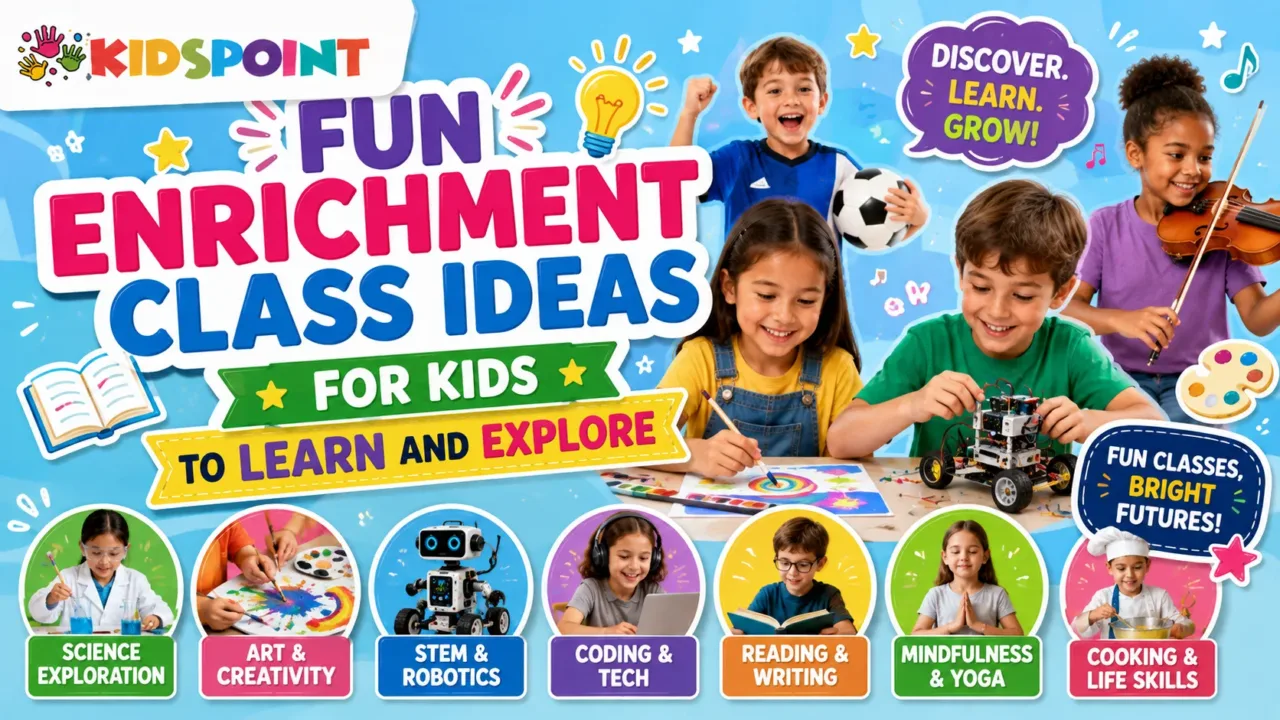
Children are naturally curious. They want to know how things work, create new things, ask questions, solve problems, and explore the world around them. While traditional school subjects provide an important foundation, enrichment classes for kids can give children additional opportunities to discover interests that may not always fit into a regular classroom schedule.
From art and coding to cooking, science, music, sports, and creative writing, enrichment classes can turn learning into an exciting experience. They can also help children discover talents, develop confidence, practice teamwork, and build skills that they can use in school and everyday life.
The best enrichment activities don’t feel like extra homework. Instead, they give children the freedom to learn by doing, experimenting, creating, and having fun.
At The Kids Point, we believe learning should inspire curiosity and imagination. In this guide, you’ll find a variety of fun enrichment class ideas for kids that parents, teachers, community groups, and educators can adapt for different ages and interests.
What Are Enrichment Classes for Kids?
Enrichment classes are activities or learning experiences that go beyond a child’s regular school curriculum.
They can focus on academic subjects, creative interests, practical skills, physical activities, technology, or social development.
For example, a child who loves building things might enjoy a robotics class. A child who enjoys storytelling might love creative writing or drama. Someone fascinated by nature could explore gardening or environmental science.
Enrichment classes don’t have to be highly structured or expensive. A library workshop, community program, school club, weekend activity, or small group project can all provide meaningful enrichment.
The goal is to give children opportunities to learn something new while enjoying the process.
1. Art and Creative Drawing Classes
Art classes are a wonderful way for children to express themselves.
Kids can experiment with drawing, painting, collage, clay, printmaking, paper crafts, and other creative techniques.
A class could begin with a simple theme such as “My Dream House” or “Under the Sea.” Children can then create their own artwork without having to make every project look the same.
Art enrichment can encourage imagination, patience, observation, and creative problem-solving.
For younger children, simple activities such as finger painting, coloring, and paper crafts work well. Older children can explore sketching, watercolor, digital art, or mixed-media projects.
2. STEM and Science Discovery Classes
Science becomes much more exciting when children can experiment instead of simply reading about concepts.
A science enrichment class could include safe, age-appropriate activities involving magnets, plants, weather, light, sound, simple machines, water, or the environment.
Children might build a paper bridge, observe plant growth, create a simple weather journal, or investigate which objects float and sink.
The focus should be on asking questions and discovering answers.
Instead of telling children what will happen, instructors can ask:
- “What do you think will happen?”
- “Why do you think that happened?”
- “What could we change?”
These questions encourage children to think like young scientists.
3. Coding and Computer Classes
Coding is another excellent enrichment opportunity for children.
Younger kids can begin with visual block-based programming, while older students can gradually explore text-based programming languages.
A coding class might involve creating a simple animation, designing a game, solving a digital puzzle, or building an interactive story.
Coding can help children develop logical thinking, sequencing, creativity, and persistence.
It also teaches an important lesson: mistakes are part of the process.
When a program doesn’t work, children learn to investigate the problem and try again.
4. Robotics Classes
Robotics combines technology, engineering, creativity, and problem-solving.
Children can build simple robots using age-appropriate kits and then experiment with movement, sensors, or commands.
A fun challenge might be:
“Can you build a robot that can move from one side of the room to the other?”
Another project could challenge children to design a robot that moves objects or follows a simple path.
Robotics is especially useful for kids who enjoy building, experimenting, and figuring out how things work.
5. Cooking and Baking Classes
Cooking classes can teach practical skills while introducing children to math, science, nutrition, and creativity.
Kids can learn how to measure ingredients, follow directions, understand kitchen safety, and create simple recipes.
Younger children might decorate fruit skewers or assemble sandwiches.
Older children could learn to prepare simple meals, bake bread, or explore recipes from different cultures.
Cooking also provides natural opportunities to practice fractions and measurements.
For example, children can explore questions such as:
“How many half-cups make one cup?”
Learning becomes more meaningful when children can use mathematical ideas in a real activity.
6. Creative Writing Classes
Children who love stories may enjoy creative writing enrichment.
A class can encourage kids to invent characters, create imaginary worlds, write short stories, or develop comic strips.
Teachers can provide fun prompts such as:
“You wake up and discover that your pet can talk.”
Or:
“A mysterious door appears in your backyard.”
Children can develop stories individually or collaborate in small groups.
Creative writing can support vocabulary, communication, imagination, organization, and confidence.
It also reminds children that there isn’t always one correct answer.
7. Drama and Theater Classes
Drama gives children an opportunity to explore storytelling through movement, voice, character development, and performance.
Kids can act out familiar stories, create short plays, practice improvisation, or invent their own characters.
Drama can be especially helpful for children who enjoy performing, but it can also help quieter kids gradually become more comfortable expressing themselves.
Activities don’t always have to involve performing in front of a large audience. Small-group role-playing can be a gentle way to begin.
8. Music and Instrument Classes
Music enrichment can introduce children to rhythm, melody, instruments, and creative expression.
Depending on age and interest, children might explore singing, keyboard, guitar, percussion, violin, or simple classroom instruments.
A beginner music class could include clapping rhythms, identifying sounds, learning simple songs, and experimenting with instruments.
The goal doesn’t have to be immediate performance.
For many children, simply discovering how music works can be an exciting learning experience.
9. Dance and Movement Classes
Dance combines physical activity with creativity.
Children can explore ballet, hip-hop, modern dance, cultural dances, creative movement, or freestyle activities.
Dance classes can encourage coordination, balance, rhythm, body awareness, and self-expression.
For younger children, instructors can turn movement into imaginative games.
For example:
- “Move like a butterfly.”
- “Pretend you’re walking on the moon.”
- “Create a dance that looks like falling leaves.”
These activities make movement playful rather than intimidating.
10. Nature and Gardening Classes
Children spend much of their time surrounded by technology, so nature-based enrichment can provide a refreshing change.
Gardening classes can teach children about plants, soil, insects, weather, and responsibility.
Kids might plant seeds, maintain a small garden, observe insects, or keep a plant growth journal.
Nature classes can also include bird watching, outdoor scavenger hunts, leaf identification, or simple environmental projects.
These experiences help children understand that science isn’t limited to textbooks or laboratories.
Sometimes the best classroom is right outside.
11. Photography Classes for Kids
Photography can teach children to observe the world differently.
A beginner class could challenge children to take photographs based on themes such as:
- Something colorful
- A funny shape
- Something tiny
- A beautiful outdoor scene
- Something that tells a story
Kids can learn about composition, perspective, light, and visual storytelling.
Even simple cameras or supervised devices can be used for beginner activities.
12. LEGO and Building Classes
Building activities are excellent for children who love creating things with their hands.
A LEGO-style enrichment class can challenge kids to build bridges, vehicles, towers, houses, animals, or imaginary inventions.
Give children a problem rather than a specific model to copy.
For example:
“Build a bridge strong enough to hold five books.”
Children can test their designs, identify weaknesses, and make improvements.
This encourages engineering thinking and persistence.
13. Chess and Strategy Games
Chess and other strategy games can provide opportunities to practice planning and decision-making.
Children learn to think ahead, consider different possibilities, and respond to changing situations.
For younger children, instructors can introduce simplified games before moving toward more complicated strategies.
Other options include checkers, logic puzzles, matching games, and age-appropriate board games.
The emphasis should be on learning and enjoying the challenge rather than winning every game.
14. Public Speaking and Communication Classes
Public speaking enrichment can help children become more comfortable expressing their ideas.
Activities might include short presentations, storytelling, show-and-tell sessions, debates, or group discussions.
A teacher could give each child one minute to talk about something they love.
Over time, children can learn how to organize ideas, speak clearly, listen to others, and answer questions.
These skills can benefit children both inside and outside the classroom.
15. Foreign Language and Culture Classes
Language enrichment can introduce children to new words, sounds, traditions, foods, stories, and cultural experiences.
For younger children, language classes can focus on songs, games, greetings, colors, numbers, and simple phrases.
Older children can explore conversation and reading.
Adding cultural activities can make language learning more meaningful.
For example, children might learn a few words and then create a craft, story, or simple food-related activity connected to the culture being studied.
16. Creative Makerspace Classes
A makerspace-style class gives children the freedom to invent.
Projects can include cardboard construction, recycled-material sculptures, simple machines, crafts, building challenges, and creative inventions.
Give kids materials and a challenge, then let them decide how to solve it.
For example:
“Can you create something that moves without using a battery?”
There may be many possible solutions, making this a great opportunity for creativity and problem-solving.
17. Outdoor Adventure Classes
Outdoor enrichment can combine learning, movement, and exploration.
Activities could include nature walks, scavenger hunts, map-reading games, outdoor art, basic observation challenges, and team-building activities.
Children can learn about their environment while developing physical confidence.
Outdoor classes also provide an opportunity to step away from screens and experience hands-on learning.
Always choose activities appropriate for children’s ages and abilities, and make safety a priority.
18. Money and Life Skills Classes
Children can benefit from learning practical skills that aren’t always covered extensively in school.
A life-skills enrichment class could introduce age-appropriate concepts such as saving, spending, budgeting, organizing, planning, and making responsible choices.
Younger children can use pretend money in simple activities.
Older children might create a mock budget for a fictional event or plan how to save for a particular goal.
These activities help connect math to everyday decisions.
19. Photography, Film, and Video Storytelling
Older children may enjoy learning how stories can be told through video.
A beginner class could teach basic concepts such as storyboarding, camera angles, dialogue, and editing.
Children could work in teams to create a short fictional commercial, mini-documentary, or silent movie.
This combines creativity, communication, technology, and teamwork.
Parents and educators should ensure that children’s privacy and safety are protected when creating or sharing digital content.
20. Community Service and Kindness Projects
Enrichment doesn’t have to focus only on academic or artistic skills.
Children can also learn through kindness and community projects.
Depending on age and local opportunities, children might create thank-you cards, organize a book collection, make appreciation posters, or participate in supervised community activities.
These projects can encourage empathy, responsibility, teamwork, and awareness of other people’s needs.
How to Choose the Right Enrichment Class
With so many options available, choosing an enrichment class can feel overwhelming.
Start with the child’s interests.
Ask:
- What does your child naturally enjoy?
- What activities make them curious?
- Do they prefer creating, moving, building, performing, or solving problems?
- Would they rather work independently or with a group?
It’s also important to consider the child’s age, schedule, learning style, and comfort level.
An enrichment class should challenge children without making them feel overwhelmed.
If possible, try a short workshop or trial class before committing to a longer program.
Make Enrichment Learning Fun at Home
Enrichment doesn’t have to happen in a formal classroom.
Parents can create mini enrichment experiences at home.
Set up an art station, conduct a science experiment, plant a small garden, build a cardboard invention, cook a simple recipe, write a family story, or organize a backyard scavenger hunt.
The most important ingredient is curiosity.
Instead of immediately giving children the answer, ask questions and let them investigate.
- “What do you think will happen?”
- “How could we change it?”
- “What would you build differently?”
These questions can turn ordinary activities into meaningful learning experiences.
Final Thoughts
The best enrichment class ideas for kids aren’t necessarily the most complicated or expensive. They are activities that encourage children to explore, create, ask questions, solve problems, and discover what they enjoy.
Art can inspire imagination. Science can encourage curiosity. Coding can develop logical thinking. Cooking can build practical skills. Sports can encourage teamwork. Drama can develop confidence. Gardening can connect children with nature.
Every child is different, so the ideal enrichment activity will depend on their interests, age, personality, and learning goals.
Give children opportunities to try different things, and don’t worry if they don’t love every activity. Exploring different interests is part of discovering who they are.
Ready to Inspire Your Child’s Next Adventure?
Choose one activity from this list and turn it into a fun learning experience this week. Whether it’s building a robot, planting seeds, creating artwork, writing a story, learning a new language, or solving a strategy puzzle, give your child room to experiment and make the activity their own.
At The Kids Point, we are passionate about creating opportunities for children to learn, explore, imagine, and grow. Explore more activities, educational ideas, games, crafts, science projects, and family-friendly resources, and join our community for more inspiration.
Frequently Asked Questions
What are enrichment classes for kids?
Enrichment classes are learning experiences that extend beyond a child’s regular school curriculum. They can include art, science, coding, music, sports, cooking, writing, technology, languages, and many other subjects.
What is the best enrichment class for a child?
The best class depends on the child’s interests, age, personality, and learning goals. A child who loves technology may enjoy coding or robotics, while a creative child might prefer art, writing, or drama.
Do enrichment classes have to be academic?
No. Enrichment can include academic subjects as well as creative arts, sports, life skills, technology, nature activities, and social experiences.
Can enrichment activities be done at home?
Absolutely. Parents can create enrichment experiences through crafts, science experiments, cooking, gardening, building challenges, reading projects, and outdoor exploration.
How do enrichment classes benefit children?
They can help children develop creativity, problem-solving, communication, confidence, teamwork, curiosity, practical skills, and new interests.
How often should kids attend enrichment classes?
There is no universal schedule. Parents should consider the child’s age, school workload, interests, family schedule, and need for free play and rest.
Are enrichment classes suitable for all ages?
Yes, but activities should be adapted to children’s developmental stages. A coding, art, science, or cooking activity for a preschooler will look different from one designed for a teenager.
How can parents choose a good enrichment program?
Look for age-appropriate activities, qualified instructors, safe environments, reasonable class sizes, clear learning goals, and opportunities for children to participate actively rather than simply listen.
Welcome to The Kids Point!
At The Kids Point, we are dedicated to creating a world of wonder, learning, and fun for children of all ages. Our team of passionate educators, writers, and parents creates engaging stories, activities, educational resources, and interactive experiences designed to spark curiosity and creativity.
We believe every child deserves opportunities to explore their interests, discover new abilities, and learn in ways that feel exciting and meaningful. That’s why our content focuses on safety, educational excellence, creativity, imagination, and inclusivity.
Whether you’re a parent, educator, or someone who loves creating memorable experiences for children, we invite you to join our community. Together, let’s make learning fun, inspiring, and full of discovery!