

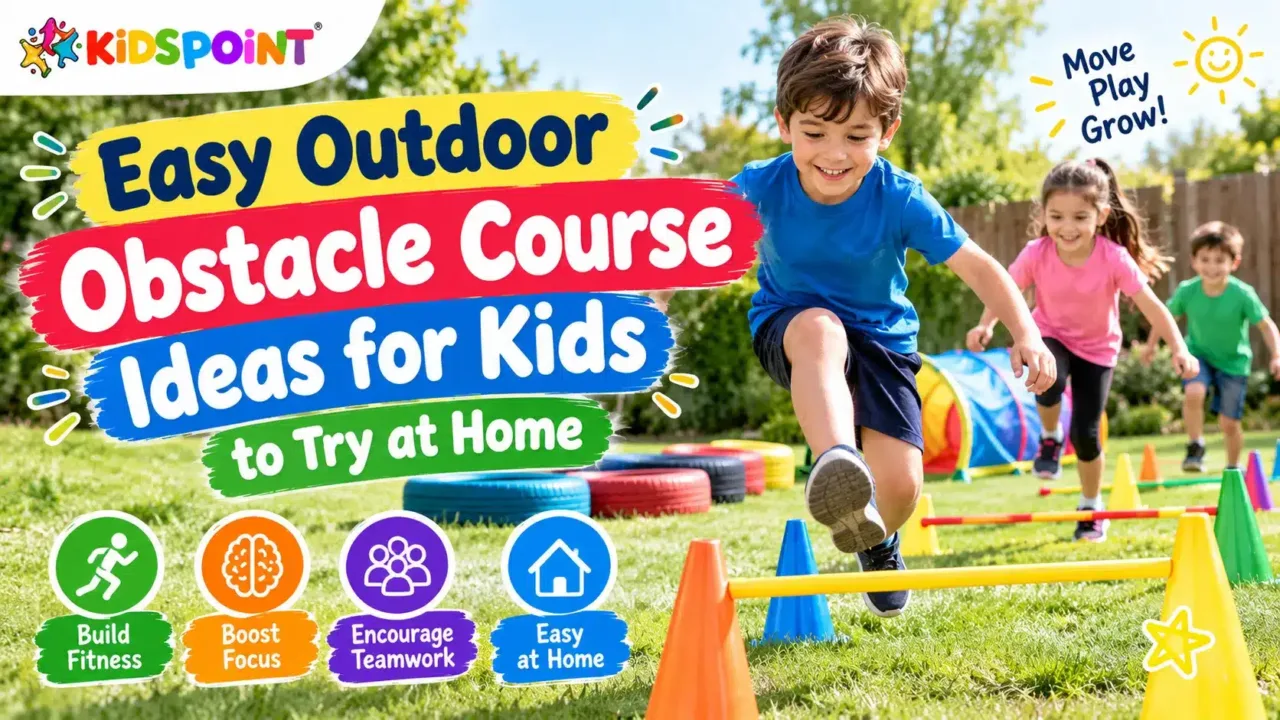
Getting children outside and moving can sometimes be a challenge, especially when they have plenty of indoor entertainment available. A simple outdoor obstacle course for kids can turn an ordinary backyard, garden, playground area, or safe outdoor space into an exciting adventure.
The best part? You don’t need expensive equipment to create one.
With items such as cardboard boxes, cushions, cones, jump ropes, plastic cups, pool noodles, and even chalk, parents can create fun challenges that encourage children to run, jump, balance, crawl, throw, and think creatively.
Outdoor obstacle courses are also easy to customize. You can make a short course for younger children or create a longer challenge for older kids. You can change the activities whenever children want something new, making an obstacle course a fun activity that can be enjoyed again and again.
At The Kids Point, we believe children learn and grow through active exploration, creativity, and play. In this guide, you’ll find simple outdoor obstacle course ideas that parents can set up at home using everyday materials.
Why Are Obstacle Courses Good for Kids?
Obstacle courses are more than just a fun way to spend an afternoon.
When children move through different challenges, they can practice a variety of physical and thinking skills.
Depending on the activities included, an obstacle course can encourage:
- Balance
- Coordination
- Agility
- Strength
- Body awareness
- Spatial awareness
- Following directions
- Problem-solving
- Confidence
- Creativity
- Patience
- Turn-taking
Children can also learn how to manage challenges. They may not complete an obstacle on the first attempt, but trying again can teach persistence and encourage a positive attitude toward mistakes.
The course doesn’t need to be competitive. For many children, simply completing a challenge can be rewarding.
How to Create a Simple Outdoor Obstacle Course
Before setting up the course, choose a safe area with enough space for children to move comfortably.
A flat section of grass or another suitable surface can work well. Remove objects that could cause trips or falls, and make sure children have enough room between obstacles.
Then decide how many stations you want.
For younger children, start with three to five simple challenges. Older children may enjoy eight or more stations.
A basic course could look like this:
Start → Jump → Crawl → Balance → Throw → Run → Finish
You can create your own route based on the space and materials available.
1. Chalk Jumping Path
Sidewalk chalk is one of the easiest ways to create an obstacle course.
Draw circles, squares, arrows, or footprints on the ground.
Children can follow the path by:
- Jumping from circle to circle
- Hopping on one foot
- Jumping with both feet
- Following colored shapes
- Moving backward carefully
- Copying different movement patterns
For younger children, make the spaces close together. For older children, create larger gaps or add movement rules.
You can even turn the path into a pretend river and tell children they must jump from “rock” to “rock” without stepping in the water.
2. Pool Noodle Tunnel
If you have pool noodles, they can become part of a fun crawling challenge.
Create a low tunnel by placing pool noodles in a safe arrangement or use them as boundaries for a crawling lane.
Children can crawl underneath or move through the designated area.
For younger children, keep the tunnel wide and easy to navigate. Avoid creating a structure that could collapse onto a child.
The goal should be movement and fun—not making the obstacle unnecessarily difficult.
3. Cardboard Box Crawl
Large cardboard boxes can make excellent pretend tunnels.
Open both ends of a sturdy, clean box and place it securely on the ground.
Children can crawl through it before moving to the next obstacle.
You can decorate the box together beforehand.
Turn it into:
- A rocket
- A train
- A cave
- A submarine
- A spaceship
- A jungle tunnel
This adds a creative storytelling element to the physical activity.
Make sure the cardboard is stable and free from sharp edges, staples, or other hazards.
4. Cup Slalom
Plastic cups can become simple markers for a zigzag running course.
Place the cups with plenty of space between them and ask children to weave around them without knocking them over.
You can change the movement:
- Walk around the cups
- Jog around them
- Side-step
- Skip
- Carry a soft object while moving
This activity can encourage coordination and body control.
Use lightweight, unbreakable cups rather than glass or other fragile objects.
5. Jump-Over the Line
Create several lines on the ground using chalk or a jump rope.
Children can jump over each line as they move through the course.
For an additional challenge, vary the distance between lines.
You can also call out instructions:
“Jump!”
“Hop!”
“Two feet!”
“Turn around!”
This transforms a basic jumping activity into a listening and movement game.
6. Balance Beam Challenge
You don’t need a raised beam to practice balance.
Use a line drawn with chalk or a sturdy object that is flat and safely positioned on the ground.
Children can walk along the line from beginning to end without stepping outside it.
Make it more imaginative by turning the line into a bridge over an imaginary river.
For younger children, make the line straight and wide. Older children can follow curved or zigzag paths.
Avoid elevated surfaces where a fall could cause injury.
7. Cushion or Soft-Object Stepping Path
If you’re setting up the course in a suitable outdoor area, use stable, soft objects as stepping markers.
Children can step from one designated spot to another without touching the ground between them.
You can use outdoor-safe play equipment or other objects that won’t slide unexpectedly.
Always check that each item is stable before children begin.
For younger kids, place the objects close together. Older children can try different patterns.
8. Beanbag Toss Station
Add a throwing challenge to your obstacle course.
Place a basket, bucket, or large container a short distance away.
Children must throw a soft beanbag or similar soft object into the target before continuing.
You can adjust the distance based on age and ability.
For an educational twist, label containers with numbers.
Children can earn points by landing the beanbag in different containers or practice simple addition by counting their scores.
9. Animal Walk Station
This is one of the easiest ways to make an obstacle course silly and fun.
Choose an animal and ask children to move like it.
Ideas include:
Frog: squat and jump
Bear: walk using hands and feet
Crab: move sideways
Penguin: take small waddling steps
Bunny: hop forward
Snake: pretend to slither
Children can choose their own animals too.
This encourages imagination while adding variety to the physical activity.
10. “Under and Over” Challenge
Create a sequence where children move both under and over safe obstacles.
For example:
- Crawl under a low, stable marker
- Walk around a cone
- Step over a rope lying flat on the ground
- Crawl through a cardboard tunnel
- Run to the finish line
Always ensure that obstacles are low, stable, and appropriate for the child’s age.
Never use unstable furniture or objects that could fall.
11. Follow-the-Arrows Course
Use chalk to draw arrows showing children where to go.
The arrows can point:
- Forward
- Left
- Right
- In circles
- Toward different stations
You can also add symbols.
For example:
⭐ = jump
👣 = walk
⭕ = spin
➡️ = run
This can turn the obstacle course into a simple movement puzzle.
12. Color Hunt Obstacle Course
Combine physical movement with a color-recognition game.
Place colorful objects around the course.
Give children instructions such as:
“Find something blue!”
“Touch the red marker!”
“Jump to the yellow circle!”
“Bring the green beanbag to the basket!”
You can adapt this activity for younger children who are learning colors.
Older children can follow more complicated sequences, such as:
“Touch red, jump to blue, then run to yellow.”
13. Treasure Hunt Obstacle Course
Turn the entire course into a mini adventure.
Tell children that they are explorers searching for hidden treasure.
Each obstacle can represent part of the journey.
For example:
Station 1: Cross the imaginary river.
Station 2: Crawl through the secret cave.
Station 3: Avoid the jungle vines.
Station 4: Complete the beanbag challenge.
Station 5: Find the hidden treasure.
The treasure could be something simple, such as stickers, a homemade certificate, or the chance to choose the next family game.
The story can make ordinary obstacles feel like part of a much bigger adventure.
14. Sponge or Water Challenge
On a warm day, a water-based obstacle course can be refreshing.
Place a bucket at the starting point and another container at the finish.
Children can use a sponge to carry water from one container to another.
The challenge is to move through the course while carrying the sponge carefully.
This activity can encourage coordination and patience.
Choose a safe location where wet surfaces won’t become dangerously slippery, and supervise children around water.
15. Mini Fitness Circuit
For older children, create a simple fitness-style course.
Possible stations include:
- Five jumping jacks
- Ten marching steps
- Five gentle squats
- A short jog
- A balance challenge
- A beanbag toss
- A crawl-through station
Keep activities age-appropriate and allow children to rest when needed.
The goal is not to push children to exhaustion. It is to make physical activity enjoyable.
16. Memory Challenge Course
Obstacle courses can involve thinking as well as movement.
Before starting, give children a short sequence:
Jump → Crawl → Throw → Balance
They must remember the order and complete the stations correctly.
For younger children, use two or three steps.
Older children can remember longer sequences.
This can turn the course into a playful memory game.
17. Timed Obstacle Course
Some children enjoy racing against the clock.
If you use a timer, keep the emphasis on personal improvement rather than beating other children.
For example, children can try the course once and record their time.
Then they can try again later and see whether they can improve their own result.
Remind children that speed isn’t the only goal. Completing the course safely and correctly matters more than finishing quickly.
18. Partner Obstacle Course
Two children can complete certain challenges together.
They might:
- Carry a soft ball together
- Take turns at each station
- Give each other instructions
- Complete a short memory challenge
- Work together to move an object
Partner activities can encourage communication and cooperation.
Make sure children have enough space so they don’t accidentally bump into each other.
19. DIY Ninja Warrior Course
Create a pretend ninja adventure using safe, ground-level activities.
Children might:
- Jump between chalk circles
- Weave around cones
- Crawl through a tunnel
- Balance along a ground-level line
- Toss a beanbag at a target
- Finish with a short run
Call each station a different “ninja challenge.”
Avoid elevated obstacles, hard surfaces, or activities that encourage children to climb unsafe structures.
20. Let Kids Design Their Own Course
One of the best obstacle course ideas may be letting children create the course themselves.
Give them a selection of safe materials and ask:
“What obstacle should come first?”
“How can we make this more challenging?”
“Where should the finish line go?”
“Can you invent a new challenge?”
Children can draw a map of their course before building it.
This turns physical play into a creative planning activity.
They are not just exercising—they are designing, measuring, communicating, making decisions, and solving problems.
How to Make an Obstacle Course Educational
An obstacle course can easily include learning activities.
Add Mathematics
Ask children to:
- Count jumps
- Count stations
- Measure distances
- Add points
- Compare times
Add Literacy
Create cards with simple instructions.
Children can read:
“Jump three times.”
“Crawl under the tunnel.”
“Throw the ball into the basket.”
Add Science
Talk about movement and forces.
Ask:
“Why does the ball roll?”
“What happens when you push it harder?”
“Why do we need balance?”
Add Creativity
Let children invent themes, names, characters, maps, and stories for the course.
This makes outdoor play a learning experience without making it feel like traditional schoolwork.
Safety Tips for a Home Obstacle Course
Safety should always come before competition or difficulty.
Before children begin, check the entire area.
Choose a Suitable Surface
Grass or another appropriate, level surface can be preferable to hard or uneven areas.
Remove rocks, sharp objects, toys, and other trip hazards.
Keep Obstacles Stable
Anything that can easily tip, slide, collapse, or roll should not be used as an obstacle.
Avoid Dangerous Heights
There is no need to create elevated platforms or jumps at home.
A fun obstacle course can be completely ground-based.
Match Activities to Age and Ability
A challenge that is appropriate for an older child may not be suitable for a toddler.
Modify obstacles based on children’s developmental abilities and confidence.
Supervise Children
An adult should supervise the activity, particularly when younger children are participating.
Keep Plenty of Space
Don’t place obstacles too close together.
Children need enough room to stop, turn, and move between stations safely.
Stop When Children Are Tired
Encourage water breaks and rest.
If a child becomes tired or uncomfortable, the course can wait for another day.
How to Keep the Obstacle Course Interesting
Children may get bored if the course never changes.
Fortunately, you can refresh it without rebuilding everything.
Try changing:
- The order of stations
- The theme
- The movement rules
- The number of obstacles
- The story
- The targets
- The colors
- The challenges
One weekend could be a jungle adventure, while the next could become a space mission.
You can also let children choose three new obstacles each time.
Frequently Asked Questions
1. How do I make an outdoor obstacle course for kids at home?
Choose a safe outdoor area and create several simple stations using items such as chalk, cones, cardboard boxes, jump ropes, plastic cups, and soft balls. Include activities such as jumping, crawling, balancing, weaving, and throwing.
2. What household items can I use for a kids’ obstacle course?
You can use cardboard boxes, chalk, plastic cups, jump ropes, pool noodles, buckets, soft balls, beanbags, and other stable, child-safe items. Always inspect materials before use.
3. Are outdoor obstacle courses good for children?
Yes. Age-appropriate obstacle courses can encourage movement, balance, coordination, agility, body awareness, problem-solving, and confidence while providing an enjoyable outdoor activity.
4. What are good obstacle course activities for younger kids?
Younger children can try simple activities such as walking along a chalk line, stepping between markers, crawling through a cardboard tunnel, jumping over a rope placed flat on the ground, and tossing a soft ball into a basket.
5. How can I make an obstacle course more challenging?
You can add more stations, change movement patterns, create memory sequences, introduce targets, add simple counting challenges, or let children complete a longer course. Increase difficulty gradually and prioritize safety.
6. Can an obstacle course be educational?
Yes. Parents can incorporate counting, colors, shapes, reading instructions, measuring distances, simple addition, memory sequences, science questions, and creative storytelling into obstacle courses.
7. How much space do I need for a backyard obstacle course?
You don’t need a large space. A small, safe, level area can work for a short obstacle course. Use fewer stations and place them with enough room for children to move safely.
8. Should kids race through an obstacle course?
Racing is optional. If children enjoy timed challenges, encourage them to focus on improving their own performance rather than competing aggressively with others. Completing the course safely should always come first.
9. How can I make an obstacle course fun for multiple children?
Create stations where children take turns, work in pairs, solve challenges together, or complete a themed adventure. Make sure there is enough space between children to reduce collisions.
10. What is the most important safety rule for a kids’ obstacle course?
Use age-appropriate, stable, ground-level obstacles and supervise children during the activity. Remove hazards from the area and avoid elevated or unstable structures.
Discover More Fun Activities With The Kids Point
At The Kids Point, we are dedicated to creating a world of wonder, learning, and fun for children of all ages. Our team of educators, writers, and parents creates engaging stories, activities, educational resources, and interactive ideas designed to encourage curiosity and creativity.
Looking for more ways to keep children learning while having fun? Explore The Kids Point for more age-appropriate activities, games, educational ideas, and resources for families and educators. You can also join our community and discover new ways to make learning fun and inspiring.