

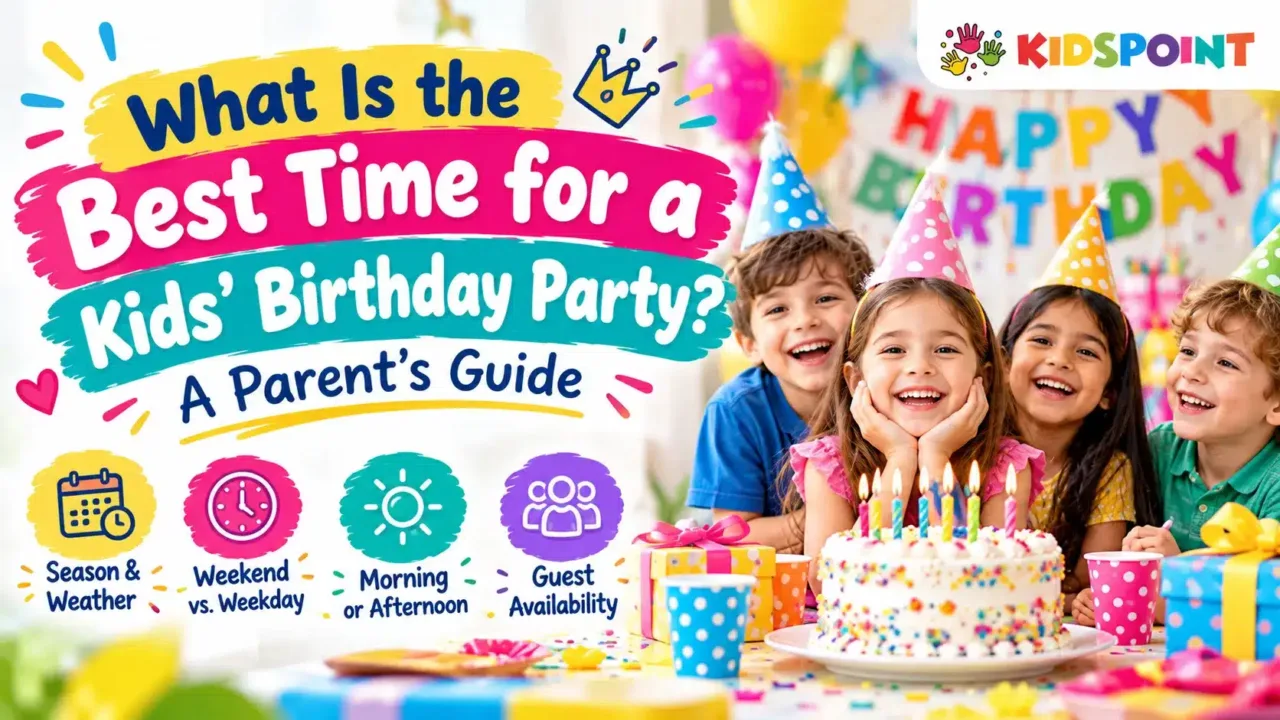
Planning a child’s birthday party can be exciting, but parents quickly discover that choosing the best time for a kids’ birthday party can be surprisingly important. The right time can affect everything from children’s energy levels and meal schedules to naps, travel, activities, and how long guests stay.
A party scheduled at the wrong time may leave young children tired, hungry, or ready for a nap just when the celebration is getting started. On the other hand, a well-timed party can help children stay engaged, enjoy the activities, and finish the celebration while everyone is still having fun.
There is no single perfect birthday-party time for every family. The best choice depends on the child’s age, daily routine, type of party, location, season, and guest list.
This guide explains how to choose a practical birthday party schedule that works for children and parents alike.
Why Does Party Timing Matter?
Young children often follow predictable daily routines. They may have regular meal times, naps, school schedules, sports practices, and bedtime routines.
A birthday party introduces excitement into that routine, so timing matters.
A well-planned party schedule can help:
- Children arrive with enough energy
- Guests avoid missing naps or meals
- Activities run smoothly
- Parents have enough preparation time
- Food is served at a convenient time
- Younger children do not become overly tired
- Families have time to travel before and after the event
When choosing a time, think about the children attending rather than only what is convenient for the adults.
What Is the Best Time for a Kids’ Birthday Party?
For many young children, late morning or early afternoon can be convenient.
A late-morning party, such as around 10:30 a.m. to 12:30 p.m., may work particularly well for younger children who are usually active earlier in the day.
An afternoon party, such as around 2:00 p.m. to 4:00 p.m., can be a good option for older children who have already finished lunch or other daytime activities.
The ideal time depends heavily on age and routine.
Best Birthday Party Times by Age
Children’s schedules change considerably as they grow.
Babies and Toddlers
For babies and toddlers, the child’s normal routine should be the priority.
Many toddlers have a predictable nap schedule, so planning a party during nap time can create unnecessary stress.
A short morning celebration may work well if the birthday child is usually cheerful and energetic in the morning.
Consider a time such as:
9:30 a.m. to 11:00 a.m.
or
10:00 a.m. to 11:30 a.m.
Keep toddler parties relatively short. Young children can become overwhelmed by too many people, activities, or unfamiliar surroundings.
Preschoolers
Preschoolers often have more flexibility than toddlers, but naps and quiet time may still matter.
A late-morning or early-afternoon party can work well.
For example:
10:30 a.m. to 12:30 p.m.
or
2:00 p.m. to 4:00 p.m.
If the child usually naps after lunch, a morning party may be easier.
Elementary-School Children
School-age children generally have more flexibility and can handle longer celebrations.
Afternoon parties are often convenient because children have already had breakfast and lunch.
A schedule such as:
2:00 p.m. to 4:00 p.m.
or
3:00 p.m. to 5:00 p.m.
can work well for games, crafts, outdoor activities, or themed parties.
Older Children and Tweens
Older children may enjoy longer parties, activity-based celebrations, movie nights, sports parties, or sleepover-style events.
Their school, extracurricular, and family schedules become more important considerations.
For this age group, an afternoon or early evening celebration can work well.
Morning vs. Afternoon Birthday Parties
Both morning and afternoon parties have advantages.
Benefits of a Morning Party
Morning celebrations can be particularly suitable for younger children.
Advantages may include:
- Children may have more energy
- It may fit around afternoon naps
- Outdoor temperatures may be more comfortable in warm weather
- The party can finish before the afternoon becomes busy
- Parents have the rest of the day available afterward
Morning parties also work well for breakfast or brunch themes.
Benefits of an Afternoon Party
Afternoon parties can be convenient for school-age children.
Advantages may include:
- Guests have time for morning activities
- Parents have more preparation time
- Lunch can happen before the party
- Many children are ready for games and activities
- It can work well for sports and outdoor celebrations
The best option depends on the specific guest group.
How Long Should a Kids’ Birthday Party Last?
Party length should generally reflect the children’s ages.
Toddlers
Around 60–90 minutes may be enough for very young children.
Toddlers can become tired or overstimulated quickly.
Preschoolers
Around 90 minutes to 2 hours can provide enough time for games, food, cake, and free play without making the celebration too long.
School-Age Children
Around 2–3 hours may work well for many school-age celebrations, particularly when the party includes several activities.
Tweens
Older children may enjoy longer events, especially when there is a movie, sports activity, craft project, or other planned entertainment.
However, longer is not automatically better. A party should have enough activities to maintain interest without becoming exhausting.
Consider Nap Schedules
For younger children, nap schedules can be one of the most important factors.
If the birthday child usually naps from 1:00 p.m. to 3:00 p.m., planning the main celebration during those hours may create problems.
Parents should consider:
- The birthday child’s nap
- Regular nap schedules of guests
- Travel time
- Whether the venue has a quiet area
- Whether the party can be flexible
Not every guest will follow the same schedule, so it may not be possible to accommodate everyone.
Prioritize the birthday child’s routine while considering the needs of the majority of guests.
Think About Mealtimes
Food is another important part of party timing.
If you schedule a party during a typical lunch or dinner period, guests may expect a full meal.
For example, a party from 11:30 a.m. to 1:30 p.m. may require more substantial food than a mid-afternoon celebration.
A party from 2:00 p.m. to 4:00 p.m. might work well with:
- Fruit
- Small sandwiches
- Crackers
- Yogurt
- Simple snacks
- Cake
- Water and other age-appropriate drinks
Parents should consider allergies, dietary restrictions, choking risks for younger children, and appropriate food storage when planning refreshments.
Should You Schedule the Party Before or After Lunch?
Both options can work.
Before Lunch
A late-morning party can be convenient for toddlers and preschoolers.
For example:
- 10:30 a.m. – Guests arrive
- 10:45 a.m. – Games or activities
- 11:30 a.m. – Snack and cake
- 12:00 p.m. – Final activity
- 12:30 p.m. – Guests leave
This schedule allows families to return home for lunch or continue with their normal afternoon routine.
After Lunch
An afternoon party can be simpler because children have already eaten.
For example:
- 2:00 p.m. – Guests arrive
- 2:15 p.m. – Games
- 3:00 p.m. – Food and cake
- 3:30 p.m. – Main activity
- 4:00 p.m. – Party ends
This format can work particularly well for school-age children.
Consider the Type of Birthday Party
The activity itself should influence the time.
Outdoor Parties
For outdoor parties, consider weather, sunlight, and seasonal temperatures.
During hot weather, an earlier or later celebration may be more comfortable than the hottest part of the afternoon.
During cooler months, a daytime party may make better use of available daylight.
Sports Parties
Sports activities often work well in the afternoon when children have finished school and lunch.
Allow enough time for changing clothes, travel, and refreshments.
Craft Parties
Craft parties can be scheduled in the morning or afternoon because they are relatively flexible.
Make sure activities are appropriate for the children’s ages and supervise the use of small parts, scissors, glue, and other materials.
Pool or Water Parties
Water-based celebrations require extra safety planning. Choose a time when responsible adults can actively supervise children and when the venue’s conditions are suitable.
Never rely solely on lifeguards or flotation devices for supervision of young children.
Movie or Indoor Parties
Indoor parties can work at almost any convenient time.
Afternoon celebrations are especially popular for school-age children because they allow families to complete morning activities first.
What Is the Best Day for a Kids’ Birthday Party?
Although the focus is often on time, the day of the week matters too.
Saturday is popular because many families have fewer school and work commitments.
Sunday can also work well, particularly for shorter daytime celebrations.
Weekday parties may be suitable for smaller gatherings, especially during school holidays.
When choosing a day, consider:
- School schedules
- Sports and extracurricular activities
- Family commitments
- Travel time
- Venue availability
- Guests’ likely availability
If most of the invited children have weekend activities, a weekday celebration during a school break might actually be easier.
Send Invitations Early
Once you decide on a date and time, send invitations with enough notice.
Include:
- Date
- Start time
- End time
- Location
- RSVP information
- Dress requirements if needed
- Special instructions
- Whether parents should stay
A clear start and end time helps families plan transportation and other commitments.
Instead of writing only “afternoon party,” provide specific times.
For example:
Saturday, 2:00–4:00 p.m.
This makes planning much easier.
Build a Simple Party Schedule
You do not need to plan every minute, but having a basic timeline can prevent the party from becoming chaotic.
A simple two-hour schedule might look like this:
- 0:00–0:15: Guests arrive and settle in
- 0:15–0:45: Main games or activity
- 0:45–1:00: Snack break
- 1:00–1:20: Birthday cake and singing
- 1:20–1:45: Final activity or free play
- 1:45–2:00: Goodbyes and party favors
Keep some flexibility. Children may need more time for one activity and less for another.
Avoid Overplanning
A common mistake is trying to fill every minute.
Children need opportunities for free play, conversation, and exploration.
If you schedule too many activities, children may feel rushed from one thing to another.
Instead, choose a few age-appropriate activities and leave some breathing room between them.
Plan Around the Birthday Child
The most important guest at the party is the birthday child.
Think about when they are usually:
- Happy
- Alert
- Hungry
- Tired
- Social
- Ready for activities
If your child is happiest in the morning, there is nothing wrong with choosing a morning celebration.
If they are more energetic after lunch, an afternoon party may be better.
Your child’s personality can be just as important as their age.
Don’t Forget Travel Time
A party that begins at 2:00 p.m. may actually require guests to leave home at 1:30 p.m. or earlier.
Consider the location of the venue and the likely travel time for families.
If the party is at a popular venue, parking and check-in can add additional time.
Providing clear arrival instructions can make the experience easier for everyone.
Final Checklist for Choosing the Best Party Time
Before sending invitations, ask yourself:
- Is this time suitable for the birthday child’s routine?
- Will younger guests be dealing with nap time?
- Will children have eaten recently?
- Is the venue comfortable at this time?
- Does the schedule work with school?
- Is the party long enough but not too long?
- Will families have enough travel time?
- Does the activity fit the time of day?
- Will parents know exactly when the party starts and ends?
If most answers are yes, you are probably on the right track.
Frequently Asked Questions
1. What is the best time for a kids’ birthday party?
Late morning and mid-afternoon are often convenient choices. However, the best time depends on the child’s age, nap schedule, meal routine, venue, activities, and guest availability.
2. What time is best for a toddler birthday party?
Morning or late-morning celebrations can work well for toddlers because they may fit more easily around afternoon naps. A shorter party of about 60–90 minutes can also be appropriate.
3. What time is best for a preschool birthday party?
Late morning or early afternoon can work well for preschoolers. Parents should consider the child’s nap or quiet-time routine when selecting the schedule.
4. What time is best for a school-age child’s birthday party?
Afternoon parties are often convenient for school-age children. A schedule such as 2:00–4:00 p.m. or 3:00–5:00 p.m. can work well for many activities.
5. How long should a children’s birthday party last?
The ideal length depends on age and activities. Toddlers may be comfortable with 60–90 minutes, while preschool and school-age children may enjoy parties lasting around two hours or longer.
6. Should a kids’ birthday party be before or after lunch?
Either option can work. A late-morning party can be convenient for younger children, while an afternoon party can work well for school-age children who have already eaten lunch.
7. Should I avoid scheduling a birthday party during nap time?
For toddlers and younger children, it is generally helpful to avoid the birthday child’s usual nap period. However, individual routines vary, so consider the needs of the birthday child and most guests.
8. What is the best day of the week for a kids’ birthday party?
Saturday is a popular choice because many families have fewer school and work commitments. Sunday and weekday celebrations can also work depending on the guest list and family schedules.
9. How early should I send kids’ birthday invitations?
The ideal timing depends on the type of party and guest list, but giving families enough notice to arrange transportation and schedules is helpful. Include a clear start and end time.
10. How can I choose the right birthday party time?
Consider the birthday child’s routine, age, energy level, meals, naps, school schedule, venue, activities, weather, and guest availability. Choose a time that makes the celebration comfortable and manageable for children.
Make Every Celebration a Learning Adventure With The Kids Point
At The Kids Point, we believe childhood should be filled with opportunities to explore, learn, create, and have fun. Our team of educators, writers, and parents creates engaging, informative, and age-appropriate resources for children and families. From creative activities and educational ideas to stories, games, and helpful parenting resources, The Kids Point is here to make learning and family experiences more inspiring. Parents and educators are also invited to join our community and discover more ideas for making childhood meaningful, safe, and fun.