

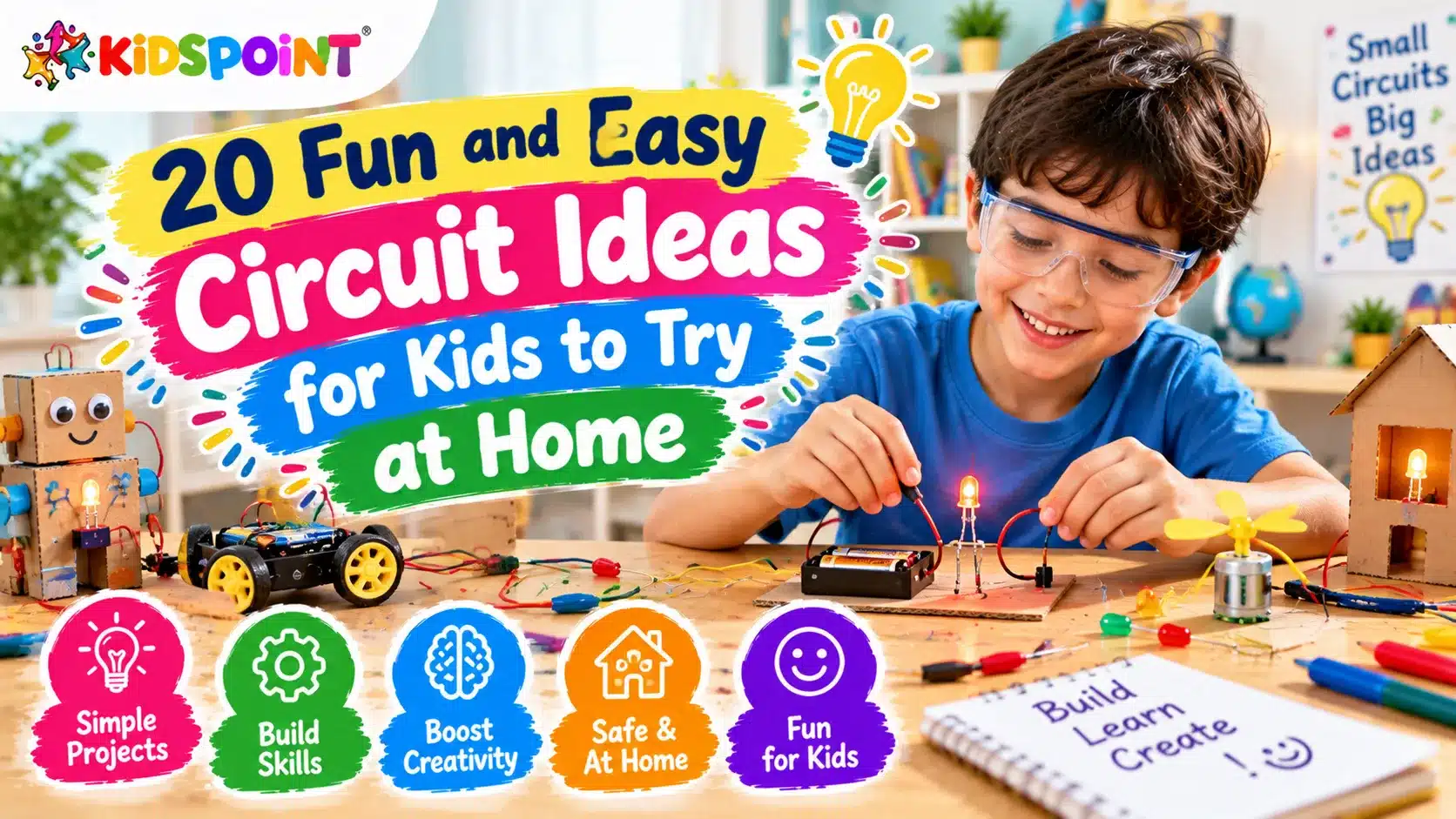
Learning about electricity does not have to mean sitting through a complicated science lesson. With a few simple materials and adult supervision, children can explore how circuits work through fun, hands-on activities at home.
Circuit projects are excellent STEM activities for kids because they combine science, problem-solving, creativity, and experimentation. Children can discover how electricity travels, why a bulb lights up, what happens when a connection is broken, and how different components work together.
At The Kids Point, we believe learning should inspire curiosity and creativity. Simple circuit activities give children an opportunity to ask questions, make predictions, test ideas, and learn from mistakes while having fun.
Before starting, remember that these activities should use only small educational batteries or low-voltage battery packs designed for children’s projects. Never connect experiments to a household electrical outlet. Young children should always have close adult supervision.
What Is a Circuit?
A circuit is a complete path that allows electrical current to flow. A very simple circuit can include a battery, wires, and a small light such as an LED.
When the path is complete, electricity can flow and the light can turn on. If the path is interrupted, the light goes off.
This simple idea introduces children to important concepts such as:
- Open and closed circuits
- Conductors and insulators
- Batteries and energy
- Switches
- Electrical connections
- Problem-solving and troubleshooting
Now, let’s explore some fun circuit ideas kids can try at home.
20 Fun Circuit Ideas for Kids
1. Simple Battery-and-LED Circuit
Start with the basics. Use a small battery, connecting wires, and an appropriate LED to create a simple closed circuit.
Help children connect the components correctly and observe what happens when the circuit is complete.
Learning opportunity: Explain that the battery provides electrical energy and the circuit gives the current a path to travel.
Safety tip: Make sure the LED and battery are compatible and follow the instructions supplied with the components.
2. Homemade Circuit Switch
Once children understand a basic circuit, add a simple switch.
A child can experiment with a safe educational switch or a simple classroom-style switch component. Pressing or moving the switch changes the circuit from open to closed.
Ask:
“What happens when the switch is open?”
Then ask:
“What happens when we close it?”
This makes the idea of circuit control easy to understand.
3. Circuit Greeting Card
Turn a circuit into a creative project by making a light-up greeting card.
Children can design a birthday card, thank-you card, or celebration card and add a small LED using an appropriate battery and conductive materials.
They can decorate around the light to create a glowing candle, star, heart, or moon.
STEM connection: Kids learn that engineering and art can work together.
4. Paper Circuit Drawing
Give children a piece of paper and let them create a picture that includes lights.
For example, they could draw a city with glowing windows, a rocket with a glowing engine, or a garden with illuminated flowers.
Conductive tape can be used as part of an age-appropriate paper circuit kit.
This activity combines electrical circuits for kids with creativity and storytelling.
5. Make a Glowing Star
Create a paper star and place a small LED at its center.
Children can draw the star, build the circuit, and decorate the surrounding area.
Once the circuit works, turn down the room lights and observe the glowing design.
Ask children to explain how the electricity reaches the LED.
6. Conductive Material Challenge
Give kids several safe everyday materials and ask them to predict which ones might conduct electricity.
For example, they can compare materials such as:
- Aluminum foil
- Paper
- Plastic
- Wooden craft sticks
- Metal objects designed for supervised experiments
Use a low-voltage circuit tester or educational circuit kit to test the predictions.
The goal is not simply to get the “right” answer. Encourage children to explain why they made each prediction.
7. Create a Simple Circuit Maze
Design a paper maze where children need to follow a conductive path.
The maze can include different stops where LEDs light up as the child completes sections of the circuit.
This can become a fun combination of a puzzle and a science experiment.
Learning skills: Planning, concentration, testing, and troubleshooting.
8. Build a Mini Traffic Light
Create a paper traffic light with three small LEDs.
Children can use red, yellow, and green lights to represent a traffic signal. An age-appropriate circuit kit can help them control the lights safely.
They can also create a cardboard road around the traffic light and use toy cars to make the project more interactive.
This is an excellent opportunity to discuss how electrical systems are used in everyday life.
9. Light-Up Rocket
Encourage children to build a cardboard rocket and add a small LED to represent the engine.
They can decorate the rocket with planets, stars, astronauts, and other space-themed details.
Once finished, the circuit can make the rocket appear ready for launch.
Pair the project with questions about space exploration and spacecraft technology for an extended STEM activity.
10. Glowing Animal Eyes
Children can create a cardboard or paper animal and use two small LEDs as its eyes.
Owls, cats, robots, dinosaurs, and imaginary creatures can all work well.
This project encourages children to think about where the circuit components need to be placed while giving them plenty of creative freedom.
11. Circuit Drawing Challenge
Give children a theme such as “A Future City.”
Ask them to draw buildings, vehicles, signs, and parks. Then challenge them to add several small lights using a safe circuit kit.
This activity encourages kids to think like designers and engineers.
They can decide:
- Where the lights should go
- How many lights they want
- Which areas should glow
- How the circuit should be arranged
12. Build a Circuit Quiz Game
Turn learning into a game.
Create several cards with questions such as:
- What provides energy in a simple circuit?
- What happens when a circuit is open?
- What is a conductor?
- Why does a light turn off when the connection is broken?
Children can answer a question and then complete a small circuit challenge.
This combines science learning with game-based learning.
13. Circuit Bug
Make a colorful cardboard “bug” with small lights for eyes.
Children can choose the bug’s colors, shape, legs, and decorations. The electrical components can be added afterward.
Once finished, kids can give their creation a name and explain how its circuit works.
This is especially fun for younger children who enjoy combining crafts with science.
14. Light-Up Paper House
Build a small paper or cardboard house.
Add tiny LEDs behind windows so the house appears illuminated when the circuit is completed.
Children can design bedrooms, kitchens, gardens, streetlights, or even a tiny neighborhood.
This project introduces the idea that electrical systems can provide lighting in homes and buildings.
15. Series Circuit Exploration
With an age-appropriate educational circuit kit, let children explore what happens when multiple lights are connected in a series arrangement.
Encourage them to observe the lights and discuss what happens if one component is disconnected.
The important part is observation rather than simply memorizing the term “series circuit.”
16. Parallel Circuit Exploration
Older children can explore a basic parallel circuit using a suitable educational kit and adult supervision.
They can compare it with the series circuit from the previous activity.
Ask them to record their observations:
“What happens to the other light when one light is disconnected?”
This simple comparison can introduce a more advanced electrical concept.
17. Circuit Detective Challenge
Pretend that a tiny electrical system has stopped working.
Give children a safe, low-voltage circuit that has been intentionally disconnected or assembled incorrectly.
Their mission is to become “circuit detectives” and find the problem.
Encourage them to check one connection at a time.
This teaches an important engineering skill: troubleshooting.
18. Light-Up Birthday Cake
Create a pretend birthday cake from cardboard or craft paper.
Add small LEDs to represent candles.
Children can decorate the cake and design a circuit that makes the candles glow.
This project can be especially enjoyable when preparing for a birthday party or learning activity.
19. Circuit Robot
Build a robot from cardboard boxes, paper cups, craft materials, and other safe reusable materials.
Add small LEDs for eyes.
Children can decide whether their robot is a friendly helper, space explorer, scientist, or imaginary character.
After completing it, ask them to explain the purpose of each circuit component.
20. Invent Your Own Circuit Project
After trying several activities, give children the freedom to create something of their own.
Provide a selection of safe, age-appropriate circuit components and craft materials.
Challenge them to design something that includes at least one light and one way to control or interrupt the circuit.
Possible inventions include:
- A glowing spaceship
- A miniature city
- A light-up monster
- An illuminated treasure box
- A glowing garden
- A robot
- A pretend alarm system
The goal is to encourage children to become creators rather than simply following instructions.
Safety Tips for Circuit Activities
Electricity can be fascinating, but safety should always come first.
For children’s circuit projects:
- Use only low-voltage batteries and educational components suitable for the child’s age.
- Never connect a homemade circuit to a wall outlet or household mains electricity.
- Supervise younger children closely.
- Keep button batteries away from young children and pets; they can be extremely dangerous if swallowed.
- Check wires and components for damage before use.
- Keep water and liquids away from electrical activities.
- Avoid overheating batteries or components.
- Follow the instructions provided with circuit kits.
- Stop an activity if a battery or component becomes unusually hot.
- Store batteries and small components securely after the activity.
Parents should also consider whether small components are appropriate for their child’s age and developmental level.
How Circuit Projects Help Kids Learn
Circuit activities can support several important learning skills.
- Problem-Solving: A circuit may not work on the first attempt. Children learn to check connections, identify mistakes, and try another approach.
- Scientific Thinking: Kids can make predictions, conduct tests, observe results, and explain what happened.
- Creativity: Paper circuits and craft-based projects allow children to combine engineering with art and storytelling.
- Early Engineering Skills: Building a circuit introduces children to the idea of designing, testing, improving, and troubleshooting a system.
- Confidence: Successfully making a light turn on can give children a rewarding sense of accomplishment.
Tips for Making Circuit Learning More Fun
You do not need a complicated setup to make circuit activities exciting.
Let children choose the project theme. A child who loves dinosaurs may want glowing dinosaur eyes, while a space enthusiast may prefer a light-up rocket.
Ask open-ended questions instead of immediately fixing problems for them.
Try questions such as:
- “What do you think will happen?”
- “Why do you think the light turned off?”
- “Which connection should we check first?”
- “What could we change?”
- “How could we make your design different?”
Allowing children to experiment makes the activity more meaningful.
Choosing Circuit Activities by Age
Ages 4–6: Focus on simple, adult-guided circuit kits and basic cause-and-effect activities.
Ages 7–9: Introduce switches, conductors, paper circuits, and simple troubleshooting.
Ages 10–12: Children can explore series and parallel circuits and more detailed STEM challenges with suitable supervision.
Tweens and teens: Older children can explore more advanced electronics kits and beginner coding or robotics projects while following appropriate safety practices.
Always choose activities based on the individual child’s skills and the manufacturer’s age recommendations.
FAQs About Circuit Ideas for Kids
1. What is the easiest circuit project for kids?
A simple battery-and-LED circuit is a good starting point when using age-appropriate educational components. Adult supervision is recommended, especially for younger children.
2. What can kids learn from circuit activities?
Circuit activities can introduce children to electricity, energy, open and closed circuits, conductors, switches, troubleshooting, scientific thinking, and basic engineering concepts.
3. What materials are needed for a simple kids’ circuit?
Depending on the project, children may use a small educational battery, compatible LED, connecting wires, a switch, and materials such as paper or cardboard. Always follow the component manufacturer’s instructions.
4. Are circuit projects safe for children?
Low-voltage educational circuit activities can be suitable for children when age-appropriate materials and proper supervision are used. Never allow children to experiment with household electrical outlets or mains electricity.
5. Can younger children make circuits?
Yes. Young children can explore very simple circuits using age-appropriate educational kits with close adult supervision. Choose projects based on their developmental level and the manufacturer’s age guidance.
6. What is a closed circuit?
A closed circuit is a complete electrical path that allows current to flow. In a basic circuit, completing the path can allow a compatible light to turn on.
7. What is an open circuit?
An open circuit has a break in the electrical path, preventing current from flowing through the complete circuit.
8. How can I make circuit activities more interesting?
Combine circuits with crafts, stories, games, or building projects. Kids can create light-up cards, robots, rockets, houses, animals, and imaginary inventions.
9. What should I do if a child’s circuit does not work?
Encourage the child to become a “circuit detective.” Check each connection one at a time, make sure components are compatible, and follow the kit instructions. Troubleshooting is an important part of engineering learning.
10. Can circuit projects be used for STEM learning?
Absolutely. Circuit activities connect science and engineering with creativity, mathematics, design, and problem-solving, making them useful hands-on STEM learning experiences.
Bring More Fun Learning Home With The Kids Point
At The Kids Point, we are dedicated to creating a world of wonder, learning, and fun for children of all ages. Our team of educators, writers, and parents creates engaging, age-appropriate resources that encourage curiosity, creativity, learning, and safe exploration. If your family enjoys hands-on STEM projects like these circuit activities, explore more educational activities, stories, games, and learning ideas, and join our community to keep discovering fun ways to learn together.