

Kids make mistakes. They forget to put away their toys, leave art supplies on the table, interrupt their siblings, or occasionally turn a quiet afternoon into a very noisy adventure. While these moments can be challenging for parents and teachers, discipline does not have to involve harsh punishment.
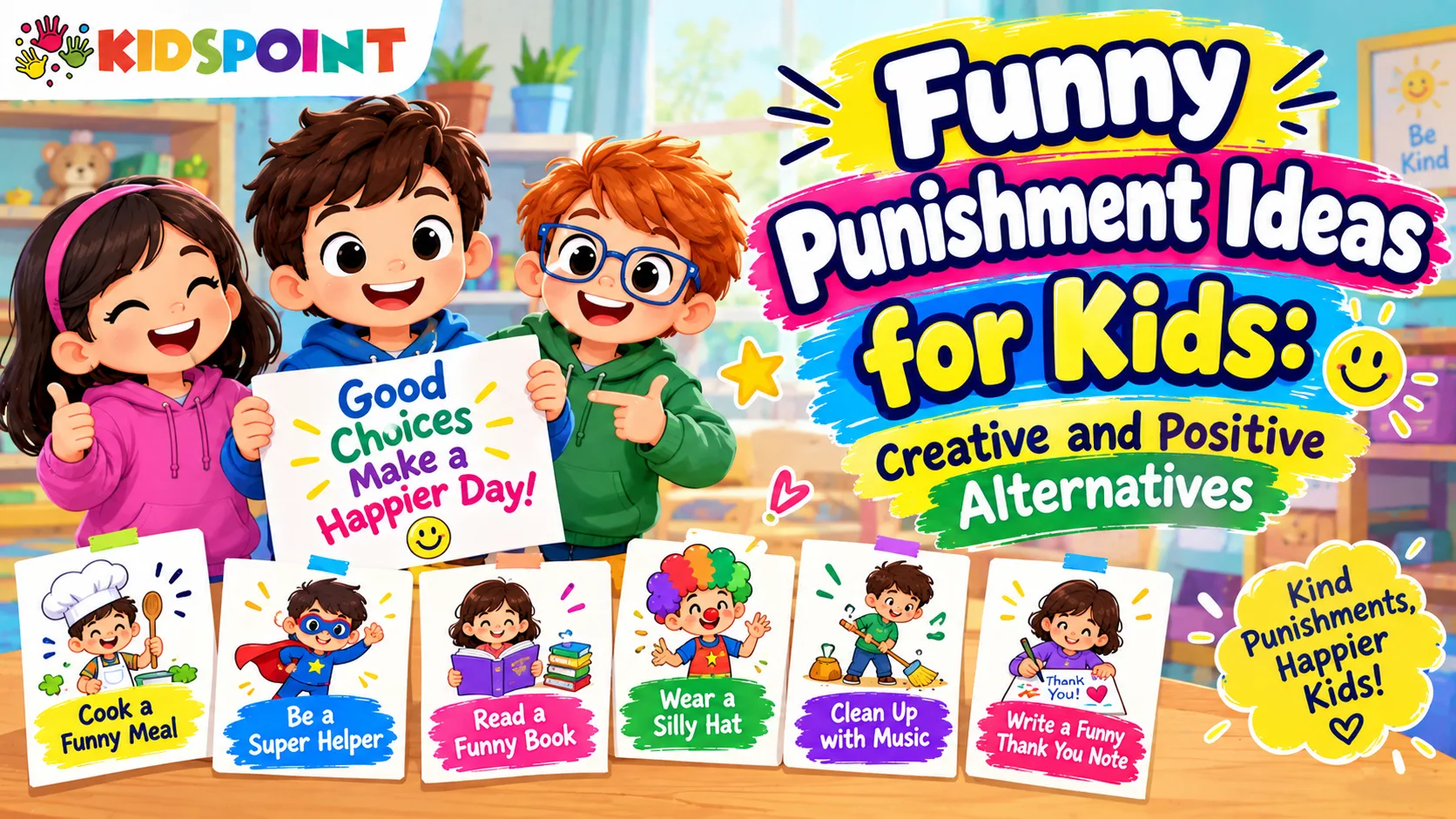
Instead, adults can use funny punishment ideas for kids that are really playful, age-appropriate consequences. The goal is not to embarrass or scare a child. It is to help children understand responsibility, repair mistakes, and make better choices next time.
A silly cleanup challenge, a helpful household task, or a short “reset activity” can turn an ordinary discipline moment into an opportunity to learn.
What Makes a Good Consequence for Kids?
A positive consequence should help children understand what happened and what they can do differently.
Good consequences are usually:
- Age-appropriate
- Safe and respectful
- Related to the behavior when possible
- Short rather than overwhelming
- Focused on learning
- Free from humiliation or fear
- Consistent and clearly explained
For example, if a child leaves building blocks all over the floor, having them help clean up the blocks makes more sense than giving an unrelated penalty.
The funny part can come from the way the task is presented—not from making fun of the child.
20 Funny and Positive Punishment Alternatives for Kids
Here are playful ideas parents and educators can adapt to different situations.
1. The Toy Rescue Mission
If toys are scattered around the room, announce a dramatic Toy Rescue Mission.
“Attention, junior rescue team! We have toys stranded on the floor!”
Give the child a few minutes to rescue the toys and return them to their proper homes.
This turns cleanup into a playful responsibility instead of a lecture.
2. The Silly Cleanup Song
When kids need to clean up, let them choose or invent a silly cleanup song.
They can sing while putting books, toys, craft supplies, or games away.
The rule is simple: when the song ends, the cleanup should be finished.
This works particularly well for younger children who enjoy music and movement.
3. The Five-Minute Helper Challenge
If a child has broken a household rule, give them a short opportunity to be helpful.
They might:
- Put books back on a shelf
- Help set the table
- Sort toys
- Water appropriate plants
- Organize pencils
- Help tidy a shared space
Call it the Five-Minute Helper Challenge.
The purpose is to encourage responsibility, not to make helping feel like a punishment.
4. The Super-Speedy Tidy-Up
Turn tidying into a friendly challenge.
Say:
“Can you put everything away before the timer reaches zero?”
Keep the challenge reasonable and never make children rush around dangerously.
The goal is simply to add energy and fun to an otherwise boring task.
5. The Missing Sock Detective
Did someone leave clothing on the floor?
Give them a detective mission: find all the missing socks and match the pairs.
Children can pretend they are investigators solving the mysterious Case of the Missing Socks.
It is a simple household responsibility with a playful theme.
6. The Book-Buddy Reset
If a child has been having trouble settling down, offer a quiet reset with a favorite age-appropriate book.
They can read independently or have an adult read with them.
This is especially useful when a child needs a calm moment rather than another consequence.
7. The Kitchen Assistant Mission
After an age-appropriate mistake during mealtime, a child can help with a simple kitchen task under adult supervision.
For example, they might help:
- Put napkins on the table
- Sort safe utensils
- Wipe an appropriate surface
- Help organize items
Avoid tasks involving hot surfaces, sharp tools, or other hazards.
The lesson is that being part of a household means helping care for shared spaces.
8. The Backpack Check Challenge
If a child repeatedly forgets school supplies, turn organization into a challenge.
Give them a simple checklist:
Pencils? Check.
Notebook? Check.
Water bottle? Check.
Homework? Check.
The goal is to help children develop routines rather than repeatedly scold them for forgetting things.
9. The Compliment Mission
If a child has been unkind to someone, encourage them to repair the situation.
Give them a Compliment Mission: think of something genuine and kind to say to the person they upset.
However, the child should not be forced to give a fake apology or compliment. If someone was hurt, a sincere apology and appropriate repair are more meaningful.
10. The Room Detective
For messy rooms, give the child a detective checklist.
“Detective, your mission is to find five things that don’t belong here.”
They locate the items and return them to their proper places.
After five items, they can continue if necessary.
11. The Book Shelf Challenge
If books are left around the room, challenge the child to organize them.
They can sort books by:
- Size
- Topic
- Color
- Favorite characters
- Fiction and nonfiction
This can make organization feel like a game while teaching responsibility.
12. The “Oops, Let’s Fix It” Rule
Sometimes the best consequence is directly connected to the mistake.
Spilled something? Help clean it.
Made a mess? Help restore the space.
Used something without permission? Return it and discuss what should happen next time.
The phrase “Oops, let’s fix it” teaches children that mistakes can be repaired.
13. The Kindness Mission
If a child has had a difficult interaction with someone, offer a positive action that helps the household or classroom.
They might help someone carry books, organize a shared activity, or assist with a small task.
The goal is not to make kindness a penalty. Instead, it can help children think about how their actions affect other people.
14. The Toy Parking Lot
Create a pretend “parking lot” for toys that are left around the room.
Toys need to return to their parking spaces before playtime can continue.
This works particularly well for younger children who enjoy imaginative play.
15. The Cleanup Captain
Give the child a temporary leadership role.
They can become the Cleanup Captain and help decide which area should be organized first.
This works best when the child is calm enough to participate positively.
Giving children responsibility can sometimes be more effective than simply telling them what to do.
16. The Silly Voice Reminder
For minor household reminders, adults can use a funny voice.
For example:
“Attention! The laundry basket is requesting assistance!”
Keep it playful and avoid using humor when a child is genuinely upset.
The purpose is to make a routine reminder lighter—not to mock the child.
17. The Puzzle Reset
When a child needs a calm break, offer a simple puzzle, drawing activity, or quiet building activity.
A short reset can give everyone time to calm down and return to the conversation.
This should not be presented as isolation or humiliation.
18. The Family Helper Card
Create cards with simple responsibilities such as:
- Book helper
- Table helper
- Plant helper
- Toy organizer
- Recycling helper
A child can choose one appropriate task and complete it.
This makes responsibility feel more like participation in the family than a penalty.
19. The “Teach Me” Challenge
If a child misuses something because they do not understand how it works, ask them to explain what they learned after discussing it with an adult.
For example:
“What should we remember when using the art supplies next time?”
This encourages reflection rather than simply imposing a consequence.
20. The Fresh Start Token
Sometimes children simply need another chance.
Give them a symbolic Fresh Start Token and say:
“Let’s try that again.”
The child can think about what happened and choose a better action.
This is especially useful when the mistake was minor and the child is ready to make a different choice.
Funny Consequences That Teach Real Lessons
The most useful playful consequences are connected to the behavior.
If toys are left everywhere, clean up the toys.
If art supplies are left out, help organize them.
If a child forgets a routine, practice the routine together.
If someone is hurt by unkind behavior, focus on repairing the relationship.
This approach teaches a simple message:
Actions have consequences, and mistakes can be repaired.
What Parents Should Avoid
Not every “funny punishment” is actually positive.
Adults should avoid consequences that involve:
- Public embarrassment
- Name-calling
- Threats
- Physical punishment
- Withholding essential needs
- Making a child feel worthless
- Forcing a child to perform humiliating actions
- Laughing at a child’s genuine distress
- Excessive chores as retaliation
- Taking away every enjoyable activity for long periods
Humor should make the situation lighter, not make the child the target of the joke.
There is an important difference between laughing together and laughing at a child.
Match the Consequence to the Child’s Age
A consequence that works for a seven-year-old may not work for a teenager.
Younger children often respond well to visual routines, short cleanup challenges, songs, and simple choices.
Older children may benefit more from conversations, problem-solving, repairing mistakes, and taking responsibility for shared spaces.
Adults should also consider the reason behind the behavior. A child who forgets something occasionally may need a reminder or routine rather than a consequence.
Use Natural and Logical Consequences
Two useful concepts are natural consequences and logical consequences.
A natural consequence happens as a direct result of an action without an adult creating a penalty.
For example, if a child leaves a toy outside and it gets wet from rain, that experience may help them remember to bring it inside next time.
A logical consequence is intentionally connected to the behavior.
For example, if a child repeatedly leaves craft materials scattered around, they can help organize the supplies before starting another craft.
Both approaches can help children understand cause and effect when used appropriately and safely.
Turn Discipline Into a Learning Moment
Instead of asking only:
“What punishment should I give?”
try asking:
“What can my child learn from this situation?”
That small change can completely alter the conversation.
A child who makes a mess can learn responsibility.
A child who interrupts can practice listening.
A child who forgets something can create a reminder system.
A child who hurts someone’s feelings can learn about repairing relationships.
Discipline becomes an opportunity to develop skills that children will use throughout life.
A Simple Three-Step Approach
When a problem happens, parents and educators can try this simple process.
Step 1: Pause
Give everyone a moment to calm down.
Step 2: Talk
Briefly explain what happened and why the behavior was a problem.
Step 3: Repair
Help the child choose an appropriate way to fix the problem or practice a better choice.
For example:
“You left the art supplies on the floor. Someone could trip over them. Let’s put everything away together, and next time we’ll check the table before leaving.”
This is clear, calm, and connected to the behavior.
The Kids Point: Positive Discipline Can Still Be Fun
At The Kids Point, we believe children learn through curiosity, creativity, play, and meaningful experiences. Discipline can follow the same principles.
A playful cleanup challenge, a helpful mission, or a fresh-start activity can make everyday responsibilities easier for children to understand. The goal is never to embarrass or frighten a child. Instead, positive consequences can help kids practice responsibility, kindness, communication, and problem-solving.
Parents and educators can choose approaches that fit each child’s age, personality, and situation while keeping safety and respect at the center.
Funny punishment ideas for kids work best when they are really positive consequences with a playful twist.
The goal is not to find the funniest way to punish a child. It is to find a safe and respectful way to help them understand their actions, repair mistakes, and develop better habits.
From Toy Rescue Missions and Cleanup Songs to Fresh Start Tokens and Helper Challenges, there are plenty of ways to make discipline more constructive.
A little humor can make a difficult moment easier—but the child’s dignity should always come first.
Frequently Asked Questions
1. What are funny punishment ideas for kids?
Funny punishment ideas can be playful, age-appropriate consequences such as cleanup challenges, helper missions, organization games, or silly cleanup songs. They should teach responsibility without embarrassing or hurting children.
2. Are funny punishments appropriate for children?
They can be appropriate when they are safe, respectful, age-appropriate, and connected to the behavior. Humor should never involve humiliation, fear, physical punishment, or making fun of a child’s genuine feelings.
3. What is a good alternative to punishment?
Logical consequences, repairing mistakes, calm conversations, short reset activities, and helping with related responsibilities can be useful alternatives to harsh punishment.
4. What should parents do when a child makes a mess?
When appropriate, parents can have the child help clean up the mess. Turning cleanup into a short game or challenge can make the responsibility more engaging.
5. How can discipline be made fun for kids?
Parents can use imaginative themes such as detective missions, rescue missions, helper cards, cleanup songs, or organization challenges. The activity should remain respectful and focused on learning.
6. Should parents use humor when disciplining children?
Humor can sometimes make minor situations feel less tense, but adults should be careful. Humor should never embarrass, shame, or ridicule the child.
7. What is a logical consequence for kids?
A logical consequence is connected to the child’s behavior. For example, a child who leaves toys scattered around can help put those toys away before beginning another activity.
8. What is a positive consequence?
A positive consequence helps children learn from their behavior while maintaining their dignity. It might involve repairing a mistake, completing a related responsibility, practicing a skill, or helping restore a shared space.
9. How can parents teach children responsibility?
Parents can give children age-appropriate responsibilities, establish clear routines, explain expectations, and allow children to participate in repairing mistakes.
10. What should parents avoid when disciplining kids?
Parents should avoid physical punishment, humiliation, threats, name-calling, and consequences that intentionally cause fear or shame. Discipline should focus on safety, learning, responsibility, and respect.