

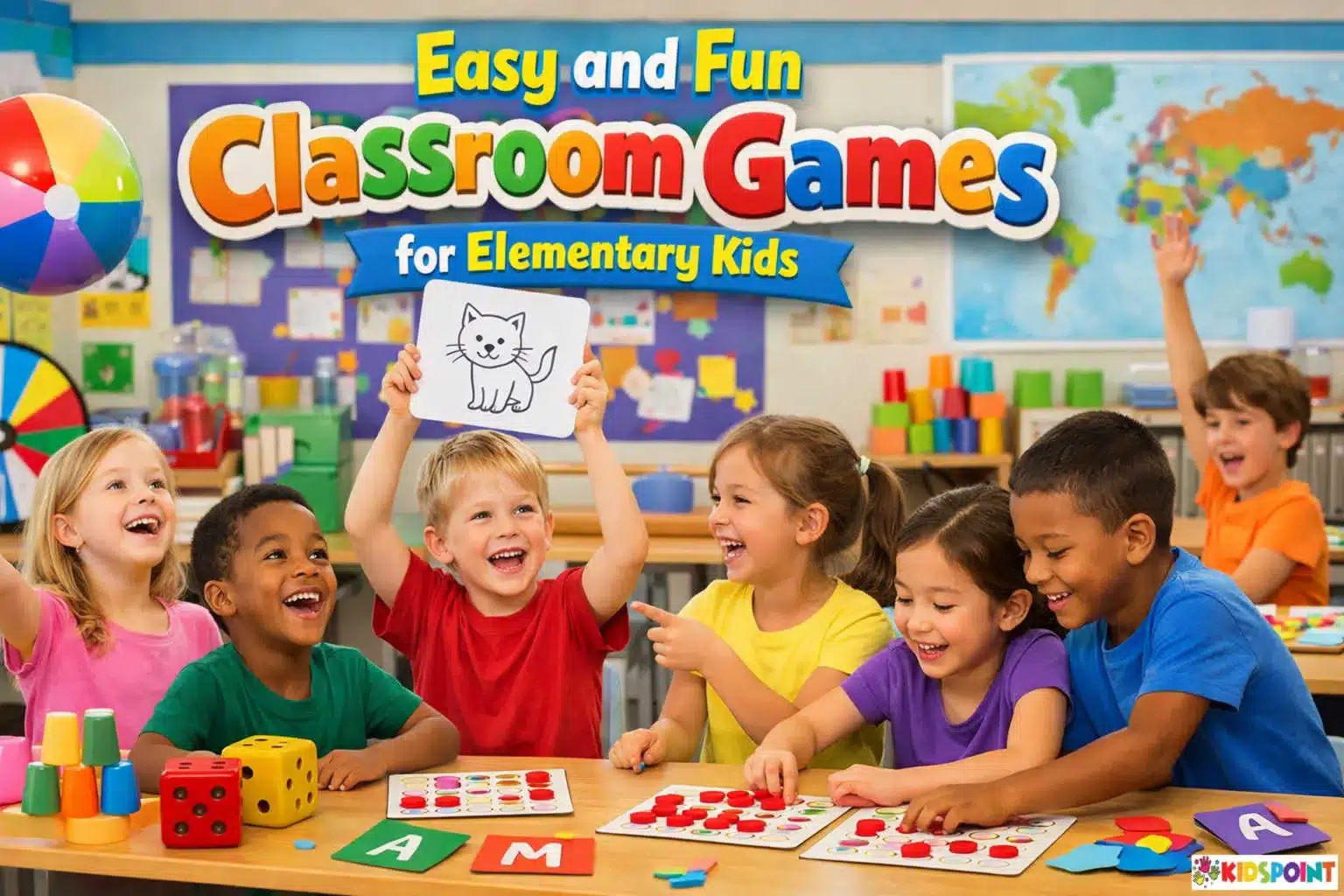
Classrooms are more than places for lessons and homework—they are spaces where children grow socially, emotionally, and academically. For elementary students, learning becomes far more effective when it is interactive and enjoyable. That is why classroom games play such an important role in modern education.
At The Kids Point, we believe that meaningful learning happens when children are actively involved. Easy and fun classroom games not only keep students engaged but also help improve teamwork, communication, critical thinking, and confidence. Whether you are a teacher looking to energize your classroom or a homeschool parent seeking creative ideas, this comprehensive guide will provide practical, low-prep games that elementary kids will love.
Why Classroom Games Are Important for Elementary Students
Children in elementary school are naturally curious and energetic. Traditional lecture-style teaching can sometimes limit their engagement. Classroom games offer several key benefits:
- Increase student participation
- Improve focus and attention
- Reinforce academic concepts
- Encourage teamwork and collaboration
- Reduce classroom stress
- Support social-emotional development
Games make learning memorable. When children associate lessons with fun experiences, they are more likely to retain information long-term.
Quick Icebreaker Games to Start the Day
Icebreakers help students feel comfortable and connected.
Two Truths and a Lie
Each student shares two true statements and one false statement about themselves. The class guesses the lie. This improves listening skills and builds classroom relationships.
Would You Rather?
Ask fun or thought-provoking questions like:
- Would you rather live in space or under the sea?
- Would you rather have super strength or super speed?
This game encourages creative thinking and respectful discussion.
Name Chain
Students say their name along with an adjective that starts with the same letter (e.g., “Happy Hannah”). The next student repeats the previous names before adding their own. This strengthens memory skills.
Educational Word and Language Games
Language games help build vocabulary, spelling, and communication skills.
Vocabulary Bingo
Create bingo cards with vocabulary words instead of numbers. Call out definitions, and students mark the matching word. This makes word learning exciting.
Word Relay Race
Divide the class into teams. Write a category on the board (animals, fruits, verbs). Each team member runs to write one word before tagging the next teammate. This combines movement with learning.
Story Building Circle
Students sit in a circle. One student starts a story with a sentence. Each student adds a new sentence. This builds creativity and narrative skills.
For word-building practice, games inspired by classics like
- Scrabble
can help improve spelling and vocabulary.
Math Classroom Games
Math becomes more enjoyable when it is hands-on and interactive.
Math Jeopardy
Create categories such as addition, subtraction, multiplication, and word problems. Divide students into teams and assign points for correct answers.
Around the World (Math Edition)
Two students stand behind a seated student’s desk. The teacher asks a math question. The first to answer correctly moves to the next desk. The goal is to travel “around the world.”
Roll and Solve
Students roll dice and solve math problems based on the numbers rolled. This is perfect for practicing addition, subtraction, or multiplication.
Active and Movement-Based Games
Elementary kids need movement throughout the day.
Silent Ball
Students gently toss a soft ball to each other without talking. If someone talks or drops the ball, they sit down. This game builds focus and self-control.
Four Corners
Label each corner of the room with a number or answer choice. Ask a question, and students move to the corner representing their answer. This works well for review sessions.
Simon Says
Inspired by the classic game
- Simon Says
This activity improves listening skills and concentration. Only follow instructions when they begin with “Simon says.”
STEM and Critical Thinking Games
Encourage problem-solving and innovation with these activities.
Build the Tallest Tower
Provide materials like paper, tape, and straws. Divide students into small teams and challenge them to build the tallest free-standing tower. This promotes teamwork and engineering thinking.
Mystery Object Guessing
Place an object in a bag. Students ask yes-or-no questions to guess what it is. This enhances logical reasoning.
Code the Teacher
Students give step-by-step instructions to complete a simple task (like drawing a shape). If instructions are unclear, the teacher follows them literally. This teaches precision and sequencing.
Teamwork and Cooperation Games
Collaboration is a key life skill.
Human Knot
Students stand in a circle and grab hands with two different people. Without letting go, they must untangle themselves. This promotes communication and teamwork.
Classroom Scavenger Hunt
Provide clues related to lesson topics. Students work in groups to solve riddles and find hidden items.
Pass the Compliment
Students pass a small object around the circle. Each student gives a compliment to the person next to them. This builds positivity and classroom unity.
Quiet Games for Focused Learning
Sometimes classrooms need calm and structured activities.
Pictionary
Divide students into teams. One student draws a word while teammates guess. This supports vocabulary development and creativity.
Hangman
A simple spelling review game that improves letter recognition and word structure skills.
Memory Match
Create matching cards with vocabulary words and definitions or math problems and answers.
Review Games Before Tests
Review sessions become more engaging with fun formats.
Quiz Ball
Students answer review questions before tossing a soft ball to another classmate.
Spin the Wheel
Create a paper spinner with categories. Students answer questions based on where the spinner lands.
True or False Dash
Mark one side of the room as “True” and the other as “False.” Read statements aloud and let students move to their chosen side.
Creative Arts and Expression Games
Art-based games allow children to express themselves.
Freeze Dance Drawing
Play music while students draw. When the music stops, they must freeze. This mixes creativity and listening skills.
Emotion Charades
Students act out emotions while others guess. This supports emotional intelligence.
Comic Strip Creation
Students create short comics related to lesson topics.
Seasonal and Holiday Classroom Games
Adding seasonal themes keeps excitement high throughout the year.
- Fall word puzzles
- Winter math challenges
- Spring science scavenger hunts
- End-of-year trivia contests
Adjust themes to match curriculum goals while maintaining fun.
Classroom Game Tips for Teachers
To ensure success:
- Keep instructions simple and clear.
- Set behavior expectations before starting.
- Use positive reinforcement.
- Adapt games to suit different learning levels.
- Rotate activities to maintain interest.
Classroom games should enhance learning—not create chaos. Proper structure keeps the environment productive and enjoyable.
Benefits Beyond Academics
Games in elementary classrooms contribute to:
- Stronger peer relationships
- Increased confidence
- Improved classroom morale
- Better problem-solving skills
- Enhanced creativity
When children feel safe, included, and excited to participate, they are more open to learning.
Adapting Games for Different Grade Levels
Younger elementary students (Grades 1–2) benefit from:
- Short, movement-based games
- Visual aids
- Simple instructions
Older elementary students (Grades 3–5) enjoy:
- Strategy-based games
- Competitive team challenges
- Creative problem-solving tasks
Adjust complexity while keeping the fun element consistent.
Technology-Enhanced Classroom Games
When used appropriately, technology can enhance classroom gaming.
- Interactive quizzes
- Educational apps
- Digital scavenger hunts
However, balance screen time with hands-on activities for optimal development.
Creating a Positive Game-Based Classroom Culture
Establish clear rules:
- Respect everyone
- Encourage teamwork
- Celebrate effort
- Keep competition friendly
Games should create joy, not pressure. Emphasize participation over winning.
How To Support Engaging Learning For Kids
We are committed to providing practical, creative, and educational resources that help teachers and parents create meaningful learning experiences. Classroom games are powerful tools that transform lessons into memorable adventures.
By integrating easy and fun games into daily routines, educators can nurture curiosity, confidence, and collaboration among elementary students.
Common Questions About Classroom Games
How often should classroom games be used in elementary classes?
Classroom games can be used daily in short sessions or a few times a week to reinforce lessons and maintain engagement.
Do classroom games really improve academic performance?
Yes, interactive games help students retain information better by making learning active and memorable.
How can teachers manage noise during games?
Set clear rules, use a signal for attention (like a hand raise or bell), and choose structured games when a calm environment is needed.
Are classroom games suitable for mixed-ability learners?
Absolutely. Most games can be adapted by adjusting difficulty levels or grouping students strategically.
What if some students are shy or reluctant to participate?
Start with low-pressure team games and encourage supportive collaboration to gradually build confidence.
Making Learning Memorable Through Play
Elementary education is a critical stage in a child’s development. When lessons are paired with interactive games, students become active participants rather than passive listeners.
From vocabulary bingo and math challenges to teamwork activities and creative expression games, these classroom ideas bring energy and enthusiasm into learning environments.
At The Kids Point, we believe that joyful learning builds lifelong success. By incorporating easy and fun classroom games throughout the school year, teachers can inspire young minds while strengthening academic skills in ways that children truly enjoy.
Learning should never feel like a chore. With the right games and positive guidance, classrooms can become vibrant spaces where education and excitement go hand in hand.