

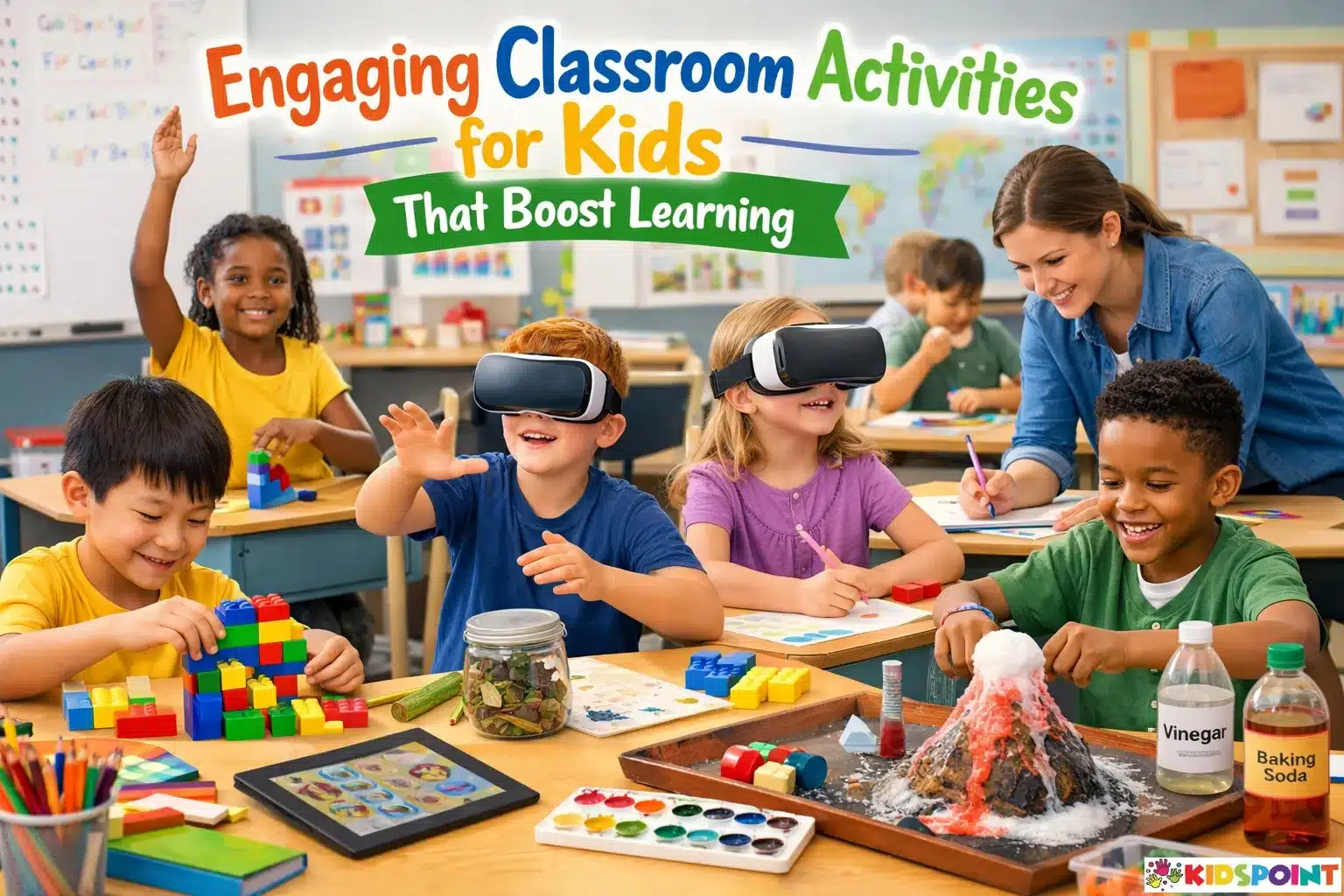
Classrooms are more than just spaces for reading, writing, and arithmetic—they are the launching pads for creativity, critical thinking, and social development. But in today’s fast-paced world, keeping kids actively engaged in learning can be a challenge. That’s where interactive classroom activities come in. By combining fun with education, teachers can create an environment that encourages curiosity, teamwork, and hands-on learning. At The Kids Point, we believe that learning should be exciting, immersive, and tailored to the needs of every child.
In this article, we’ll explore a wide range of engaging classroom activities for kids that not only make learning enjoyable but also help boost academic skills and social development.
Why Classroom Activities Are Essential for Learning
Before diving into specific activities, it’s important to understand why interactive classroom activities are so effective:
- Enhances Cognitive Skills – Hands-on activities help children understand and retain concepts better than passive learning.
- Encourages Social Interaction – Group activities foster teamwork, communication, and empathy.
- Boosts Motivation – Fun and engaging tasks keep children interested and motivated to learn.
- Supports Diverse Learning Styles – Activities can cater to visual, auditory, kinesthetic, and tactile learners.
- Develops Problem-Solving Abilities – Many classroom games and challenges enhance critical thinking and creativity.
By incorporating these activities into daily lessons, teachers can transform classrooms into dynamic spaces where learning comes alive.
Fun and Educational Games for the Classroom
Math Bingo
Math doesn’t have to be boring—Math Bingo turns numbers into a game!
How to Play:
- Prepare bingo cards with answers to math problems (addition, subtraction, multiplication).
- Call out the problems one by one.
- Kids solve them and mark the correct answer on their cards.
- The first student to complete a row or column shouts “Bingo!”
Benefits: Improves math skills, speed, and accuracy while keeping students engaged.
Word Treasure Hunt
A perfect game to strengthen vocabulary and spelling.
How to Play:
- Hide word cards around the classroom.
- Provide clues or riddles related to the words.
- Students work in pairs or small groups to find the words and form sentences using them.
Benefits: Enhances vocabulary, reading comprehension, and teamwork.
Quiz-Based Learning
Quizzes aren’t just for exams—they can be exciting classroom games too.
How to Play:
- Create short quizzes with multiple-choice or true/false questions.
- Divide the class into teams and ask questions in a timed format.
- Award points for correct answers and celebrate winners with small prizes.
Benefits: Reinforces knowledge, improves recall, and encourages friendly competition.
Hands-On Activities That Encourage Creativity
Art Integration
Art can be a powerful tool for learning across subjects.
How to Play:
- Integrate art projects into lessons. For example, create a science diagram, historical timeline, or math shapes using crafts.
- Let kids express concepts visually using colors, textures, and materials.
Benefits: Boosts creativity, comprehension, and fine motor skills while making lessons memorable.
Storytelling Sessions
Storytelling encourages imagination and communication.
How to Play:
- Pick a theme or topic, such as friendship, science, or nature.
- Students create and narrate their stories individually or in groups.
- Use props, puppets, or visual aids to make it interactive.
Benefits: Enhances language skills, creativity, and confidence in public speaking.
DIY Science Experiments
Hands-on experiments make science concepts tangible.
How to Play:
- Conduct simple experiments like vinegar and baking soda reactions, floating objects, or plant growth observations.
- Encourage students to hypothesize, test, and record results.
Benefits: Develops critical thinking, observation skills, and scientific curiosity.
Movement-Based Learning Activities
Classroom Scavenger Hunt
Movement combined with learning keeps kids energized.
How to Play:
- Hide educational items or cards around the classroom.
- Provide students with a checklist or clues.
- They must find all items and answer related questions to complete the hunt.
Benefits: Promotes active learning, problem-solving, and teamwork.
Learning Stations
Divide the classroom into interactive stations for different subjects.
How to Play:
- Each station focuses on a specific activity: math puzzles, reading challenges, science experiments, or art projects.
- Students rotate every 10–15 minutes.
Benefits: Keeps students engaged, allows personalized learning, and breaks monotony.
Role-Play Activities
Role-play allows children to experience real-life scenarios.
How to Play:
- Assign roles based on a lesson, such as a historical event, environmental issue, or story character.
- Students act out scenarios, make decisions, and reflect on outcomes.
Benefits: Enhances empathy, understanding, and problem-solving skills.
Technology-Enhanced Classroom Activities
Interactive Learning Apps
Educational technology can complement traditional teaching.
How to Play:
- Use tablets or computers for learning games, quizzes, and interactive simulations.
- Apps like Kahoot!, Quizizz, or ABCmouse can make lessons fun and competitive.
Benefits: Engages digital learners, provides instant feedback, and tracks progress.
Virtual Field Trips
Traveling from the classroom can be as simple as logging in.
How to Play:
- Use online resources to “visit” museums, historical sites, or natural parks.
- Assign tasks such as observation notes, quizzes, or creative projects based on the virtual tour.
Benefits: Expands knowledge beyond the classroom, promotes curiosity, and provides immersive experiences.
Digital Story Creation
Combine technology with creative expression.
How to Play:
- Students use digital tools to create stories with text, images, and audio.
- Platforms like StoryJumper or Book Creator make this easy for kids.
Benefits: Enhances literacy, creativity, and digital skills while encouraging collaboration.
Social and Emotional Learning Activities
Circle Time Discussions
Circle time builds communication and emotional intelligence.
How to Play:
- Gather students in a circle and discuss a theme such as gratitude, teamwork, or problem-solving.
- Encourage every student to share thoughts, experiences, or solutions.
Benefits: Improves listening, empathy, self-expression, and conflict resolution.
Compliment Chain
Boosts positivity and self-esteem in the classroom.
How to Play:
- Each child gives a compliment to another student in the circle.
- Continue until everyone has received a compliment.
Benefits: Strengthens friendships, fosters kindness, and builds confidence.
Mindfulness Activities
Mindfulness enhances focus and reduces stress.
How to Play:
- Introduce simple breathing exercises, guided imagery, or quiet reflection time.
- Use calming music or visualizations to help children relax.
Benefits: Supports mental health, attention span, and emotional regulation.
Group Projects That Boost Learning
Classroom Mural or Collage
Collaborative art projects teach cooperation.
How to Play:
- Assign a topic such as “Our Community” or “The Solar System.”
- Each group contributes a piece of art to the larger mural or collage.
Benefits: Encourages teamwork, creativity, and knowledge sharing.
Environmental Projects
Teaching sustainability through action-based learning.
How to Play:
- Engage students in planting trees, recycling projects, or classroom gardening.
- Assign roles for planning, planting, and monitoring.
Benefits: Promotes responsibility, environmental awareness, and scientific observation.
Classroom Newspaper
A creative way to combine writing, research, and art.
How to Play:
- Students create a monthly or weekly newspaper featuring class events, student interviews, stories, and artwork.
- Assign editors, writers, and illustrators to different roles.
Benefits: Enhances literacy, teamwork, research skills, and creativity.
Tips for Implementing Classroom Activities Successfully
- Plan According to Age and Ability – Customize activities to suit your students’ developmental level.
- Mix Learning Styles – Combine visual, auditory, and kinesthetic methods to engage all learners.
- Rotate Activities – Prevent boredom by alternating between active, quiet, individual, and group tasks.
- Provide Clear Instructions – Ensure students understand goals and rules for smooth execution.
- Encourage Reflection – Allow students to share experiences and insights after activities.
- Celebrate Achievements – Recognize effort, creativity, and teamwork to boost motivation.
Supplies and Resources You Might Need
To ensure smooth execution of these classroom activities, you may need:
- Art supplies (paper, markers, paints, glue, scissors)
- Balloons, flashcards, and charts for games
- Tablets, computers, or projectors for digital activities
- Plants, soil, or recycling materials for environmental projects
- Notebooks or digital platforms for storytelling and newspapers
Common Questions About Classroom Activities
What is the best age group for these activities?
Most activities can be adapted for children aged 4–12. Adjust complexity and instructions according to age.
How often should interactive activities be used in the classroom?
Ideally, include at least one interactive or hands-on activity in every lesson to maintain engagement and interest.
Can these activities be adapted for remote learning?
Yes! Many activities, such as digital storytelling, quizzes, and virtual field trips, are perfect for online classrooms.
How can teachers manage large groups effectively?
Divide students into smaller teams or learning stations, rotate activities, and assign roles to maintain order and participation.
Do these activities require special supplies?
Most activities use simple, inexpensive materials. For digital activities, access to tablets or computers is beneficial but not mandatory.
Making Classroom Learning Exciting and Effective
Engaging classroom activities are essential for nurturing a love for learning among children. By combining fun, creativity, and hands-on experiences, teachers can create an environment where children are motivated, curious, and confident. From interactive games and art projects to technology-enhanced lessons and social-emotional activities, there are endless ways to make classroom learning dynamic and effective.
At The Kids Point, we understand that every child learns differently, and incorporating a variety of engaging activities ensures that every student can thrive. By prioritizing interactive learning, educators are not only helping children excel academically but also shaping well-rounded, confident, and creative individuals ready to embrace the world.