

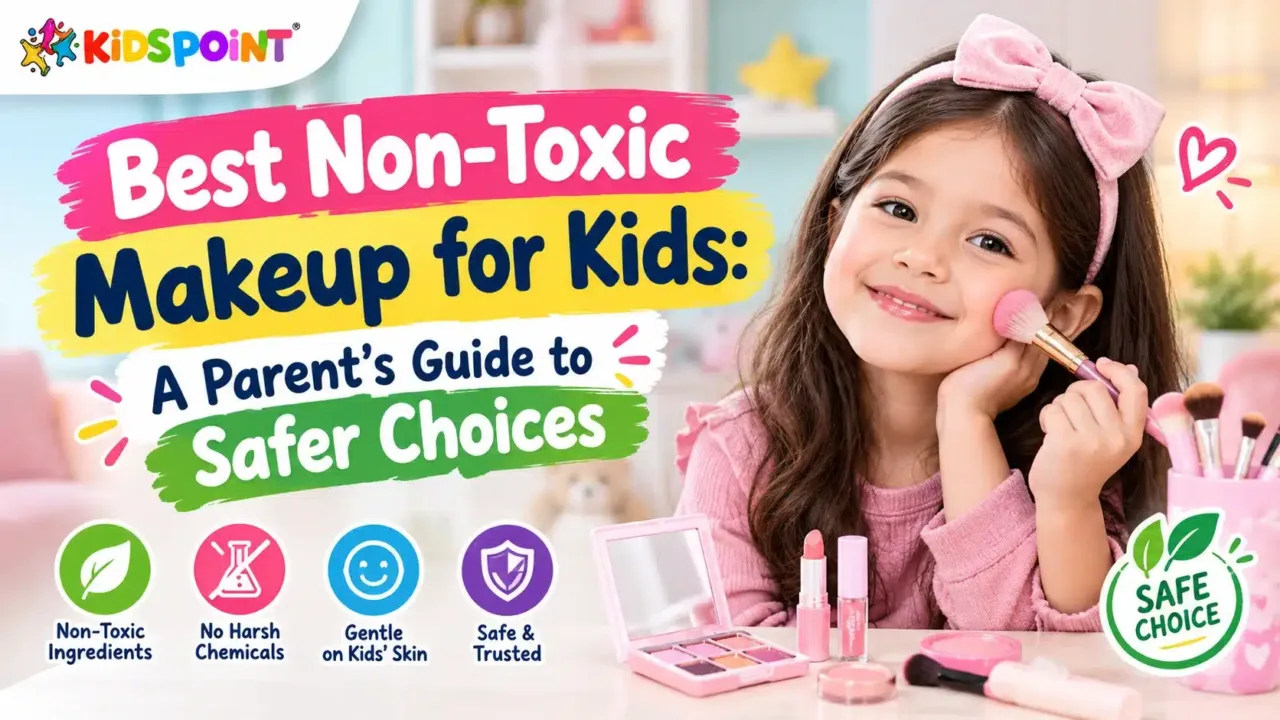
Children love pretending, dressing up, and expressing their creativity. Whether they are getting ready for a costume party, playing make-believe, performing in a school show, or simply having a fun afternoon at home, makeup can become an exciting part of imaginative play.
But when makeup is being used by children, parents naturally have an important question: What makeup is safe for kids?
Choosing children’s makeup can be confusing. Colorful packaging may look appealing, while terms such as “natural,” “clean,” “organic,” and “non-toxic” can make a product sound safer without telling you everything you need to know. Children may also have more sensitive skin than adults, and young kids are more likely to touch their faces, rub their eyes, or accidentally put makeup-covered fingers in their mouths.
That is why choosing age-appropriate, properly labeled children’s makeup and using it responsibly is so important.
At The Kids Point, we believe children’s activities should encourage creativity while putting safety first. In this guide, we’ll explore what parents should look for when shopping for non-toxic makeup for kids, ingredients and features to consider, application tips, and ways to make pretend makeup play safer and more enjoyable.
What Does “Non-Toxic Makeup for Kids” Actually Mean?
The term “non-toxic” sounds reassuring, but it is important to understand that it is not a universal guarantee that a product will be completely harmless for every child.
A better approach is to look beyond marketing language and examine the product itself.
Parents should consider:
- Whether the product is specifically designed for children’s use
- The recommended age range
- The ingredient list
- Whether the product has appropriate safety testing or quality standards
- Whether the packaging clearly identifies the manufacturer
- Whether the product is intended for the face, lips, eyes, or body
- Whether the child has known sensitivities or allergies
- Whether the product is easy to remove
A product described as “natural” is not automatically better for a child’s skin. Likewise, a product without the word “non-toxic” on its packaging isn’t necessarily unsafe.
The goal is to choose products from reputable manufacturers, follow the instructions, and use makeup only for its intended purpose.
Why Should Parents Be Careful With Children’s Makeup?
Children’s skin can be sensitive, and some children may react to particular ingredients, fragrances, preservatives, pigments, or adhesives.
There are also practical concerns. Young children may accidentally get makeup into their eyes or mouth. Sharing makeup can transfer germs between children, while old or contaminated products can become a source of irritation.
For these reasons, children’s makeup should generally be treated as a special-occasion or supervised play product, rather than something children need to use every day.
Parents should also remember that “kid-friendly” doesn’t mean children should be left unsupervised with cosmetics.
What to Look for in Non-Toxic Makeup for Kids
When choosing makeup for children, a few simple checks can make shopping easier.
1. Choose Age-Appropriate Products
Always check the recommended age on the packaging.
Products designed specifically for children are generally a better starting point than giving a child an adult cosmetic simply because it looks gentle or comes in a small package.
Age recommendations can also help parents determine whether a product is suitable for a preschooler, school-age child, or older child.
2. Read the Full Ingredient List
Don’t rely entirely on phrases such as “natural,” “clean,” or “non-toxic.”
Look at the ingredient list and choose products from manufacturers that clearly disclose what is included.
If you are concerned about a particular ingredient because your child has a known sensitivity, discuss it with an appropriate healthcare professional and check the label carefully.
3. Avoid Products With Unclear Labeling
Be cautious with cosmetics that have:
- No ingredient list
- No manufacturer information
- Missing age recommendations
- Damaged or suspicious packaging
- Unclear instructions
- Claims that sound too good to be true
A transparent product label makes it easier for parents to make informed decisions.
4. Consider Fragrance-Free Options
Some children may be sensitive to fragrances.
If your child has easily irritated skin, choosing a fragrance-free product may be worth considering. However, “fragrance-free” does not guarantee that irritation cannot occur, so other ingredients still matter.
5. Look for Easy-to-Remove Makeup
Kids’ makeup should ideally come off without aggressive scrubbing.
Water-based or easily washable products can be convenient for pretend play because parents can remove them at the end of the activity without excessive rubbing.
Follow the manufacturer’s removal instructions rather than experimenting with harsh household products.
Ingredients Parents May Want to Avoid or Evaluate Carefully
There isn’t one universal list of ingredients that every child must avoid. Individual sensitivities vary, and ingredient safety depends on factors such as concentration and intended use.
However, parents may want to pay particular attention to products containing strong fragrances, known allergens, or ingredients that may irritate their child’s skin.
If your child has eczema, allergies, very sensitive skin, or a history of reactions to cosmetics, it is especially important to check ingredients carefully and seek professional advice when necessary.
Be particularly cautious with products that are not actually intended for use on children or on the specific body area where you plan to apply them.
For example, craft glitter is not necessarily appropriate for the face or around the eyes. Cosmetic glitter specifically manufactured for the intended area is a safer choice than improvising with craft supplies.
Face Paint vs. Children’s Makeup
Parents sometimes use the terms “face paint” and “children’s makeup” interchangeably, but they can serve different purposes.
Face paint is usually designed for temporary designs, such as animals, superheroes, flowers, or fantasy characters.
Children’s makeup may include pretend lipstick, blush, eyeshadow, or other cosmetic-style products.
For either category, check that the product is intended for the body area where it will be used.
Never assume that a product suitable for cheeks is automatically suitable for the lips or eye area.
Be Especially Careful Around the Eyes
The eye area deserves extra attention.
Avoid using products around the eyes unless they are specifically designed and labeled for that purpose. Keep makeup away from the inside of the eyelids and avoid products that could easily flake or become loose particles.
Makeup brushes and applicators should also be handled carefully.
If a product gets into a child’s eye and causes discomfort, stop using it and rinse the eye appropriately. Seek medical advice if irritation continues or symptoms are concerning.
What About Children’s Lip Makeup?
Children may enjoy colorful pretend lipstick or lip gloss, but parents should check whether a product is actually intended for use on the lips.
Avoid using face paint, craft paint, or other products as makeshift lipstick.
Because young children may lick their lips or put their fingers in their mouths, supervision is particularly important with lip products.
Patch Testing Can Be a Helpful Precaution
If you’re introducing a new cosmetic to a child, consider testing a small amount on a small area of skin first.
Wait and observe for signs of irritation according to the product’s instructions and your healthcare professional’s advice.
If redness, itching, swelling, burning, or another unusual reaction occurs, discontinue use.
A patch test cannot guarantee that a child will not experience a reaction later, but it can be a useful precaution for some families.
Makeup Hygiene Matters
Even a well-formulated product can become problematic if it is contaminated.
Teach children a few basic hygiene rules:
- Don’t share makeup directly with friends.
- Don’t share lip products.
- Don’t put fingers directly into products unnecessarily.
- Keep makeup containers closed when not in use.
- Wash hands before applying makeup.
- Keep brushes and reusable applicators clean.
- Don’t use products that smell unusual or have changed appearance.
- Follow the manufacturer’s storage and replacement instructions.
For group activities, individual applicators or disposable tools can help reduce unnecessary sharing.
Never Share Eye Makeup
Eye-area cosmetics deserve special hygiene precautions.
Mascara, eyeliner, and similar products should not be shared between children. If an eye cosmetic becomes contaminated, replacing it is generally preferable to trying to clean it.
For young children, parents may also decide that avoiding eye cosmetics altogether is the simplest option.
Supervision Makes Makeup Play Safer
Children often become excited when playing dress-up, and that’s when accidents can happen.
An adult can help children:
- Apply makeup correctly
- Avoid sensitive areas
- Use an appropriate amount
- Prevent products from being shared
- Keep cosmetics away from younger siblings
- Remove makeup properly afterward
Supervision is particularly important for toddlers and preschoolers.
Instead of giving children an entire makeup bag, parents can provide a small selection of age-appropriate products and guide the activity.
Safer Alternatives for Younger Children
If you’re uncomfortable using actual cosmetics, there are plenty of ways to enjoy the same imaginative experience.
Try:
- Pretend makeup kits designed for role-play
- Costume accessories
- Washable face crayons made specifically for skin
- Colorful hair accessories
- Stick-on costume decorations intended for skin
- Dress-up jewelry
- Hats and masks
- Costume clothing
- Mirror-based pretend-play games
These activities can give children the opportunity to explore creativity without requiring a full makeup routine.
How to Store Children’s Makeup
Proper storage is easy but important.
Keep cosmetics:
- In a cool, dry location
- Away from direct sunlight
- In their original packaging when possible
- Out of reach of very young children
- Separate from craft supplies
- Closed tightly after use
Do not leave makeup in places where heat or moisture can damage the product.
A small storage box can make cleanup easier while teaching children responsibility for their belongings.
How to Remove Children’s Makeup
At the end of playtime, remove makeup gently.
Start with the product manufacturer’s recommended removal method. For washable children’s makeup, lukewarm water and a gentle cleanser may be enough.
Avoid aggressive scrubbing.
After removal, gently pat the skin dry. If the child’s skin feels dry or irritated, stop using the product and consider discussing recurring reactions with a healthcare professional.
Teaching Kids About Safe Makeup Habits
Makeup play can actually become a learning opportunity.
Parents can teach children that cosmetics are personal-care products that need to be handled responsibly.
Simple rules can include:
- “Only use makeup made for skin.”
- “Never put makeup in your eyes.”
- “Don’t share makeup.”
- “Wash your hands before and after.”
- “Ask an adult before trying a new product.”
These habits can help children develop a healthy understanding of personal care and hygiene.
A Simple Parent Checklist
Before buying or using children’s makeup, ask:
☐ Is it appropriate for my child’s age?
☐ Does the packaging clearly identify the product and manufacturer?
☐ Is there a complete ingredient list?
☐ Is the product designed for the area where it will be applied?
☐ Does my child have any known allergies or sensitivities I should consider?
☐ Can it be removed easily?
☐ Is the packaging intact?
☐ Will an adult supervise its use?
☐ Is the product clean and stored properly?
If you cannot confidently answer several of these questions, consider choosing another product.
Making Makeup Play Creative and Fun
The best children’s makeup experiences don’t have to focus on looking “perfect.”
Instead, encourage children to experiment with imaginative themes.
They can become:
- Butterflies
- Fairies
- Tigers
- Superheroes
- Storybook characters
- Garden creatures
- Fantasy royalty
- Circus performers
Parents can turn makeup time into a storytelling activity. Ask children to invent a character, choose colors for that character, and explain why they selected them.
This encourages creativity, communication, and imaginative thinking.
A Note About “Non-Toxic” Claims
One of the most important lessons for parents is that marketing terminology should not replace careful product selection.
“Non-toxic” can be useful descriptive language, but it should not be treated as a guarantee that a product will never cause a reaction.
Instead, consider the entire picture: age suitability, intended use, ingredient transparency, manufacturer information, hygiene, supervision, and your child’s individual needs.
When in doubt, choose simplicity.
A small amount of an age-appropriate product used occasionally and correctly can be more sensible than a large collection of cosmetics with unclear labeling.
Final Thoughts
Finding the best non-toxic makeup for kids is less about finding a magical “perfect” product and more about making thoughtful choices.
Look for age-appropriate cosmetics with clear labeling and transparent ingredients. Avoid using products for purposes they weren’t designed for, especially around the eyes and mouth. Practice good hygiene, supervise younger children, and remove makeup gently after play.
Most importantly, remember that makeup is just one tool for creative play. Dress-up clothes, storytelling, face-safe washable colors, accessories, and imaginative games can all give children opportunities to express themselves.
At The Kids Point, we believe childhood should be filled with creativity, discovery, learning, and safe opportunities to explore. With a little preparation, makeup-themed play can become another fun way for children to use their imagination.
Frequently Asked Questions
1. Is non-toxic makeup safe for kids?
“Non-toxic” does not automatically mean a product is risk-free for every child. Parents should check age recommendations, ingredients, intended use, manufacturer information, and their child’s individual sensitivities. Supervision is also important.
2. What age can children start using makeup?
There is no single appropriate age for every child. It depends on the product, its intended use, the manufacturer’s age recommendation, and the child’s maturity. For younger children, pretend makeup or supervised face-paint activities may be preferable.
3. What ingredients should parents avoid in kids’ makeup?
There isn’t one universal ingredient list that applies to every child. Parents should pay attention to known allergens, ingredients that have previously caused reactions, strong fragrances, and unclear or incomplete labeling. Children with particular sensitivities may need individualized guidance from a healthcare professional.
4. Can kids use adult makeup?
Adult makeup is not automatically appropriate for children. It may contain ingredients or formulations intended for adult use, and products designed specifically for children may have more suitable instructions and age guidance. Always check the label and intended use.
5. Is children’s face paint better than regular makeup?
It depends on the activity. Face paint specifically made for skin can be appropriate for temporary designs when used according to its instructions. Regular cosmetics should not automatically be substituted for face paint, and craft paints should never be treated as cosmetics.
6. Should kids share makeup?
It is better to avoid sharing makeup, particularly lip and eye products. Sharing can transfer germs between children. Individual applicators and good hygiene can help make group activities safer.
7. How should children’s makeup be removed?
Follow the manufacturer’s removal instructions. Many washable products can be removed with lukewarm water and a gentle cleanser. Avoid vigorous scrubbing, especially if the child’s skin is sensitive.
8. What should I do if my child reacts to makeup?
Stop using the product if your child develops irritation or an unusual reaction. For significant, persistent, or concerning symptoms, contact a healthcare professional promptly. Seek urgent medical care for a severe reaction or breathing difficulty.
9. Is natural makeup automatically safer for children?
No. “Natural” describes the source or marketing positioning of ingredients rather than guaranteeing that a product will not cause irritation or an allergic reaction. Parents should evaluate the complete product and ingredient list.
10. What are alternatives to makeup for young children?
Pretend makeup, dress-up clothing, washable skin-safe colors, costumes, hats, masks, accessories, storytelling, and role-play games can all provide creative alternatives to traditional cosmetics.
Make Safe, Creative Play Part of Every Day
Looking for more ideas that combine fun, creativity, learning, and child-friendly activities? Explore The Kids Point for engaging activities, educational resources, stories, games, and ideas designed to help children learn while they play. Parents and educators can discover new ways to encourage curiosity and imagination while keeping children’s well-being at the center of every activity.
Visit The Kids Point and join our community of parents, educators, and children’s-content enthusiasts working together to make learning fun and inspiring.