

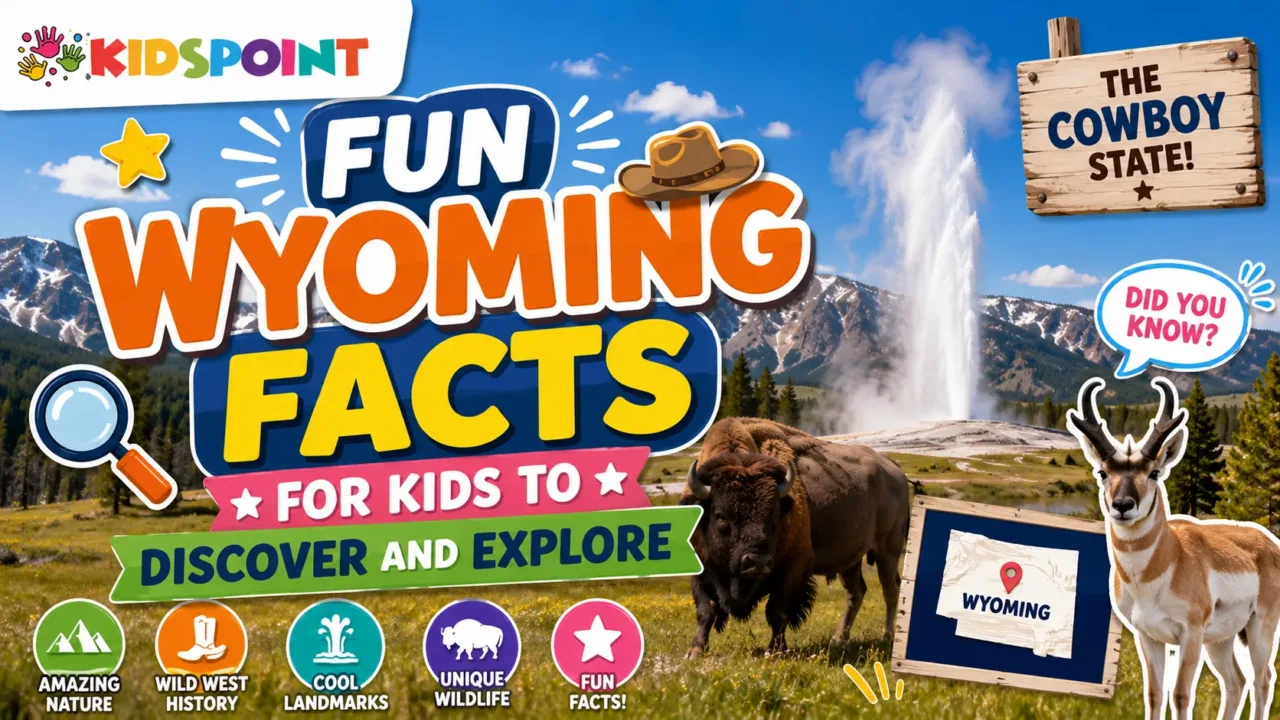
Wyoming is a state filled with wide-open spaces, towering mountains, fascinating wildlife, colorful landscapes, and stories from the American West. It is also home to one of the most famous national parks in the United States, making it an exciting place for children to learn about geography, nature, history, and science.
From geysers that shoot hot water into the air to enormous mountains and animals that roam across the plains, Wyoming facts for kids can turn a geography lesson into an adventure.
At The Kids Point, we love helping children discover interesting places through fun, age-appropriate learning. Exploring Wyoming gives kids a chance to learn about landforms, wildlife, Native American history, state symbols, famous landmarks, and the natural world.
So grab your imaginary explorer’s backpack and let’s discover some amazing facts about the Equality State!
Where Is Wyoming?
Wyoming is located in the western part of the United States.
It shares borders with Montana, South Dakota, Nebraska, Colorado, Utah, and Idaho.
Wyoming is one of the states known as the Mountain West. Much of its landscape includes mountains, high plains, grasslands, forests, rivers, and valleys.
The state’s location makes it an excellent place to learn about how geography can influence weather, wildlife, communities, and outdoor activities.
Wyoming Is the 10th Largest State
Wyoming is surprisingly large.
By land area, it is the 10th-largest state in the United States.
Even though Wyoming covers a huge area, it has a relatively small population compared with many other states.
This means children can imagine Wyoming as a place with lots of open land, where large stretches of countryside separate towns and communities.
Wyoming Is Known as the Equality State
Wyoming’s official nickname is the Equality State.
The nickname relates to Wyoming’s important history involving women’s voting rights.
In 1869, Wyoming Territory gave women the right to vote. This happened decades before women gained the right to vote nationwide in the United States.
That makes Wyoming an interesting state to study when learning about American history and the development of voting rights.
Wyoming Was the First State to Give Women the Right to Vote
One of the most important Wyoming facts for kids is its connection to women’s voting rights.
When Wyoming was still a U.S. territory, it passed a law allowing women to vote.
The decision made Wyoming a notable part of American history.
A woman named Louisa Swain is often remembered as the first woman to cast a ballot under Wyoming’s women’s suffrage law.
This history helps children understand that different states sometimes played important roles in changing the country.
Wyoming Became a State in 1890
Wyoming became the 44th state of the United States on July 10, 1890.
Before becoming a state, it was known as Wyoming Territory.
Today, July 10 is celebrated as Wyoming’s statehood day.
Learning when a state joined the country is a simple way for children to practice historical timelines.
Cheyenne Is the State Capital
Cheyenne is the capital and largest city of Wyoming.
It was established in the 19th century and became an important location along transportation routes through the region.
Cheyenne is also famous for its connection to the American West and its annual Cheyenne Frontier Days, a major celebration featuring rodeo events, entertainment, and Western traditions.
Wyoming Has Famous Mountains
Wyoming is home to many impressive mountains.
One of the best-known mountain ranges is the Teton Range.
The Teton Range contains dramatic peaks that rise above the surrounding landscape.
The highest mountain in Wyoming is Gannett Peak, which reaches about 13,804 feet above sea level.
That is more than two and a half miles high!
For children interested in geography, mountains provide a great opportunity to learn about elevation, erosion, glaciers, weather, and ecosystems.
Grand Teton National Park
Grand Teton National Park is one of Wyoming’s most spectacular natural areas.
The park protects the Teton Range and surrounding forests, lakes, rivers, and wildlife habitats.
Visitors may see animals such as elk, moose, bison, bears, and many kinds of birds.
The mountains also make the park a popular place for hiking, photography, camping, wildlife watching, and other outdoor activities.
Yellowstone National Park Is Partly in Wyoming
One of the most famous facts about Wyoming is that much of Yellowstone National Park is located within the state.
Yellowstone was established in 1872 and is widely recognized as the world’s first national park.
Although parts of Yellowstone extend into Montana and Idaho, most of the park lies in Wyoming.
The park is famous for geysers, hot springs, waterfalls, wildlife, forests, and enormous landscapes.
Old Faithful Is a Famous Geyser
Yellowstone is home to Old Faithful, one of the world’s most famous geysers.
A geyser is a hot spring that periodically shoots water and steam into the air.
Old Faithful became famous because its eruptions can be predicted relatively well compared with many other geysers.
Watching hot water shoot into the air can help children understand that Earth’s interior contains enormous amounts of heat.
Yellowstone Has Many Geysers
Old Faithful is only one part of Yellowstone’s geothermal world.
The park contains thousands of geothermal features, including geysers, hot springs, mud pots, and fumaroles.
These features exist because Yellowstone sits above a region with intense geothermal activity.
That makes Yellowstone an incredible natural classroom for learning about geology and Earth’s internal heat.
Wyoming Has Colorful Hot Springs
Some of Yellowstone’s hot springs are famous for their bright colors.
Different microorganisms can live around hot springs and contribute to colors such as yellow, orange, green, and brown.
Minerals and temperature also influence the appearance of geothermal features.
Children should always remember that these areas can be extremely hot and dangerous. Visitors need to stay on designated trails and follow park safety instructions.
Wyoming Is Home to Bison
Bison are one of the animals strongly associated with Wyoming and the American West.
Large herds can be found in and around Yellowstone.
Bison are powerful wild animals and can move much faster than they look.
Even though they may appear calm, people should never approach or attempt to touch them.
Wild animals are best admired from a safe distance.
Wyoming Has Many Other Amazing Animals
Wyoming’s varied habitats support many types of wildlife.
Children may learn about:
- Elk — Large members of the deer family that live in many parts of the state.
- Moose — Large animals often associated with forests, wetlands, and mountain environments.
- Pronghorn — Fast-running animals found across Wyoming’s open landscapes.
- Bighorn sheep — Mountain animals known for their impressive curved horns.
- Grizzly bears and black bears — Bears that live in parts of Wyoming, including areas around Yellowstone and the northern Rocky Mountains.
- Wolves — Predators that play important roles in some ecosystems.
Learning about these animals can help children understand food chains and the importance of protecting habitats.
Wyoming Has a Unique Animal Called the Pronghorn
The pronghorn is one of the most interesting animals children can learn about.
It lives across parts of Wyoming’s open country and is famous for being an incredibly fast runner.
The pronghorn is not actually an antelope, even though it is sometimes called the American antelope.
It belongs to its own unique family of mammals.
Its ability to run quickly helps it escape predators across wide-open landscapes.
Wyoming’s State Animal Is the Bison
Wyoming selected the American bison as its state mammal.
The bison represents the state’s Western heritage and natural environment.
Children may see bison represented in artwork, educational materials, state symbols, and historical stories.
Wyoming’s State Bird Is the Western Meadowlark
The western meadowlark is Wyoming’s state bird.
It is known for its cheerful song and yellow-and-brown coloring.
The bird can be found in grasslands and open areas.
Learning about state birds is a fun way for children to connect geography with nature.
Wyoming’s State Flower Is the Indian Paintbrush
The Indian paintbrush is Wyoming’s state flower.
It is known for its colorful red, orange, pink, yellow, or other shades depending on the species.
Wildflowers such as Indian paintbrush can be found across parts of Wyoming’s landscapes.
The Wyoming State Flag Has a Bison
- Wyoming’s state flag has a white silhouette of a bison in the center.
- The bison faces away from the flagpole.
- The flag also uses colors associated with the state’s history and natural landscape.
- Ask children to draw their own Wyoming flag and explain what each part represents.
- This makes a fun art and geography activity.
Wyoming Is Famous for the American West
Wyoming played an important role in the history and culture of the American West.
Stories of cowboys, cattle ranching, wagon travel, railroads, Native American communities, and frontier towns are connected with the region.
However, the history of Wyoming is much broader than cowboy stories.
The state’s past also includes the long history of Indigenous peoples who lived in and traveled through the region.
Learning about Wyoming means exploring many different cultures, communities, and historical perspectives.
Native American History in Wyoming
Native peoples have lived in the area now known as Wyoming for thousands of years.
Several Indigenous nations have important historical and cultural connections to the region, including the Eastern Shoshone and Northern Arapaho.
The Wind River Reservation is located in central Wyoming and is home to the Eastern Shoshone and Northern Arapaho communities.
Children learning about Wyoming should understand that Indigenous history is an important part of the state’s story, not simply a chapter from the distant past.
Wyoming Has Fossils
Wyoming is an exciting place for children interested in dinosaurs and fossils.
Fossils from ancient plants and animals have been discovered throughout the state.
Wyoming’s geological history includes periods when the environment was very different from what we see today.
Fossils help scientists understand what life and environments were like millions of years ago.
A fossil activity can be a great way for children to connect Wyoming geography with Earth science.
Wyoming Has a Famous Fossil Fish
One interesting Wyoming fossil is the Knightia, an extinct freshwater fish.
Knightia fossils are commonly found in the Green River Formation.
These fossils help scientists study ancient aquatic ecosystems.
Children can imagine what Wyoming may have looked like millions of years ago, when lakes covered areas that are now dry land.
Wyoming Has Wide-Open Plains
Not all of Wyoming is covered by mountains.
The state also has enormous grasslands and high plains.
These open areas provide important habitats for animals such as pronghorn, bison, and many bird species.
The wide-open landscape is one reason Wyoming is often associated with big skies and dramatic horizons.
Wyoming Has Beautiful Rivers and Lakes
Wyoming contains many rivers and lakes.
Rivers such as the Snake River and North Platte River are important parts of the state’s geography.
Waterways support plants and animals and have historically helped communities develop.
Children can use a map to trace Wyoming’s major rivers and see how water moves through landscapes.
Wyoming Has a Dry Climate
- Much of Wyoming has a relatively dry climate.
- The state’s high elevation and mountain ranges influence its weather.
- Some areas receive more precipitation than others, especially mountainous regions.
- Winter can bring heavy snow to the mountains, while summers can be warm in lower areas.
- This makes Wyoming an interesting place to study how elevation affects weather.
Wyoming Has Amazing Night Skies
Because many parts of Wyoming have relatively low population density and large open areas, there are places where the night sky can appear remarkably dark.
On a clear night, children may be able to see many stars.
This makes Wyoming an exciting setting for learning about astronomy.
Try asking children to imagine what it would be like to camp under a sky filled with thousands of stars.
Fun Wyoming Facts at a Glance
- Wyoming is the 10th-largest U.S. state by land area.
- It became the 44th state in 1890.
- Its capital is Cheyenne.
- Wyoming is nicknamed the Equality State.
- Much of Yellowstone National Park is located in Wyoming.
- Yellowstone was established in 1872.
- Old Faithful is one of Yellowstone’s most famous geysers.
- The Teton Range is located in northwestern Wyoming.
- Gannett Peak is Wyoming’s highest mountain.
- The American bison is Wyoming’s state mammal.
- The western meadowlark is the state bird.
- Indian paintbrush is the state flower.
- Wyoming has a long and important Indigenous history.
- The state is famous for its mountains, plains, wildlife, fossils, and Western heritage.
Fun Ways for Kids to Explore Wyoming
Learning facts becomes even more exciting when children turn information into activities.
Draw a Wyoming Map
Give children a blank map and ask them to mark Wyoming’s capital, Yellowstone, Grand Teton, and neighboring states.
Design a State Flag
Children can draw Wyoming’s flag and then create their own version using animals, mountains, or other symbols they associate with the state.
Create a Wildlife Journal
Ask children to choose five Wyoming animals and create a page for each one.
They can draw the animal, describe where it lives, and write one interesting fact.
Make a Geyser Model
Using safe household materials, children can create a simple demonstration of how water can move upward under pressure. Adult supervision is important, and experiments involving heat or pressure should be avoided unless specifically designed for children and properly supervised.
Plan an Imaginary Wyoming Adventure
Ask children to imagine spending one week exploring Wyoming.
- Where would they go?
- What animals would they hope to see?
- Would they visit Yellowstone or Grand Teton?
- What would they pack?
This turns geography into imaginative writing.
Why Learning Wyoming Facts Is Valuable
Learning about a state is more than memorizing names and numbers.
Wyoming can introduce children to geography, geology, ecology, history, astronomy, wildlife, and environmental responsibility.
- A child who learns about geysers can become curious about Earth’s interior.
- A child who learns about bison may become interested in wildlife conservation.
- A child who studies mountains may want to learn about elevation and weather.
That’s the beauty of geography: one question can lead to another.
Discover More With The Kids Point
Wyoming is a state where science, nature, history, and adventure come together. From the spectacular peaks of the Teton Range to the geothermal wonders of Yellowstone, there is something fascinating around almost every corner.
For kids, learning about Wyoming can be the beginning of a much bigger adventure into geography and the natural world.
Ready for More Learning Adventures?
Encourage your child to choose one Wyoming topic that interests them most. They could draw a bison, research a geyser, create a state map, learn about a mountain, or write a story about exploring Yellowstone.
At The Kids Point, we are committed to creating engaging resources that help children learn while having fun. Explore more educational activities, science ideas, games, jokes, crafts, and learning resources, and join our community for more kid-friendly inspiration.
Let’s make every learning adventure curious, creative, safe, and fun!
Frequently Asked Questions
What is Wyoming famous for?
Wyoming is famous for Yellowstone National Park, Grand Teton National Park, mountains, wildlife, geysers, wide-open landscapes, and its connection to the history of the American West.
Why is Wyoming called the Equality State?
Wyoming is called the Equality State because of its early role in women’s voting rights. Wyoming Territory gave women the right to vote in 1869.
What is the capital of Wyoming?
The capital of Wyoming is Cheyenne.
When did Wyoming become a state?
Wyoming became the 44th U.S. state on July 10, 1890.
What national parks are in Wyoming?
Yellowstone National Park and Grand Teton National Park are two of Wyoming’s best-known national parks. Yellowstone also extends into Montana and Idaho.
What is Wyoming’s state animal?
The American bison is Wyoming’s official state mammal.
What is Wyoming’s state bird?
The western meadowlark is Wyoming’s state bird.
What is Wyoming’s state flower?
The Indian paintbrush is Wyoming’s state flower.
What is the highest mountain in Wyoming?
Gannett Peak is the highest mountain in Wyoming, reaching approximately 13,804 feet above sea level.
What animals live in Wyoming?
Wyoming is home to animals including bison, elk, moose, pronghorn, bighorn sheep, bears, wolves, and many species of birds.
Why is Yellowstone important?
Yellowstone is famous for its geothermal features, wildlife, landscapes, and scientific importance. It was established as a national park in 1872.
Is Wyoming good for learning about nature?
Yes. Wyoming provides opportunities to learn about mountains, wildlife, fossils, rivers, forests, grasslands, geology, weather, and geothermal activity.
Welcome to The Kids Point!
At The Kids Point, we are dedicated to creating a world of wonder, learning, and fun for children of all ages. Our mission is to provide engaging, informative, and entertaining content that sparks curiosity, creativity, and joy in young minds.
We are a team of passionate educators, writers, and parents who understand the importance of quality content for children. Our diverse backgrounds and expertise come together to create stories, activities, educational resources, interactive games, jokes, and articles that are both entertaining and enriching.
Our content is carefully created to be age-appropriate, safe, educational, creative, and inclusive. We believe every child deserves a place where they can explore, learn, imagine, and grow.
Whether you are a parent, educator, or simply someone who loves great content for kids, we invite you to join our community. Together, let’s make learning fun, meaningful, and inspiring for children everywhere!