

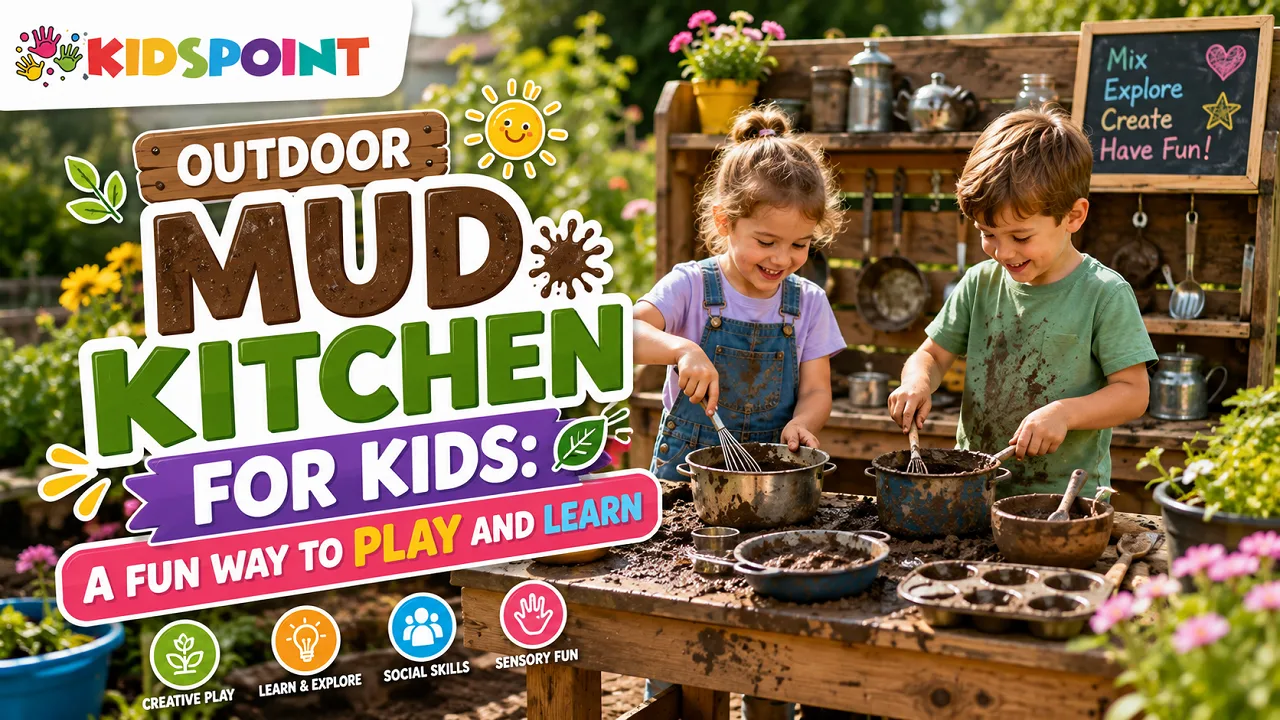
There is something wonderfully exciting about playing with mud. Give children a little soil, some water, a few old kitchen tools, and a place to experiment, and they can spend hours mixing, pouring, scooping, stirring, pretending, and creating.
An outdoor mud kitchen for kids turns simple natural materials into an open-ended play space where imagination and learning can happen together. Children can pretend to be chefs, scientists, restaurant owners, gardeners, or inventors while exploring what happens when soil, water, leaves, sticks, stones, and other natural materials come together.
Unlike many toys that have one specific purpose, a mud kitchen does not tell children exactly what to make. A bowl can become a cooking pot, a stick can become a spoon, and a pile of mud can become a pretend cake.
At The Kids Point, we believe children learn best when they have opportunities to explore, create, and experiment. A mud kitchen is a simple way to encourage all three.
What Is an Outdoor Mud Kitchen?
An outdoor mud kitchen is a play area designed for children to explore mud, water, and natural materials through imaginative and sensory play.
It can be as simple as a small table with a few old bowls and spoons or as elaborate as a dedicated outdoor station with shelves, containers, a sink, cooking surfaces, and storage.
The most important part is not how expensive or complicated the setup is.
The goal is to provide children with a safe place where they can use their imagination and experiment with natural materials.
Why Do Kids Love Mud Kitchens?
Mud kitchens give children something many modern toys do not: freedom to decide what happens next.
A child can make a pretend soup in one moment and turn the same ingredients into a magical potion the next.
There are no strict rules about what the finished product should look like.
This open-ended quality makes mud kitchens particularly enjoyable for imaginative play.
Children can also get their hands dirty, which adds a sensory element that many indoor activities cannot provide.
They can feel wet mud between their fingers, listen to water pouring, smell damp soil, observe different textures, and watch mixtures change.
The Learning Benefits of Mud Kitchen Play
Mud play may look like simple fun, but it can support many areas of children’s development.
Imagination and Pretend Play
Children naturally create stories around mud kitchens.
One child might pretend to run a restaurant.
Another might create a pretend bakery.
A group of children could imagine that they are scientists preparing mysterious mixtures.
Pretend play allows children to practice communication, storytelling, decision-making, and creativity.
Because there is no single correct way to use a mud kitchen, children can create their own worlds.
Sensory Development
Mud kitchens provide rich sensory experiences.
Children can explore:
- Wet and dry textures
- Heavy and light materials
- Smooth and rough surfaces
- Warm and cool water
- Thick and thin mixtures
- Different smells and natural materials
These experiences help children become more aware of the world around them.
Early Science Skills
Mud kitchens can naturally introduce scientific thinking.
Children may notice that dry soil changes when water is added.
They may discover that too much water creates a runny mixture while less water creates something thicker.
They can experiment with leaves, sand, stones, flowers, and other natural objects.
Instead of simply being told about cause and effect, children can observe it themselves.
Early Math Skills
Math can also appear naturally during mud kitchen play.
Children may count spoons of soil, compare the amount of water in containers, sort natural materials, or decide which container is bigger.
You can introduce questions such as:
- “Which bowl holds more?”
- “How many scoops did you use?”
- “Which mixture is heavier?”
- “Can you make two equal portions?”
These questions turn play into an informal math experience.
Language Development
Children often talk a lot while playing pretend games.
They may explain recipes, describe ingredients, negotiate roles, or tell stories about what they are making.
Parents can encourage language development by asking open-ended questions.
- “What are you making?”
- “What ingredients did you use?”
- “What happens when you add more water?”
- “Who is going to eat your pretend meal?”
The goal is not to correct every answer. It is to encourage children to communicate and explain their ideas.
How to Create a Simple Outdoor Mud Kitchen
You do not need a large backyard or expensive equipment.
A basic mud kitchen can be created with a sturdy outdoor table, a few containers, and access to soil and water.
Look around your home for items that are no longer needed.
Old metal bowls, wooden spoons, measuring cups, plastic containers, baking trays, sieves, and muffin tins can become wonderful mud-play tools.
Avoid using anything sharp, fragile, or unsafe for children.
Choose the Right Location
Choose an outdoor area where children can get messy without causing problems.
A garden corner, patio, backyard, or other suitable outdoor space can work.
It is helpful to have the mud kitchen close to a water source if possible.
Think about drainage too. A place where excess water can safely soak into the ground is often easier to manage.
Add a Child-Friendly Work Surface
A small outdoor table or sturdy bench can become the main workspace.
Children should be able to reach the surface comfortably.
If you are building a permanent structure, make sure it is stable and cannot easily tip over.
You do not need to create a realistic kitchen.
A simple surface with containers can provide plenty of opportunities for creative play.
Add Simple Mud Kitchen Tools
A mud kitchen can include many everyday objects.
Consider providing:
- Old bowls
- Wooden spoons
- Measuring cups
- Small buckets
- Colanders
- Muffin trays
- Plastic containers
- Whisks
- Small watering cans
- Baking trays
- Funnels
- Scoops
- Spatulas
Choose sturdy items that are appropriate for outdoor use.
Children can use these objects to scoop, pour, mix, measure, sort, and create.
Natural Materials Make Play More Interesting
The best ingredients for a mud kitchen often come directly from nature.
Children can use soil, sand, water, small sticks, fallen leaves, grass, pinecones, and safe natural materials available in the area.
These materials change with the seasons.
Spring may bring flowers and fresh leaves.
Summer can provide plenty of warm soil and outdoor water play.
Autumn offers colorful leaves and seed pods.
Winter can introduce interesting changes in texture and temperature where weather conditions permit safe outdoor play.
Always supervise children around unfamiliar plants and natural materials, and teach them not to eat anything they find outdoors.
Mud Kitchen Recipes for Kids
Pretend recipes can make mud kitchen play even more engaging.
Mud Soup
Children can combine soil, water, leaves, grass, and small stones in a bowl.
They can stir everything together and invent a name for their soup.
Maybe it is “Rainbow Garden Soup” or “Dinosaur Soup.”
Mud Cakes
Children can pack damp mud into old containers or molds.
They can decorate their pretend cakes with leaves, petals, or small natural objects.
Magical Potions
Give children containers and encourage them to create imaginary potions.
They can invent names and explain what each potion supposedly does.
This is a great opportunity for storytelling.
Mud Pies
Mud pies are a classic.
Children can make different sizes and compare them.
They can decorate each one differently and create a pretend bakery.
Encourage Group Play
Mud kitchens can work particularly well for siblings and groups of children.
Children can assign different roles.
One child might be the chef.
Another might be the customer.
Another could collect ingredients.
Another could manage the pretend restaurant.
This type of cooperative play encourages communication and negotiation.
Children learn that they may need to listen to other people’s ideas and share resources.
Encourage Independent Play Too
A mud kitchen does not always need a group.
Children can also spend quiet time exploring independently.
Independent play gives children opportunities to make decisions without constantly receiving instructions from adults.
Parents can provide the materials and step back when appropriate.
Sometimes the most creative ideas appear when adults allow children to take the lead.
Turn Mud Play Into a Science Experiment
Parents can introduce simple scientific questions without turning play into a formal lesson.
Ask:
- “What happens if you add more water?”
- “What happens if you add sand?”
- “Which mixture is easiest to pour?”
- “What happens when the mud dries?”
- “Can you make a mixture that is thick enough to build with?”
These questions encourage children to predict, test, observe, and describe.
That is scientific thinking in a playful form.
Add Math to the Mud Kitchen
Math can be introduced naturally.
Ask children to count how many scoops of mud they use.
Challenge them to fill a container halfway.
Ask them to compare two bowls.
You could say:
- “Can you make two bowls with the same amount?”
- “Which container holds more?”
- “Can you use five scoops?”
These simple challenges help children practice number sense and measurement.
Art and Creativity With Mud
- Mud can also become an art material.
- Children can use sticks to draw patterns in wet mud.
- They can create pretend food displays.
- They can decorate mud cakes with natural materials.
- They can make temporary pictures on suitable outdoor surfaces.
- This combines sensory exploration with creative expression.
Mud Kitchen Safety Tips
Safety should always come first.
Children should be supervised appropriately, especially when playing with water, tools, or unfamiliar natural materials.
Teach children that mud kitchen ingredients are for pretend cooking and should never be eaten.
Use clean containers and child-safe utensils.
Avoid sharp tools, broken dishes, glass, or rusty objects.
Wash hands thoroughly after outdoor mud play, especially before eating.
Keep the play area free from hazardous plants, animal waste, sharp objects, and other unsafe materials.
If children have cuts or irritated skin, consider covering the affected area before messy play.
Keep the Mud Kitchen Clean
Mud kitchens do not need to be spotless.
Mess is part of the fun.
However, tools should be rinsed regularly and stored somewhere clean and dry when appropriate.
Remove spoiled food or organic materials that children may have introduced into pretend recipes.
If real food is used for a separate activity, keep it clearly separate from mud-play materials.
A simple cleaning routine can keep the area enjoyable and hygienic.
How Parents Can Encourage Better Mud Play
You do not need to constantly direct children.
Instead, try making occasional suggestions.
For example:
- “Can you make something that floats?”
- “Can you create a restaurant menu?”
- “Can you make three different kinds of mud?”
- “Can you build a tiny garden?”
- “Can you make a recipe with five ingredients?”
These prompts provide inspiration without taking control of the activity.
Create a Mud Kitchen Menu
For children who enjoy pretend restaurant play, make a simple menu together.
They can invent food names such as:
- Chocolate Mud Pie
- Rainbow Leaf Salad
- Garden Soup
- Dinosaur Stew
- Sprinkle Stone Cake
Children can draw pictures beside each item.
This combines pretend play, writing, drawing, and storytelling.
Mud Kitchens Can Grow With Children
A mud kitchen does not have to stay the same.
As children grow, add new challenges.
Younger children may focus on scooping and pouring.
Older children can experiment with measuring, mixing, designing recipes, building structures, and creating elaborate pretend stories.
You can also change the materials according to children’s interests.
A child interested in gardening might enjoy adding pots and natural materials.
A child interested in science might enjoy measuring cups and experiment challenges.
A child who loves storytelling might turn the kitchen into a magical restaurant.
Why Simple Play Can Be So Powerful
Children do not always need expensive toys or elaborate activities.
A simple outdoor mud kitchen can provide opportunities for creativity, sensory exploration, communication, science, math, and social play.
The materials are simple, but the possibilities are almost endless.
That is the beauty of open-ended play.
There is no single finished product.
Children decide what they want to create.
Make Outdoor Learning Messy, Creative, and Fun
An outdoor mud kitchen gives children permission to explore the natural world with their hands. They can mix, pour, scoop, pretend, experiment, create stories, and learn from the results.
Most importantly, children can enjoy the process without worrying about making everything perfect.
At The Kids Point, we believe meaningful learning can happen anywhere—even in a muddy backyard.
Ready to Create Your Own Mud Kitchen?
You do not need a complicated setup to get started. Find a sturdy outdoor surface, gather a few safe old kitchen tools, choose a suitable muddy play area, and let your child’s imagination take over.
Encourage your child to invent recipes, create pretend restaurants, conduct simple experiments, and explore natural materials. Give them the freedom to make a mess while providing the supervision and safety guidance they need.
For more creative activities, educational ideas, science experiments, games, and learning resources for children, join The Kids Point community.
Together, we can help children play creatively, explore confidently, and discover the joy of learning through everyday experiences.
Frequently Asked Questions
What is an outdoor mud kitchen for kids?
An outdoor mud kitchen is a play area where children can use mud, water, natural materials, and safe kitchen tools for imaginative and sensory play.
What do children learn from mud kitchen play?
Mud kitchen play can support creativity, sensory development, communication, early science, math concepts, problem-solving, cooperation, and imaginative thinking.
What should I put in a kids’ mud kitchen?
You can include old bowls, wooden spoons, measuring cups, buckets, muffin trays, colanders, sieves, watering cans, funnels, and other sturdy child-safe kitchen items.
Is mud play safe for children?
Mud play can be an enjoyable activity when children are appropriately supervised and the play area is free from hazards. Children should not eat mud or unknown natural materials and should wash their hands afterward.
Do I need to build a permanent mud kitchen?
No. A mud kitchen can be as simple as a small outdoor table with containers, spoons, and access to mud and water. A permanent structure is optional.
How can I make a mud kitchen educational?
Parents can introduce simple questions about measurement, mixtures, texture, cause and effect, counting, sorting, and observation while allowing children to lead the play.
What natural materials can children use in a mud kitchen?
Children can use safe soil, sand, water, fallen leaves, small sticks, pinecones, and other suitable natural materials. Always check unfamiliar plants and materials for safety.
Can toddlers use a mud kitchen?
Toddlers can enjoy age-appropriate mud kitchen activities with close adult supervision. Use large, safe tools and avoid small objects that could create a choking hazard.
Welcome to The Kids Point!
At The Kids Point, we are dedicated to creating a world of wonder, learning, and fun for children of all ages. Our mission is to provide engaging, informative, and entertaining content that sparks curiosity, creativity, and joy in young minds.
We are a team of passionate educators, writers, and parents who understand the importance of quality content for children. From captivating stories and exciting activities to educational articles and interactive games, The Kids Point offers resources designed to inspire and educate.
Our content is carefully created to be age-appropriate, safe, educational, creative, and inclusive. We believe every child deserves opportunities to explore, learn, imagine, and grow.
Whether you are a parent, educator, or simply someone who loves great content for kids, we invite you to join our community. Together, let’s make learning fun and inspiring for children everywhere.