

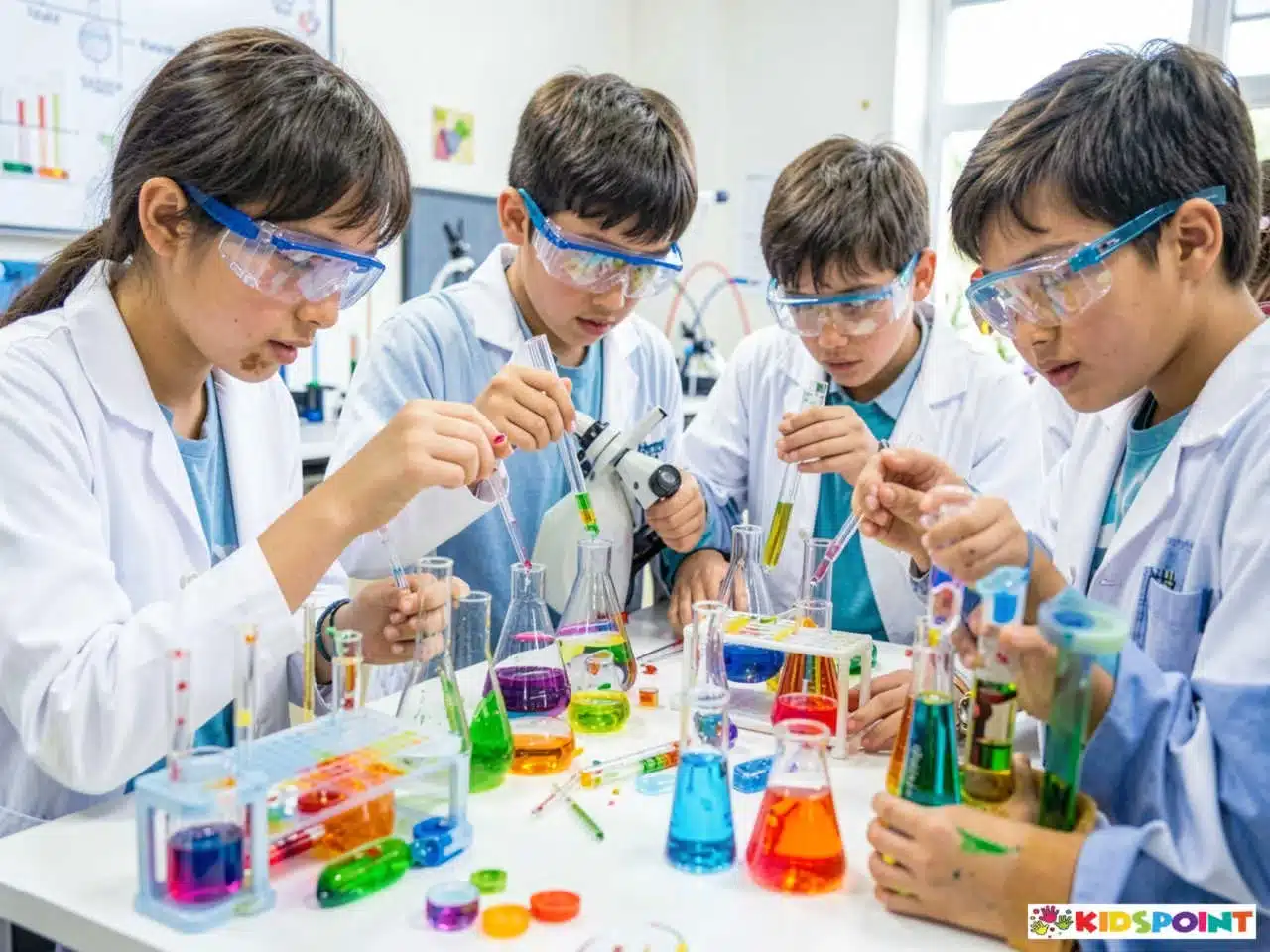
Science is everywhere. It is in the air we breathe, the food we eat, the rain that falls, and even the way a bird flies across the sky. For children, science is much more than a school subject. It is an exciting adventure filled with questions, surprises, and discoveries. Kids naturally ask, “Why is the sky blue?” “How do plants grow?” or “Why does ice melt?” These simple questions are the beginning of scientific thinking.
Learning science should never feel boring or difficult. The best way for children to understand science is by seeing it happen with their own eyes and experiencing it with their own hands. Fun experiments and real-life discoveries can turn learning into a joyful journey.
At The Kids Point, we believe that science should inspire curiosity, creativity, and excitement. When children explore science through engaging activities, they build confidence and develop a love for learning that can stay with them for life.
Why Science Matters for Kids
Science helps children understand how the world works. More importantly, it teaches them how to think. Instead of simply memorizing facts, science encourages children to ask questions, make predictions, test ideas, and learn from results.
Scientific learning helps children develop important skills such as:
- Problem-solving abilities
- Critical thinking
- Observation skills
- Creativity
- Patience
- Communication skills
These skills are useful not only in science classes but also in everyday life.
Imagine a child building a paper airplane and wondering why some designs fly farther than others. That simple activity involves experimenting, observing, and improving designs based on results. The child becomes a little scientist without even realizing it.
Science Is About Curiosity
Many of the world’s greatest discoveries began with curiosity. Scientists often start by asking a simple question.
Children are naturally curious. They notice details adults sometimes ignore. They ask unusual questions and imagine possibilities that seem impossible.
Curiosity should be encouraged because every question opens a door to learning.
For example:
- Why do stars twinkle?
- Why do leaves change color?
- Why do magnets stick to metal?
- How do fish breathe underwater?
- Why does a rainbow appear after rain?
Even when adults do not know the answers immediately, exploring those questions together creates valuable learning experiences.
Fun Experiment 1: The Rainbow Milk Experiment
This colorful experiment helps children learn about chemical reactions.
Materials:
- Milk
- Food coloring
- Dish soap
- Cotton swabs
- A shallow plate
Steps:
- Pour milk into the plate.
- Add drops of different food coloring around the milk.
- Dip a cotton swab into dish soap.
- Touch the soap-covered swab to the milk.
What Happens?
The colors begin moving and swirling around, creating beautiful patterns.
Why It Happens
Milk contains fats and proteins. Dish soap breaks apart fat molecules, causing movement in the liquid. As the molecules move around, they push the food colors in different directions.
Children learn that science can create something both educational and visually exciting.
Fun Experiment 2: Build a Volcano
Volcano experiments remain a favorite among children because they combine creativity and dramatic results.
Materials:
- Baking soda
- Vinegar
- Food coloring
- Dish soap
- Small container
- Clay or paper for creating a volcano shape
Steps:
- Place the container in the middle of your volcano model.
- Add baking soda into the container.
- Add food coloring and a few drops of dish soap.
- Pour vinegar into the container.
What Happens?
Foamy lava erupts from the volcano.
Why It Happens
Baking soda and vinegar create a chemical reaction that releases carbon dioxide gas. The gas creates bubbles and pressure, causing the foamy eruption.
This experiment teaches children about reactions between different substances.
Fun Experiment 3: Invisible Ink Messages
Children love mysteries and secret messages.
Materials:
- Lemon juice
- Cotton swab
- White paper
- Lamp or warm light source
Steps:
- Dip the cotton swab into lemon juice.
- Write a message on paper.
- Allow the paper to dry completely.
- Hold the paper near a warm light source.
What Happens?
The hidden message slowly appears.
Why It Happens
Lemon juice contains carbon compounds that oxidize and turn brown when heated.
Kids learn about chemical changes while enjoying a fun spy activity.
Amazing Discoveries That Changed the World
Science experiments done at home are exciting, but real scientists have made discoveries that changed human life forever.
Electricity
Imagine life without lights, computers, televisions, or phones. Electricity powers much of our modern world.
Scientists spent many years understanding electricity and learning how it moves through wires and materials.
Today children can learn basic electricity concepts using batteries, wires, and small bulbs.
Gravity
Gravity keeps us on Earth and prevents us from floating into space.
If gravity suddenly disappeared, everything around us would drift away.
Children can explore gravity by dropping objects of different sizes and observing how they fall.
Dinosaurs and Fossils
Many children become fascinated by dinosaurs. Fossils allow scientists to learn about creatures that lived millions of years ago.
Scientists carefully study bones, footprints, and preserved remains to understand ancient life.
Children can create homemade fossils using clay and small objects like shells or leaves.
Space Exploration
Space is one of the most exciting scientific subjects for children.
People once looked at stars and wondered what existed beyond Earth. Today scientists use telescopes, satellites, and spacecraft to explore planets and galaxies.
Kids can create simple solar system models or observe moon phases to learn more about space.
Fun Experiment 4: Walking Water
This experiment looks like magic but demonstrates real science.
Materials:
- Several clear cups
- Water
- Food coloring
- Paper towels
Steps:
- Fill alternating cups with colored water.
- Leave some cups empty.
- Fold paper towels and place them between the cups.
What Happens?
Colored water slowly moves into the empty cups.
Why It Happens
This happens because of capillary action. Water molecules move through the tiny spaces in the paper towel.
Plants use a similar process to move water from roots to leaves.
Science in Nature
Nature itself is one giant science laboratory.
Children can learn countless scientific lessons simply by going outdoors.
Observe clouds and discuss weather changes.
Watch insects and learn about habitats.
Collect leaves and compare their shapes.
Plant seeds and observe growth over time.
Nature teaches children that science exists beyond books and classrooms.
Even simple activities like watching birds build nests can inspire questions and learning.
The Importance of Making Mistakes
Many children worry about getting the wrong answer. Science teaches an important lesson: mistakes are valuable.
Scientists often fail many times before achieving success.
An experiment may not work as expected, but that does not mean it failed completely. Unexpected results can teach important lessons.
For example, if a paper airplane does not fly well, children can change its shape and try again.
Learning through trial and error builds resilience and confidence.
Children begin understanding that progress often comes through repeated attempts.
Fun Experiment 5: Growing Crystal Shapes
Growing crystals can feel like watching science create art.
Materials:
- Warm water
- Salt
- String
- Glass jar
- Pencil
Steps:
- Mix salt into warm water until no more dissolves.
- Tie string around a pencil.
- Place the string into the jar.
- Leave it undisturbed for several days.
What Happens?
Small crystals begin forming on the string.
Why It Happens
As water evaporates, dissolved salt particles gather together and create crystal structures.
Children learn about evaporation and the formation of solids.
Science and Everyday Life
Science affects nearly everything we do.
Cooking involves chemistry.
Sports involve physics.
Gardening involves biology.
Music includes sound waves.
Medicine uses scientific research.
Transportation depends on engineering.
Helping children recognize science in everyday activities makes learning more meaningful.
For example, baking cookies can become a science lesson by discussing how heat changes ingredients.
Even blowing bubbles becomes a chance to discuss air pressure and surface tension.
Encouraging Young Scientists at Home
Parents and teachers do not need expensive equipment to support science learning.
Simple actions can make a big difference.
Ask Questions
Instead of giving immediate answers, ask:
“What do you think will happen?”
“Why do you think that happened?”
“How could we test your idea?”
Questions encourage children to think deeply.
Create Exploration Time
Allow children time to experiment and investigate.
Free exploration often leads to unexpected discoveries.
Celebrate Curiosity
No question should feel silly.
When adults show excitement about children’s questions, kids become more confident learners.
Read Science Books Together
Books can introduce children to animals, space, weather, inventions, and famous discoveries.
Stories about scientists can inspire future interests and dreams.
Amazing Facts Kids Love
Children enjoy surprising information that sparks curiosity.
Here are some fun science facts:
- Octopuses have three hearts.
- Honey never spoils.
- A day on Venus is longer than its year.
- Bananas are technically berries.
- Sound travels faster in water than in air.
- Some trees can communicate through underground networks.
Facts like these often inspire more questions and conversations.
The Future Belongs to Curious Minds
Today’s curious children may become tomorrow’s inventors, engineers, doctors, astronauts, or researchers.
The future will need people who can think creatively and solve problems.
Science education is not only about preparing children for careers. It is about helping them understand the world and giving them confidence to explore it.
Children who learn to ask questions and investigate ideas become lifelong learners.
FAQs
Why is science important for kids?
Science helps children develop curiosity, problem-solving skills, and a better understanding of the world around them.
What are some easy science experiments for kids?
Simple experiments like rainbow milk, volcano reactions, walking water, and growing crystals are fun and educational.
Can kids do science experiments safely at home?
Yes, children can safely perform many simple experiments with adult supervision and common household materials.
How does science help children in everyday life?
Science teaches critical thinking and helps children understand daily activities like cooking, weather, nature, and technology.
How can parents encourage children to enjoy science?
Parents can encourage curiosity by asking questions, exploring nature, reading science books, and doing hands-on activities together.
Science is one of the most exciting adventures children can experience. Through hands-on experiments, fascinating discoveries, and endless curiosity, kids can develop a deeper understanding of the world around them.
Whether creating colorful reactions, building volcanoes, growing crystals, or exploring nature, every activity becomes an opportunity to learn something new.
At The Kids Point, we believe learning should be fun, inspiring, and filled with wonder. Science gives children the opportunity to discover that the world is full of amazing mysteries waiting to be explored. Every question can lead to a discovery, and every discovery can lead to a bigger dream.
The journey of science begins with one simple question: “What happens if we try?”