

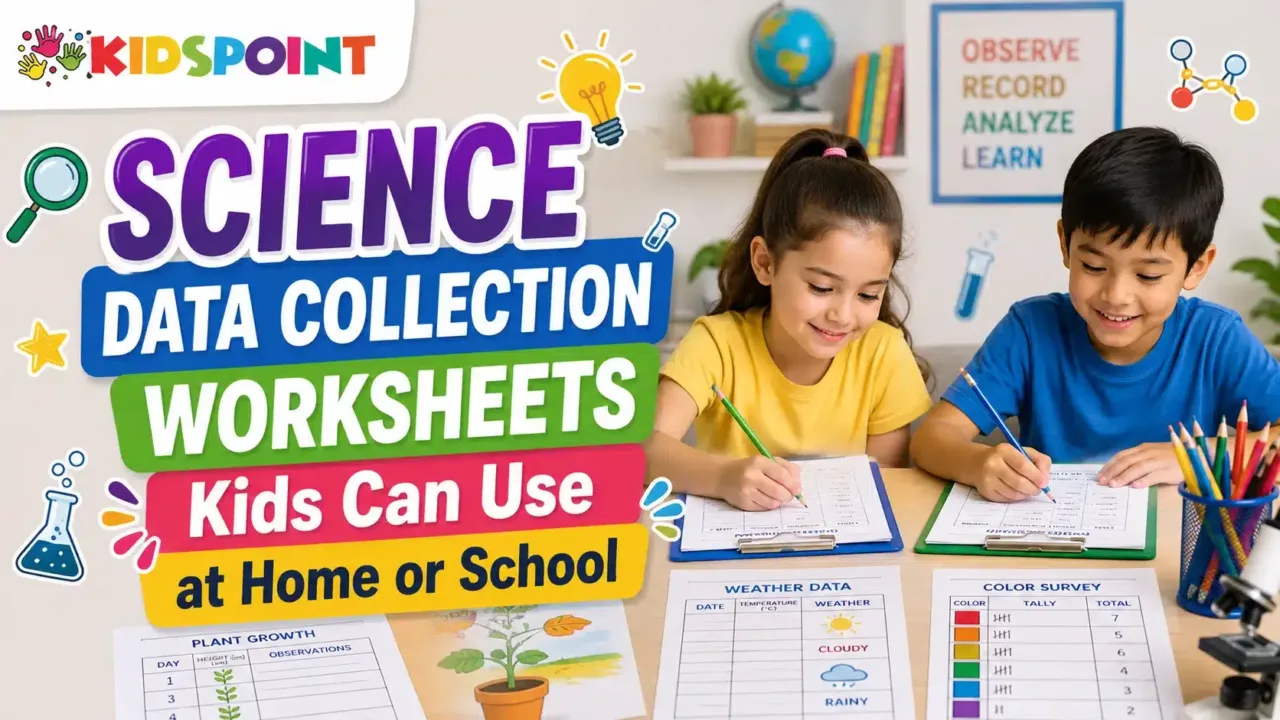
Science is everywhere. Children can discover science while watching a plant grow, observing clouds, testing which objects float, measuring shadows, or investigating how quickly ice melts. These everyday experiences can become meaningful learning opportunities when kids learn how to collect and record information.
Science data collection worksheets for kids provide a simple way to guide children through this process. Instead of simply observing something and moving on, children can write down what they see, make predictions, take measurements, compare results, and explain what they learned.
The best part is that children do not need expensive laboratory equipment. Many science data activities can be completed with materials found around the home, classroom, garden, or playground.
At The Kids Point, we believe learning should be engaging, creative, and hands-on. Science worksheets can help children turn their natural curiosity into organized investigations while developing skills they can use in school and everyday life.
Whether you are a parent looking for an educational activity, a teacher preparing a science lesson, or a caregiver searching for something fun to do with children, these ideas can help make data collection simple and enjoyable.
What Is Science Data Collection?
Science data collection means gathering information during an observation, experiment, or investigation.
For example, imagine a child wants to know how quickly a plant grows. Looking at the plant once may not provide enough information. Instead, the child can measure its height every day and record the results.
The measurements become data.
Data can include:
- Measurements
- Counts
- Dates and times
- Written observations
- Drawings
- Temperature readings
- Comparisons
- Descriptions of changes
- Results from repeated tests
A science worksheet gives children a convenient place to organize these details.
Why Is Data Collection Important for Kids?
Learning to collect data helps children understand how scientists investigate questions.
Instead of simply saying, “I think this plant grew a lot,” children can collect evidence that shows exactly how much it grew.
This process helps develop:
- Observation skills
- Measurement skills
- Critical thinking
- Problem-solving
- Organization
- Communication
- Mathematical thinking
- Scientific reasoning
Data collection also teaches children that predictions are not guaranteed to be correct. Sometimes an investigation produces a surprising result, and that is perfectly fine.
An unexpected result can lead to another question and another investigation.
10 Science Data Collection Activities for Kids
1. Plant Growth Data Collection
Plant growth is an excellent activity for teaching children how to collect data over time.
Children can plant a seed and observe it for several days or weeks. They can measure its height and record changes in its appearance.
A worksheet can ask children to record:
- The date
- Plant height
- Number of leaves
- Plant color
- Changes they notice
- A drawing of the plant
Encourage children to measure the plant using the same method each time.
After several days, ask them:
- Did the plant grow every day?
- When did you notice the biggest change?
- Did the number of leaves increase?
- What conditions might affect the plant’s growth?
This activity combines science, measurement, observation, and basic mathematics.
2. Weather Observation Worksheet
Weather is one of the easiest subjects for children to investigate because they can observe it every day.
Create a weekly weather observation activity. Children can record whether the day is sunny, cloudy, rainy, windy, or a combination of conditions.
Older children can also record temperature using an appropriate thermometer with adult guidance.
They can observe:
- Temperature
- Cloud conditions
- Rain
- Wind
- Sunshine
- Changes throughout the day
Younger children can draw a picture representing the weather.
After collecting information for several days, ask children to look for patterns.
Was one day warmer than the others? Did the weather change throughout the week? Were cloudy days cooler?
This activity shows children how repeated observations can reveal patterns.
3. Floating and Sinking Investigation
A bowl or container of water can become a simple science laboratory.
Choose several safe objects such as a plastic spoon, leaf, cork, small toy, or rock.
Before placing each object in water, ask children to predict whether it will float or sink.
They can record:
- The object
- Their prediction
- The actual result
- What they observed
Encourage children to compare their predictions with the results.
If an object behaves differently from what they expected, ask why they think that happened.
This activity introduces children to ideas related to buoyancy, density, prediction, and evidence.
4. Shadow Length Investigation
Shadows are constantly changing, making them ideal for a simple data collection activity.
Choose a suitable object outside and observe its shadow at different times of the day.
Children can record the time, measure the shadow, and draw what they see.
Ask:
- Is the shadow the same length all day?
- When is the shadow longest?
- When is it shortest?
- Does the direction change?
Children can compare observations from morning, midday, and afternoon.
This activity introduces basic concepts related to sunlight, position, and shadows while giving children valuable measurement practice.
5. Ice Melting Investigation
An ice cube experiment is a simple way to explore how environmental conditions affect change.
- Place similar-sized ice cubes in different safe locations.
- For example, one might be placed in a shaded area and another somewhere warmer.
- Ask children to predict which one will melt first.
- They can record when each ice cube begins melting and when it has completely melted.
- After the activity, discuss why the results were different.
Encourage children to think about temperature, sunlight, and surrounding conditions.
This is also a useful introduction to the idea of a fair test, where scientists try to keep important conditions consistent when comparing results.
6. Paper Airplane Data Collection
Paper airplanes provide a fun way to combine science, engineering, and mathematics.
Ask children to create different airplane designs. They can test each design several times and record how far each airplane travels.
Encourage them to start from the same location and measure the distance in the same way each time.
After testing, ask:
- Which design traveled the farthest?
- Did it perform well in every trial?
- Which design was most consistent?
- What could you change?
- Would a different wing shape affect the distance?
Children can redesign their airplanes and test them again.
This activity demonstrates that science can involve creativity, experimentation, and engineering.
7. Water Absorption Experiment
Children can investigate which materials absorb the most water.
Collect safe materials such as paper towels, tissues, cloth, and napkins.
Before testing, ask children to predict which material will absorb the most water.
Give each material a similar amount of water and observe what happens.
Children can record their observations and rank the materials from most absorbent to least absorbent.
Ask questions such as:
- Which material absorbed the most?
- Which absorbed the least?
- Did your prediction match the result?
This activity teaches comparison, measurement, prediction, and observation.
8. Nature Observation Worksheet
Children can collect science data simply by observing nature.
A backyard, school garden, or local outdoor area can become an exciting place for investigation.
Children can observe:
- Birds
- Insects
- Leaves
- Flowers
- Trees
- Clouds
- Other safe natural features
Ask children to record what they see, how many they observe, where they found them, and what they were doing.
Encourage children to describe observations accurately.
For example, instead of writing “The bird was happy,” a child could write, “The bird hopped across the grass and flew into a tree.”
This helps children learn the difference between an observation and an assumption.
9. Sound Observation Activity
Children can collect data about sounds in their environment.
Ask them to sit quietly for a few minutes and listen carefully.
They might hear:
- Birds
- Cars
- People talking
- Wind
- Dogs
- Rain
- Doors
- Construction sounds
Children can classify sounds as loud or soft, natural or human-made, and near or far.
Younger children can draw pictures of the things making each sound.
This activity encourages careful listening and helps children become more aware of their environment.
10. Temperature Tracking
Temperature tracking is another simple activity that can be completed at home or school.
With an appropriate thermometer and adult guidance, children can record temperatures at different times of the day.
They can compare morning, afternoon, and evening readings.
After collecting data for several days, children can answer questions such as:
- Which time of day was usually warmest?
- Which was coolest?
- Did the temperature change every day?
- What patterns did you notice?
Older children can turn their results into a simple graph.
What Should a Science Data Collection Worksheet Include?
A science worksheet does not need to be complicated. A simple format can be enough to guide children through an investigation.
A useful worksheet can include:
- My Question: What do I want to find out?
- My Prediction: What do I think will happen?
- Materials: What will I need?
- My Observations: What did I see, hear, measure, or notice?
- My Results: What happened?
- My Conclusion: What did I learn?
These sections can be adjusted according to the child’s age and the complexity of the activity.
Science Data Collection for Different Ages
Not every child needs the same type of worksheet.
Younger Children
Preschool and kindergarten children can focus on simple observations, counting, sorting, drawing, and basic comparisons.
For example, they might draw the weather or circle whether an object floated or sank.
Elementary Students
Elementary-aged children can begin recording measurements, making predictions, completing simple data activities, and comparing results.
Older Students
Older children can work with repeated trials, variables, averages, graphs, and written conclusions.
The goal should always be to make the activity educational without making it unnecessarily difficult.
How Parents Can Help Kids Collect Better Data
Parents do not need to be science experts to support data collection.
One of the easiest ways to help is by asking questions.
Before an investigation, ask:
“What do you think will happen?”
During the activity, ask:
“What are you noticing?”
Afterward, ask:
“Why do you think that happened?”
Encourage children to write down observations immediately. This prevents them from forgetting details.
Also encourage consistency. If children are measuring plant growth, they should use the same measuring method each time.
Most importantly, teach children to record the actual results—even if the results are different from their predictions.
Turn Science Data Into Graphs
After children collect information, introduce them to simple graphs.
For example, children tracking plant growth can create a line graph showing how the plant’s height changed.
Children tracking weather can create a graph comparing temperatures.
Students counting birds can create a picture graph showing how many they observed each day.
Graphs make data easier to understand and help children recognize patterns.
Encourage Kids to Investigate Their Own Questions
One of the best ways to make science meaningful is to let children ask their own questions.
Suppose a child discovers that one paper airplane design travels farther than another.
Instead of ending the activity, ask:
“What would happen if we changed the wing shape?”
That question can become a new investigation.
Children can make another prediction, test the new design, collect more data, and compare the results.
This encourages curiosity and shows children that science is a process rather than a single activity.
Science Data Collection Safety Tips
Adult supervision should be provided whenever an activity requires it.
Choose experiments and observations that are appropriate for the child’s age and abilities.
Be particularly careful with:
- Small objects
- Water around electronics
- Measurement equipment
- Household materials
- Outdoor environments
- Heat
- Wildlife
Children observing animals outdoors should maintain a safe distance and avoid touching or disturbing wildlife.
Parents and teachers should review each activity before beginning and provide appropriate guidance throughout.
How to Make Science Worksheets More Fun
A worksheet should support the activity rather than take away from the fun.
Let children draw their observations, decorate their science pages, choose questions, and explain results in their own words.
You can also create science challenges at home.
For example, ask:
- Which paper airplane design can travel the farthest?
- Which material absorbs the most water?
- How does a plant change over five days?
- How does the weather change during a week?
Questions like these make children active participants rather than passive learners.
Why Science Data Collection Is a Valuable Learning Skill
Science data collection teaches children much more than how to fill in a worksheet.
- It teaches them how to pay attention.
- It teaches them how to measure.
- It teaches them how to organize information.
- It teaches them how to compare evidence.
- It teaches them that unexpected results can be useful.
- Most importantly, it teaches children that questions can be investigated.
When children collect their own information, science becomes something they experience rather than something they simply read about.
Make Science Learning Exciting With The Kids Point
At The Kids Point, we are dedicated to creating a world of wonder, learning, and fun for children of all ages. We believe children should have opportunities to explore ideas, ask questions, experiment, and discover answers.
Science data collection activities are a wonderful way to bring learning into everyday life. A plant on a windowsill, an ice cube in the kitchen, a paper airplane in the backyard, or clouds in the sky can all become the starting point for a science investigation.
Ready to Explore More?
Turn your child’s curiosity into an exciting learning adventure with The Kids Point. Explore our collection of educational activities, science ideas, games, stories, and creative resources designed to make learning enjoyable.
Join The Kids Point community and discover more ways to help children explore, learn, imagine, and grow.
At The Kids Point, we believe every question can lead to a discovery and every discovery can become a learning opportunity.
Frequently Asked Questions
What is a science data collection worksheet for kids?
A science data collection worksheet helps children record information during an experiment or observation. It can include sections for questions, predictions, measurements, observations, results, and conclusions.
What can kids collect data about at home?
Children can collect data about plants, weather, temperature, shadows, sounds, ice melting, floating and sinking objects, paper airplanes, water absorption, and nature.
Why is data collection important for children?
Data collection helps children develop observation, measurement, organization, critical thinking, problem-solving, communication, and scientific reasoning skills.
Can younger children use science data collection worksheets?
Yes. Younger children can use simplified worksheets with pictures, drawings, counting activities, checkboxes, and basic observations. Activities should be appropriate for their age and abilities.
Can teachers use science data worksheets in school?
Yes. Teachers can use science data worksheets during classroom experiments, outdoor observations, science projects, laboratory activities, and hands-on investigations.
What should kids do if their results are different from their predictions?
Children should record the actual results. An unexpected result is not a failure. It can help children ask new questions and understand that scientific investigations do not always produce predictable outcomes.
How can parents make science data collection more enjoyable?
Parents can allow children to choose questions, make predictions, use everyday objects, draw observations, conduct repeated tests, and discuss their discoveries.
What skills do science data collection worksheets teach?
They can help children develop observation, measurement, organization, communication, mathematical thinking, critical thinking, problem-solving, and scientific reasoning skills.
Welcome to The Kids Point!
At The Kids Point, we are dedicated to creating a world of wonder, learning, and fun for children of all ages. Our mission is to provide engaging, informative, and entertaining content that sparks curiosity, creativity, and joy in young minds.
We are a team of passionate educators, writers, and parents who understand the importance of quality content for children. From captivating stories and exciting activities to educational articles and interactive games, The Kids Point offers a wide range of resources designed to inspire and educate.
Our content is carefully created to be age-appropriate, safe, educational, creative, and inclusive. We believe every child deserves opportunities to explore, learn, imagine, and grow.
Whether you are a parent, educator, or simply someone who loves great content for kids, we invite you to join our community. Together, let’s make learning fun and inspiring for children everywhere.