

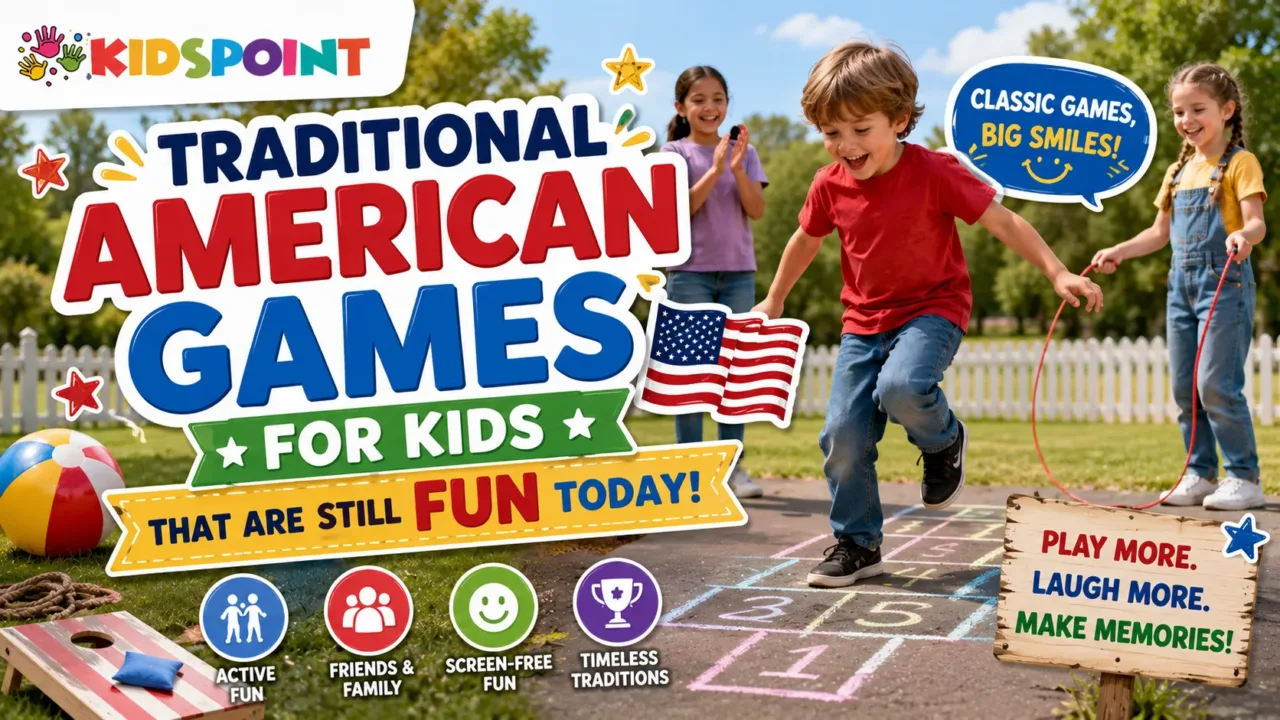
Children today have countless ways to play, but some of the most enjoyable games require nothing more than a little space, a few simple materials, and a group of willing players. Traditional American games for kids have been passed down through families, schools, neighborhoods, camps, and community gatherings for generations. They offer something special: simple rules, active movement, creativity, and plenty of opportunities to play together.
Games such as tag, hopscotch, jump rope, hide-and-seek, and four square don’t need expensive equipment or complicated technology. They encourage children to get outside, interact with others, solve problems, practice coordination, and use their imagination.
At The Kids Point, we believe some of the best childhood memories come from simple activities shared with friends and family. Traditional games can bring children together while also helping them develop physical, social, and thinking skills.
Let’s explore some classic American games that are still enjoyable today.
Why Traditional Games Are Still Great for Kids
Traditional games may be old-fashioned, but that doesn’t mean they are outdated. In fact, their simplicity is one of their greatest strengths.
Many classic games encourage children to move their bodies, communicate with others, follow rules, make decisions, and handle both winning and losing. They can also be adapted for different ages and abilities.
Another advantage is accessibility. A child doesn’t always need a special toy or electronic device to participate. A sidewalk, playground, backyard, or open field can become a place for exciting play.
Traditional games can also create opportunities for generations to connect. Parents and grandparents can teach children games they enjoyed when they were young, creating shared memories along the way.
1. Tag
Tag is one of the easiest games to organize and can be played almost anywhere with enough safe space.
One child is chosen as “It.” That player tries to tag another child. Once someone is tagged, the players can follow the agreed-upon rules for becoming the new “It.”
There are many variations, including freeze tag, tunnel tag, and flashlight tag for appropriate settings.
Tag encourages running, quick reactions, awareness, and cooperation. Children can also create their own versions by adding safe rules or special zones.
2. Hide-and-Seek
Hide-and-seek is a timeless game that combines movement, imagination, and anticipation.
One child closes their eyes and counts while the other players hide in an agreed-upon area. After counting, the seeker looks for everyone.
For younger children, keep the boundaries small and make sure adults know where everyone is hiding. Older children may enjoy larger, clearly defined areas.
Hide-and-seek can help children practice memory, observation, patience, and strategic thinking.
3. Hopscotch
Hopscotch turns a simple sidewalk into a fun activity.
Draw numbered squares with sidewalk chalk. Players take turns tossing a small marker onto a numbered space and moving through the pattern while following the rules.
Depending on the design, children may jump on one foot, use both feet, or alternate between different movements.
Hopscotch supports balance, coordination, counting, and body control. Kids can also design their own hopscotch patterns and numbers.
4. Jump Rope
Jump rope has been a favorite playground activity for generations.
Children can jump individually or work together with longer ropes. Traditional rhymes can make the activity even more entertaining.
Kids can practice basic jumps before trying more challenging movements, such as alternating feet or changing direction.
Jumping rope helps develop rhythm, coordination, balance, and endurance. It can also become a fun group challenge without requiring complicated equipment.
5. Four Square
Four square is a classic playground game that works particularly well with a group.
A large square is divided into four smaller squares. Each player occupies a section and tries to keep the ball moving according to the agreed-upon rules.
Players need to pay attention, react quickly, and decide where to send the ball.
The rules can be simplified for younger children or made more challenging for experienced players. Four square is especially useful for encouraging turn-taking and friendly competition.
6. Red Light, Green Light
Red Light, Green Light is a simple game that encourages children to listen carefully and control their movements.
One child acts as the leader and stands some distance away from the other players.
When the leader says “Green Light,” players move forward. When the leader says “Red Light,” everyone must stop.
Anyone who moves after “Red Light” follows the agreed-upon rule for returning or losing a turn.
The game helps children practice listening, reaction time, self-control, and body awareness.
7. Duck, Duck, Goose
Duck, Duck, Goose is a popular group game for younger children.
Players sit in a circle while one child walks around the outside, gently tapping players and saying “duck.” Eventually, the child chooses someone as “goose.”
The selected child gets up and chases the first player around the circle.
The game is easy to understand and encourages children to participate in a group setting. Adults can adapt the pace and rules for younger players.
8. Simon Says
Simon Says is a classic listening game that can be played indoors or outdoors.
One person becomes “Simon” and gives instructions such as:
“Simon says touch your toes.”
Players should only follow an instruction when it begins with “Simon says.”
If Simon gives a command without those words, players should remain still.
The game encourages careful listening, memory, concentration, and self-control. It can also become educational by incorporating math, spelling, science, or movement challenges.
9. Musical Chairs
Musical chairs is a lively group game that combines music, movement, and quick reactions.
Place chairs in a circle with one fewer chair than the number of players. While music plays, children move around the chairs. When the music stops, everyone tries to find a seat.
For younger children, consider adapting the game so nobody is eliminated. Instead, remove a chair and encourage children to work together to fit everyone safely into the remaining spaces.
This version focuses on cooperation rather than competition.
10. Marbles
Marbles are small glass balls that have been used in children’s games for generations.
There are many ways to play. Children can create a small playing area and try to knock other marbles toward a target or outside a marked boundary.
Because marbles are small, adults should consider the child’s age and supervision needs. They can present a choking hazard for young children.
For older children, marble games can encourage precision, hand-eye coordination, planning, and patience.
11. Kick the Can
Kick the Can combines elements of tag and hide-and-seek.
Players choose a designated area and place an empty can or similar safe object in a central location. One player guards the can while others hide.
Players try to reach the can without being caught.
Rules can vary considerably, so it’s important to establish boundaries and safety expectations before playing.
This game can be especially exciting for larger groups because children must decide when to hide, run, or help another player.
12. Capture the Flag
Capture the Flag is a classic team game that encourages strategy and cooperation.
Players divide into teams, and each team has a designated flag or object. The objective is to reach the other team’s area and bring its flag back while following the agreed-upon rules.
Because running games can become energetic, choose a safe playing area without traffic, dangerous obstacles, or restricted spaces.
Capture the Flag encourages communication, planning, teamwork, and problem-solving.
For younger children, simplify the game by reducing the playing area and removing complicated rules.
13. Kickball
Kickball is a playground favorite that combines elements of baseball with a softer, easier-to-kick ball.
One team kicks while the other team fields. The kicker runs between bases according to the agreed-upon rules.
Kickball can be modified for different ages. Younger children can use larger, softer balls and shorter distances.
The game encourages physical activity, coordination, teamwork, and basic understanding of rules and turns.
14. Red Rover
Red Rover is a historical playground game involving two groups of children standing opposite one another. Traditionally, players attempted to break through a linked line.
However, the traditional version can involve collisions and falls, so it isn’t the best choice for every group.
A safer modern alternative is to adapt the idea into a team challenge where children move between designated areas without physical contact. This keeps the teamwork element while reducing the risk of collisions.
When introducing traditional games, it’s always worth updating rules when necessary to make them more suitable for today’s children and play environments.
15. Charades
Charades doesn’t require running or special equipment, making it a great indoor or outdoor group activity.
One child acts out a word, animal, activity, or character without speaking. The other players try to guess what is being acted out.
For younger children, use simple ideas such as animals, foods, sports, or everyday actions.
Older children can create more challenging categories.
Charades encourages creativity, communication, observation, confidence, and imagination.
Making Traditional Games More Inclusive
One of the best things about classic games is that many can be adapted.
If running is difficult for a child, games such as tag can be changed into walking tag or seated tag.
Hopscotch can include different movement options.
Simon Says can include hand gestures, sounds, facial expressions, or simple questions.
Team games can focus on cooperation rather than eliminating players.
The goal isn’t simply to follow an old set of rules. The goal is to create an enjoyable experience where everyone can participate.
How Parents Can Bring Classic Games Back
Bringing traditional games into family life doesn’t have to require a major plan.
Choose one afternoon each week for a classic game day.
Let children select the game. Ask grandparents about games they played growing up. Try different versions and allow children to invent their own rules.
A family game afternoon can become a wonderful opportunity to spend time together without relying on screens.
You can even create a family list of favorite games and gradually work through them.
Safety Tips for Traditional Children’s Games
Before starting any active game, choose an appropriate playing area.
Remove obstacles that could cause trips or falls. Keep children away from roads, water hazards, construction areas, and other unsafe locations.
Use age-appropriate equipment and supervise younger children, particularly when games involve small objects such as marbles.
For running games, encourage children to watch where they are going and avoid pushing, grabbing, or unsafe physical contact.
Most importantly, make sure the rules are clear before the game begins.
The Educational Benefits of Classic Games
Traditional games can support much more than physical activity.
Children may practice counting while playing hopscotch, develop listening skills through Simon Says, and use strategy during Capture the Flag.
Games also provide opportunities to practice social skills.
Children learn how to take turns, communicate, follow rules, solve disagreements, cooperate with teammates, and respond appropriately when things don’t go their way.
These experiences can help children build confidence and independence in a natural, enjoyable environment.
Make Your Own Traditional Game
Once children become familiar with classic games, encourage them to invent something new.
They can combine elements from several games.
For example, they might create a game that includes:
- A starting line
- A jumping challenge
- A running section
- A teamwork activity
- A final target
Let children choose the name and rules.
They can even draw a map of the playing area and write instructions.
This turns playtime into a creative design project while encouraging children to think about fairness, safety, and problem-solving.
Bring Classic Play Into Your Child’s Day
Traditional American games remind us that fun doesn’t always require expensive toys, electronic devices, or complicated activities. A ball, some chalk, a jump rope, or simply a group of friends can be enough to create hours of entertainment.
Games such as tag, hide-and-seek, hopscotch, jump rope, four square, Simon Says, kickball, and charades continue to offer valuable opportunities for children to move, imagine, communicate, and connect.
At The Kids Point, we encourage parents and educators to keep these simple traditions alive while adapting them to make play safe, inclusive, and enjoyable for today’s children.
Ready to Make Playtime More Fun?
Pick one traditional game from this list and try it with your children this week. Let them choose the game, help establish the rules, and even invent a new variation. You may be surprised by how quickly a simple activity becomes a favorite family tradition.
For more fun games, educational activities, creative projects, jokes, science ideas, and learning resources for children, join The Kids Point community. Together, we can help children explore, learn, laugh, and grow through meaningful play.
Frequently Asked Questions
What are traditional American games for kids?
Traditional American games are activities that have been enjoyed by children across generations in homes, schools, playgrounds, camps, and neighborhoods. Examples include tag, hide-and-seek, hopscotch, jump rope, four square, and kickball.
Why are traditional games good for children?
Traditional games can encourage physical activity, creativity, communication, teamwork, coordination, problem-solving, listening, and social development.
What traditional games can kids play outside?
Children can play tag, hide-and-seek, hopscotch, kickball, Capture the Flag, jump rope, four square, and many other games outdoors.
Which traditional games are good for younger children?
Simple games such as Simon Says, Duck, Duck, Goose, Red Light, Green Light, hopscotch, and modified versions of tag can work well for younger children when age-appropriate rules and supervision are provided.
Can traditional games be played indoors?
Yes. Games such as Simon Says and charades can easily be played indoors. Other active games can sometimes be adapted for larger indoor spaces with appropriate safety precautions.
How can parents make traditional games more inclusive?
Parents can modify rules, reduce running distances, offer alternative movements, use softer equipment, and focus on cooperation rather than elimination so that more children can participate comfortably.
Are traditional games educational?
Yes. Many traditional games naturally support skills such as counting, listening, memory, coordination, strategic thinking, communication, teamwork, and problem-solving.
How can children create their own traditional games?
Children can combine elements of games they already know, create new rules, choose equipment, design a playing area, and test their game with friends or family. They can then adjust the rules to make the game fair and fun.
Welcome to The Kids Point!
At The Kids Point, we are dedicated to creating a world of wonder, learning, and fun for children of all ages. Our mission is to provide engaging, informative, and entertaining content that sparks curiosity, creativity, and joy in young minds.
We are a team of passionate educators, writers, and parents who understand the importance of quality content for children. Our diverse backgrounds and expertise come together to create stories, activities, educational resources, interactive games, and creative ideas that are both entertaining and enriching.
Our content is carefully designed to be age-appropriate, safe, educational, creative, and inclusive. We believe every child deserves a place where they can explore, learn, express themselves, and enjoy meaningful experiences.
Whether you’re a parent, educator, or simply someone who loves great content for kids, we invite you to join our community. Together, let’s make learning fun, inspiring, and exciting for children everywhere!